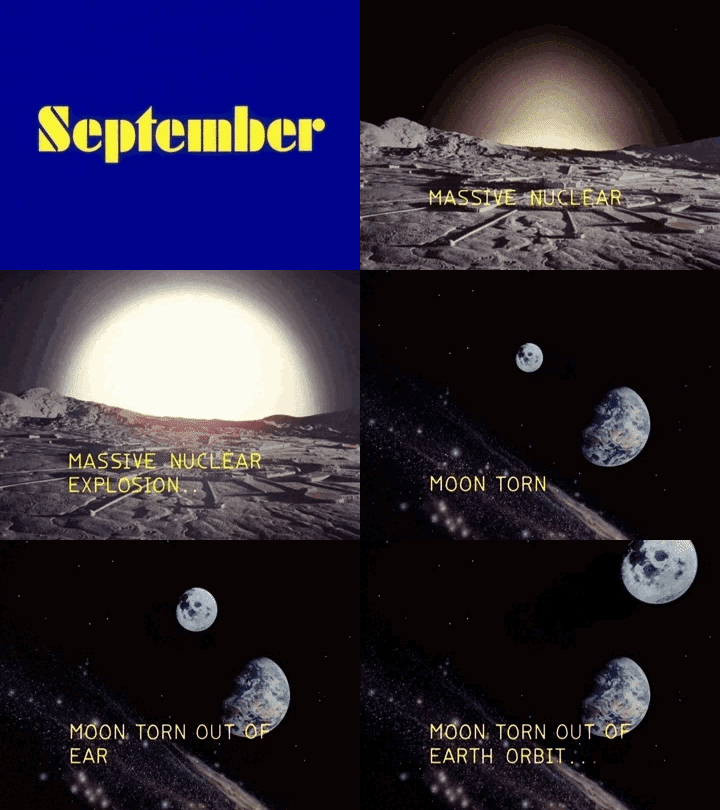
Do you have an alibi, Paul?
1 day ago
3
0
1
0
Do you have an alibi, Paul?
I'll try to have more to say about this tomorrow, but Olivier Hainaut is a global astro-hero for doing this kind of careful quantitative modeling.
True zodiacal dust in inner parts of other systems is out of reach unless it’s dozens of times dustier than ours, and even then we can’t usually make images or maps. But the Nancy Grace Roman telescope will be great at this.

we can see the outer equivalent - like Kuiper belt dust - around dozens of other stars; mostly younger stars whose small bodies haven’t settled down and so are colliding thousands of times more than our system. This gallery is from GPI (Esposito et al.) vcresearch.berkeley.edu/sites/defaul...
I’ve seen it from Chile; it was amazing. (While we were also observing extrasolar zodiacal-like light, see next post.) Fun fact: zodiacal light is the second brightest thing in our solar system - total luminosity a hundred times more than Jupiter.
The zodiacal light is so amazing, though, I feel it’d be gilding the lily to ask for anything more. The fragmented record of our comets and asteroids, and we can see that same record around other stars.
Interesting evolutionary point - that's probably not what our solar system actually looks like (though depending on technology, hypothetical remote observers probably would struggle to see either Pluto and friends or the hypothetical Planet IX)
If you're patient, the easiest way to do this is with some variation of the Korycansky, Laughlin, and Adams strategy - shuffle an asteroid back and forth between the moon and something with spare angular momentum (like Jupiter.) Probably only takes 10-20 passes, less than a hundred years. Easy.
My preferred moon-destroying strategy would be to change its orbit so its perigee is within Earth's Roche limit (20,000 km.)
Really, really big centrifuges
I quite liked it - a good balance of hopeful-rebuilding vs messy world, generally good cast (especially liked Holly Hunter.) And FWIW our teenager really took to it quickly. Sad to see it go without a chance and apprehensive about what will come next.
I did spend some time while reading the book mentally designing a coronagraph to map astrophage around nearby stars.
I feel extremely seen.
bluesky: the website for leftists who can recite the specs of every plane used by the allies in operation torch
And the intent was that the Probes should be an ongoing line, with one launch per decade, so it's still possible (if Astro2030 decides to support it and HWO stays in budget) that AXIS could enter the next Probe process and launch before 2040 - not great but not wait-for-a-flagship either.
Two notes: AXIS and PRIMA were Probe mission concepts ($1B), not Explorers ($300M).
i have every confidence In their ability to hit 15% unadjusted GDP growth with 20% inflation.
To be fair, he didn’t say if this was real GDP or nominal. .
Best it could find was He II . Is ionization hell?
It's kind of an amazing combo. I'm going to be out of town that week (sadly.)
Wow, this is spectacular. And dearly though I love exoplanets, I sometimes think things like this (and astroseismology) will be the most important legacy of TESS.
if we have a functioning government and NASA budget and there’s a 2030s competition AXIS 2 could still fly by 2040!
It doesn’t have to be that bad - the intent of Astro2020 was that there would be a series of Probe calls, and that whichever of the Far-IR or X-ray didn‘t get selected this time could complete again (together maybe with a new focus area out of astro2030).

Lovely images! So many beautiful galaxies.
Are the images black-on-white negatives (a) to bring out faint structure, or (b) to give a deliberately retro photographic plate vibe? Please say b.

Cover of "Picture an Astronomer: Best Practices for Retaining Talent in Astrophysics", which features an illustration of a 19-year-old Vera Rubin looking through a telescope over a backdrop of a first light image of spiral galaxies from the Rubin Observatory.
Happy International Women's Day!
Perfect time for me to (re)share our white paper on increasing the retention of women in professional astrophysics (really full of suggestions that broaden participation in academic science in general).
arxiv.org/abs/2512.24465
🧪🔭☄️👩🔬

If you live in the Bay Area, are bored on Wednesday night, and would like to hear flippant remarks about exoplanets and see pictures of golden retrievers, come here me talk at Foothill College: www.seti.org/events/pictu...
Beautiful and amazing
Perhaps you can build AI into your HVAC?
That usually ends well.
Olivort and Travillo are my new best friends.