French President Emmanuel Macron has just given a truly remarkable speech on France's nuclear policy at a moment of great anxiety in Europe. I wanted to offer an early comment. Welcome to the age of 'Dissuasion Avancée' in Europe.
New post: panda.substack.com/p/dissuasion...
Posts by JD Menton
A U.S. attack on Iran can have limitations: “If you want to get the IAEA back in there in a meaningful way, military strikes just don’t really help you with that,” explains @jdmenton.bsky.social 👇️
The current iteration of this crisis is about more than just the nuclear file, but metastatic uncertainty about Iran's nuclear capabilities still bodes poorly for regional stability.
In light of the SOTU's unspecified references to Iranian nuclear activities, re-upping an article I wrote for
@foreignpolicy.com after the 12 Day War about the need to restore nuclear oversight if all parties aspire to more than a temporary respite between crises.
Iran's foreign minister reported "good progress" in nuclear talks with the U.S. this week.
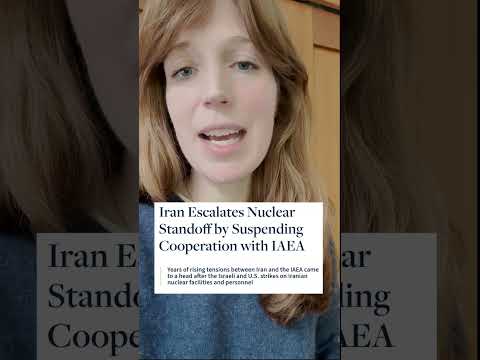
But amid U.S. military buildup in the region, tensions with regulators, and pressure within Iran, what should we make of statements like this? @jdmenton.bsky.social explains: youtube.com/shorts/qANNr...
You know a country by its values. By what a country values. And it turns out that what a country values can change over time. Sometimes, though, there’s a sort of cognitive delay between the country you think you are in, and the country you’ve actually become. For example, you can keep selling yourself, to foreigners, as the country of William Shakespeare and Jane Austen, and luring busloads of tourists to Stratford-upon-Avon and Bath, and put a statue of George Orwell in front of the BBC, and imagine yourself a cultured and literate nation, which the rest of the world admires for its devotion to the written word – but if you then chronically underfund your cultural institutions, and treat your cultural workers with contempt, many people will suspect you of being full of it. And as the decades pass – and fewer and fewer Shakespeares and Austens and Orwells emerge from your little island – even more people will begin to suspect that in truth you do not value culture at all, and are in fact running a giant heritage museum in which the only cultural workers you respect are the dead ones.
Great piece by Zadie Smith. When the right talks about classics or "Western" culture, these works are only important to the extent that it demonstrates their superiority, they have no interest in art in and of itself beyond that www.theguardian.com/commentisfre...
President Trump's interview on 60 Minutes did very little to clarify his stance on the United States resuming full-scale nuclear tests for the first time in more than three decades. Let's look at some of his statements. 1/11
Resuming U.S. nuclear testing, as President Trump has suggested, “would do more to benefit our adversaries than the United States," says @coreyah.bsky.social on @npr.org.
More from Corey on why: www.npr.org/2025/10/30/n...
Read @nicolegrajewski.bsky.social and @jdmenton.bsky.social piece, "MENA at the Threshold? Proliferation Risks and Great Power Competition", in a series of essays by @tnsr.org on the shifting global nuclear order. Check it out here: tnsr.org/roundtable/n...
Given the stakes, restoring some degree of transparency/confidence is vital, despite the clear political and at this point technical hurdles. But success requires Iranian buy-in. Without cooperation, nuclear ambiguity will undermine regional stability for years to come.
The "12 day war" has dramatically amplified the risks I wrote about back in October. What baselines remained are now gone. We just don't know how much damage the war caused, or how many capabilities Iran has retained (and can readily access).
This decision also increases the burden on natl intelligence services, and our dependence on their conclusions (and how policymakers interpret them). That intel assessments are already being contested publicly between members of the same administration is not reassuring.
Iran is not Iraq (for one thing, its nuclear program is far more advanced). But history suggests that curtailing oversight yields limited leverage and incurs major liabilities. Even if Iran doesn't sprint for the bomb, it will struggle to convince others it has abandoned pursuit.
At first the consequences seemed minimal (SH had already concluded compliance wouldn't beget sanctions relief), but ambiguity festered. Saddam's repudiation of intl oversight ultimately rendered contestable claims and interpretations more credible, easing the path to war in 2003.
Saddam Hussein followed a similar playbook after the first Gulf War (when UN/IAEA inspectors were tasked with dismantling his covert nuclear weapons program). Eventually, intransigence triggered targeted strikes on Iraqi military facilities + the loss of inspector access.
The decision isn't surprising, especially given the sequencing of the BoG determination of non-compliance and the Israeli/US strikes. It also fits a longer pattern of Tehran wielding access as a diplomatic cudgel post the US exit from the JCPOA.
In the fall, I wrote a piece for
@carnegienpp.bsky.social about the hazards of playing political football with international oversight. Today, Iran's president announced the suspension of cooperation w/ the #IAEA. 🧵
Me in @carnegieendowment.org’s Diwan: The end of open hostilities has not brought clarity to Iran’s strategic direction. Instead, it has exposed an ongoing effort within the political and military establishment over how to interpret the war’s outcome. carnegieendowment.org/middle-east/...
“In the absence of cooperation, future crises will be hard to avoid and even harder to de-escalate.”
@jdmenton.bsky.social on nuclear uncertainty – and the need for diplomacy – in Iran, for @foreignpolicy.com: foreignpolicy.com/2025/06/27/i...
Really great piece, and perspective, from @nktpnd.bsky.social
"In the days and weeks to come, policymakers will have to carefully distinguish between Iran’s legitimate frustrations and domestic political constraints and attempts to manipulate these conditions to mask clandestine proliferation ambitions."
In @foreignpolicy.com I wrote about Iran and why nuclear uncertainty is bad for regional stability. Unclear diplomatic priorities + backlash against the IAEA w/in Iran are setting us down a dangerous path. @carnegieendowment.org @carnegienpp.bsky.social foreignpolicy.com/2025/06/27/i...
Tired: JCPOA 2.0... Wired: KEDO 2.0
Even if Iran never reconstitutes a nuclear weapons program, this is not something that we can take for granted, and without some degree of international oversight, speculation and suspicion is likely to fester. The pretext for the next intervention practically writes itself.
It is, however, a problem. Iran's nuclear program was highly sophisticated, and re-establishing verification baselines matters. US and Israeli intel is clearly very good, but exclusively relying on it (or what leaders say it says) is risky (just look at the Iraq War, or Trump/Tulsi).
Meanwhile, in Iran, the Majlis passed a bill, calling for the suspension of Iran's cooperation with the IAEA. This is not surprising, given that the US (a nuclear weapons state) and Israel (an undeclared nuclear weapons state), just attacked a number of facilities under IAEA safeguards.
That's because the strikes have created a lot of uncertainty! (and some "known unknowns," e.g. the fate of Iran's HEU stockpiles, are pretty concerning). Earlier today, however, Trump essentially said that the crisis was over, and any diplomatic commitments would essentially be superfluous.
News media and social media are already saturated with speculation about the state of Iran's nuclear program (how much did the US/Israel destroy, how quickly could they reconstitute, will the regime pursue the bomb or not)