Advertisement · 728 × 90

Posts by Patrick Mineault

Building this kind of mechanical compiler will require the coordination of connectome people, slice physiologists, systems neuroscientists and modelers: it ain't easy! But it's definitely a worthy goal for the next 20 years of neuro.

2 weeks ago 2 0 0 0

Then if we have calibration data, we can think of each of the layers of the ultrastructome as imposing (Bayesian) constraints on biophysical simulation parameters. Each extra calibratred layer removes some undeterminacy. 4/

2 weeks ago 0 0 1 0

And we can keep adding layers, like labelling proteins (e.g. PSD95 in PRISM and LICONN). I think the endgame is that the connectome data will be so rich that it'll be conceptually a different kind of object, an ultrastructome. 3/

2 weeks ago 0 0 1 0

It's remarkable how far we've taken simulations with *just* connections (e.g. Shiu et al. 2024). And we haven't exhausted what we can do with connectome data: it tells us about connections, yes, but also neuron morphology, neurotransmitter identity, and the position of dense core vesicles 2/

2 weeks ago 1 0 1 0

Stoked this is finally out! We ask: how can we simulate the brain from the bottom up? It's not sufficient to grab the connectome and wire it up in silico! We need 1) ultrastructure 2) (causal) calibration data 3) functional data. Then we can build a simulation compiler. 1/

2 weeks ago 19 5 1 0
Post image

Paradoxically, when you see a yellow on blue slide, you know you're about to get a fantastic lecture. Bonus points for Times New Roman.

3 weeks ago 34 1 1 2
Video

🧵 New preprint led by @bingbrunton.bsky.social, @elliottabe.bsky.social, @lawrencehu.bsky.social

We gave a worm brain control of a fly body and it walked

What did we learn? Nothing, other than deep reinforcement learning is effective

We call it the digital sphinx

www.biorxiv.org/content/10.6...

3 weeks ago 397 147 9 26
Post image

The recommendations features

1 month ago 0 0 0 1

If you have a good substack about neuro / AI and are cranking out solid content, happy to add it to my list of recs on substack—that little feature has driven 100's of subscribers to other newsletters

1 month ago 5 0 1 0
Advertisement

A cool insight here: CDM isn’t just hard to infer, it’s hard to train directly (because it can’t be specified as a loss on systems behavior).

This means it either needs to emerge as a consequence of other losses, data, or architecture choices.

1 month ago 18 6 4 0

Current AI models are trained on human behavior -- the words we produce. New preprint explores the idea that we might be able to address some of the gaps in these systems by training on the latent variables behind that behavior: human cognition.

1 month ago 17 2 0 0
Post image

A remarkable journey of resilience and transformation, from the chaotic corridors of group homes to the halls of Columbia and Stanford, EMERGENCE is a coming-of-age tale where heartbreak and humor meet the scientific wonder of modern artificial intelligence.

🔗 Preorder: tinyurl.com/fzcxb5ea

5 months ago 73 16 3 1

We know about cosmological dark matter despite being unable to measure it because, without it, galaxies would fall apart. By analogy, let's talk about "cognitive dark matter" (CDM): brain functions that meaningfully shape behavior but are hard to infer from behavior alone.

New paper! 🧵👇

1 month ago 41 8 3 4

There's no better way to learn than to teach! Help make NMA a resounding success!

1 month ago 9 5 0 0

Excellent, excellent

1 month ago 1 0 0 0

Ran into David Chalmers at Wash Sq Park. Beautiful day to ponder the hard problem of consciousness.

1 month ago 11 0 1 0

Would you say it's a fair characterization that splitters are winning mindshare in neuro over lumpers

1 month ago 1 0 1 0

I agree BTSP is a big one, and quite underrated.

1 month ago 3 0 0 0
Advertisement

Looking for YOUR INPUT on what we've learned in neuro in the past 20 years. I've only heard pessimistic takes! Come on, grid cells, manifolds, optogenetics, connectomes, moving past the monoamine theory of depression and the Ab theory of AD, glymphatics and lymphatics, what is sleep?! We did stuff!

1 month ago 7 3 1 0

I want to write a fun little post on what we've learned in neuroscience in the last 20 years. What are the most interesting results you can think of? Biggest trends?

1 month ago 32 7 10 1
Preview
Compact deep neural network models of the visual cortex Nature - Parsimonious deep neural network models can be used for prediction of visual neuron responses.

DNN models of the brain are getting bigger. Are we replacing one complicated system in vivo with another in silico?

In new work, we seek the *smallest* DNN models of visual cortex, balancing prediction with parsimony.

It turns out these compact models are surprisingly small!

rdcu.be/e5H8G

1 month ago 127 47 3 4

Some soup for you!

1 month ago 1 0 1 0

CAMs or soup?

1 month ago 0 0 1 0

Lots of things to think about in these posts from @patrickmineault.bsky.social -- nice to see more blog entries :)

1 month ago 2 1 0 0
Preview
Cell types: from genes to circuits Part II in our series on cell types and connectomes

Here's the second one: www.neuroai.science/p/cell-types... . I made a New Year's resolution to blog more, and so far I'm sticking to it!

1 month ago 8 2 1 0
Preview
Cell types: encoding the brain's BIOS Inferring the structure of primary rewards from connectomics

What are cell types good for, computationally? Encoding innate behavior! In this 2-parter, I break down the relationship between cell types—which I had, in years prior, dismissed as mere implementation detail—and computation. I changed my mind!

www.neuroai.science/p/cell-types...

1 month ago 44 13 2 3
Advertisement
Preview
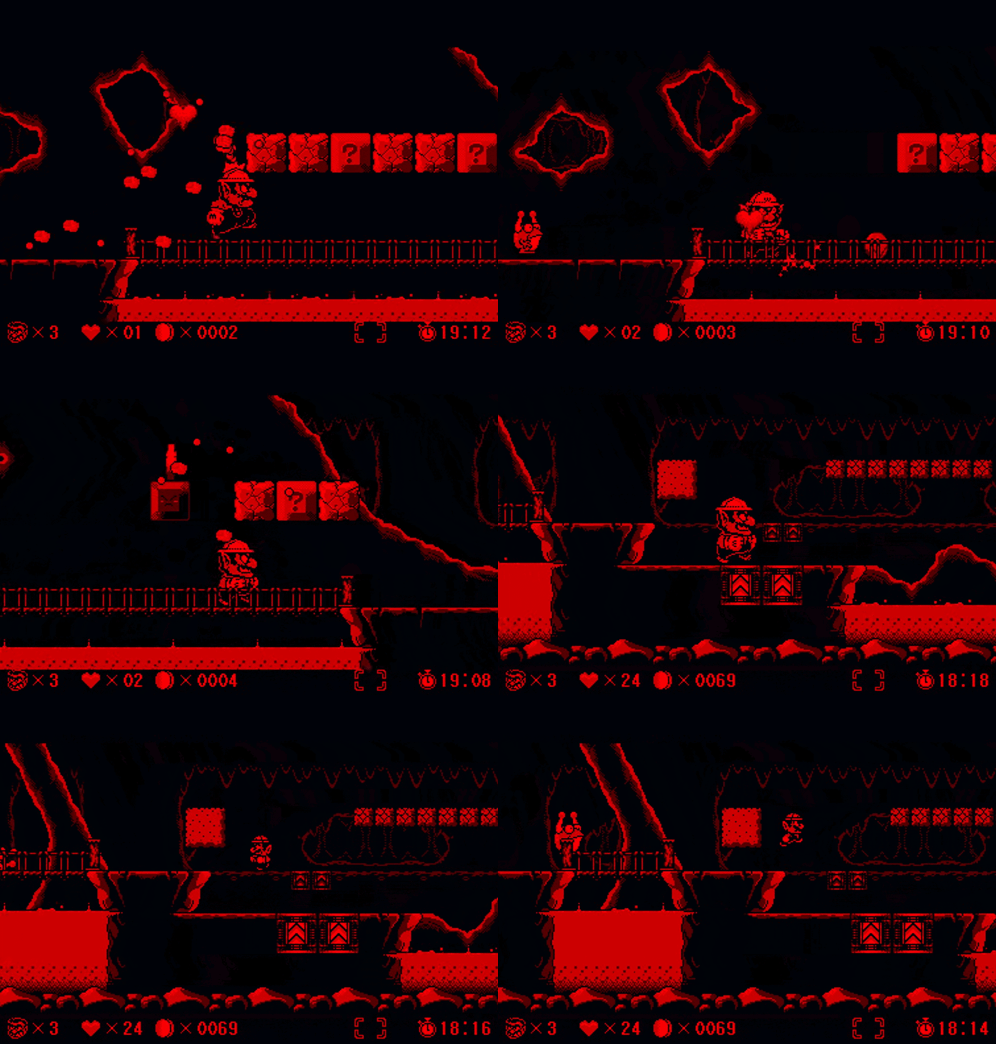
a screenshot of a video game with a time of 18:15 ALT: a screenshot of a video game with a time of 18:15

Time to bring back the Virtual Boy

1 month ago 1 0 0 0
Book cover. A silhouette of a person's head filled with colorful geometric shapes—perhaps symbolizing cognitive resources or deployment thereof. The style is attractive and modern, if generic.

text: 
The Rational Use of Cognitive Resources
Falk Lieder, Frederick Callaway, Thomas L. Griffithts

Book cover. A silhouette of a person's head filled with colorful geometric shapes—perhaps symbolizing cognitive resources or deployment thereof. The style is attractive and modern, if generic. text: The Rational Use of Cognitive Resources Falk Lieder, Frederick Callaway, Thomas L. Griffithts

I'm excited to announce that I had my first (co-authored) book published today! "The Rational Use of Cognitive Resources" with Falk Lieder and Tom Griffiths (@cocoscilab.bsky.social ). You can read it for free! (see thread)

2 months ago 147 45 2 0

The revised version of our paper on the impact of top-down feedback is now out @elife.bsky.social:

doi.org/10.7554/eLif...

tl;dr: we show that using human-brain-like feedback/anatomy in a deep RNN leads to human-like visual biases!

This work was led by @tmshbr.bsky.social

#NeuroAI 🧠📈 🧪

2 months ago 65 18 0 0

🚨 new work from the lab on how eye movements 👀 versus orofacial movements influence 🐭 visual cortex activity 🧠 #neuroscience #behavior #neuroAI

2 months ago 45 11 0 0