
3 weeks ago
15917
4743
196
296
Posts by Katie Tschida
It turns out that home cage running wheels impact the social behaviors of female mice, but not for the reasons we thought! Thanks to our reviewer for a great control experiment suggestion. Please RT!
www.biorxiv.org/content/10.1...
bsky.app/profile/kati...
3 weeks ago
15
3
1
1
Very excited to dig into the next steps and to continue learning more about RAm! The hindbrain is small but mighty (and complicated!)
1 month ago
0
0
0
0
Surprisingly, these two vocalization types drive different patterns of RAm Fos expression. Our results are consistent with the idea that RAm is heterogeneous and may contain multiple populations of vocalization-related neurons (USV-only, squeak-only, and shared neurons important for both).
1 month ago
0
1
1
0
In this study, we considered the nucleus retroambiguus, a hindbrain premotor region important for vocal production. We directly compared patterns of Fos expression in mice that produced USVs with mice that produced squeaks.
1 month ago
1
0
1
0

Our lab has become really interested in understanding how brainstem circuits are organized to regulate the production of different vocalization types (i.e., mating calls, territorial calls, etc.).
1 month ago
0
0
1
0
Hi friends, we did a new thing!
www.biorxiv.org/content/10.6...
Congrats to authors Patryk Ziobro and @djzheng.bsky.social, and thanks to our undergrad RA co-authors too!
@cornellpsych.bsky.social
1 month ago
5
2
1
0
Advertisement

A Black-capped Chickadee showcasing winter fashion by donning a snowflake accessory.
2 months ago
11667
3151
77
100
So psyched for this year's Neural Mechanisms of Acoustic Communication (NMAC) GRC! Come join us in May, and please RT!
2 months ago
8
6
0
0
A reminder to the news media: “conflicting accounts” is what you say BEFORE the incontrovertible video evidence appears. After that, your job is to ask why one side is lying, not to repeat the lie and pretend no one knows the truth.
2 months ago
47461
14277
521
597
The first-ever GRC on Social Behaviors is coming up in March! Looking forward to a great meeting, please RT!
www.grc.org/the-neurosci...
3 months ago
3
1
0
0

Imagine, if you will, that NASA updated its website to suggest gravity might not exist, prompting CalTech and CERN to release statements saying, "With great sadness, we can no longer recommend listening to NASA."
This is what's happening in epidemiology.
4 months ago
2532
990
33
18
It’s widely known (and, I think, pretty uncontroversial) that learning requires effort — specifically, if you don’t have to work at getting the knowledge, it won’t stick.
Even if an LLM could be trusted to give you correct information 100% of the time, it would be an inferior method of learning it.
5 months ago
5611
1583
88
46
My former postdoc @xinzhao322.bsky.social is recruiting a PhD student. Xin is a great scientist and mentor, can't say enough good things about him and his work! Please pass on to your undergrads and please RT!
5 months ago
4
1
0
0
The published version of our study on the early-life transition from isolation USVs to adult-like USVs in juvenile mice is out in Animal Behaviour!
authors.elsevier.com/a/1m1YDmjMA4GP
bsky.app/profile/kati...
5 months ago
18
5
0
0
The Tschida Lab is recruiting a new PhD student this cycle! We have ongoing projects related to (1) neural circuits that regulate vocal communication across behavioral contexts and/or development and (2) motor control of different vocalization types. Please RT! Strong neuro background a plus.
6 months ago
25
22
1
1
Advertisement
Looking forward to applying to the Harvard Trade school for kids who can't AI good.
6 months ago
6
1
0
0

Come be my colleague! Lots of exciting science, fantastic students and supportive colleagues. Emory University Biology Department tenure-track assistant professor position in neuroscience. share.google/945Jko4W1MTA.... Please feel free to retweet and share widely.
6 months ago
21
16
3
2
We hope these findings are useful to those studying mouse social behavior! Congrats to former undergrad Stephen Batter, whose honors project kicked off this study. Thanks also to co-first authors Patryk Ziobro and Cass Malone, and to our current undergrads who helped bring this to the finish line!
6 months ago
2
0
0
0
Interestingly, there is past work showing that mice will forgo reinforcers (even cocaine and amphetamine) to gain access to a running wheel. So one possibilty is that running wheels are like crack for mice and decrease their sensitivity to other rewards, perhaps even social rewards.
6 months ago
7
1
1
0
These effects on social behavior are somewhat long-lasting, as they're not reversed by a 2-week period with running wheels removed and replaced with a standard paper hut.
6 months ago
1
0
1
0
Unexpectedly, we found that free access to running wheels in the home cage, either for 5-weeks over adolescence (weaning till adulthood) or even for a 2-week period in adulthood, inhibits social motivation in group-housed female mice when they are given the chance to interact with a novel female.
6 months ago
3
1
2
0
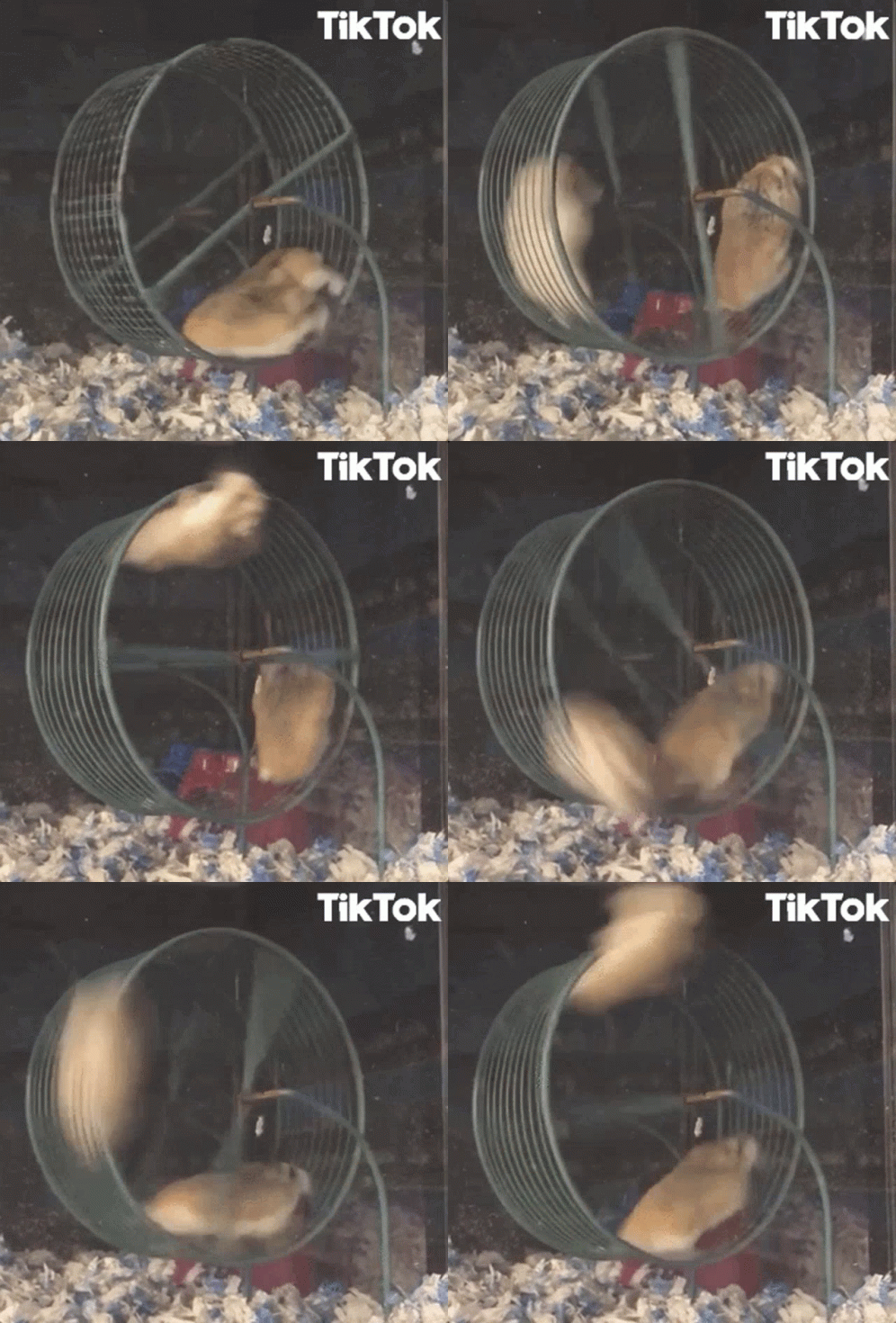
New story to share! We routinely put running wheels in our mouse cages. The mice love them, and there's lots of evidence that exercise is great for health. Given our focus on social behaviors, though, we wondered whether running wheels change mouse social behavior.
www.biorxiv.org/content/10.1...
6 months ago
14
3
2
1

Image of a checklist, which included “control the media”
Controlling the media is one of the items on the authoritarian checklist; this includes not just hard news, and increasingly social media, but also threatening satirists who mock the regime.
The FCC is pushing this control, but corporations do not have to fold. open.substack.com/pub/donmoyni...
7 months ago
620
152
15
2
Advertisement


Dear Dr. Bhattacharya: I have listened to your performance on the “War Room” podcast with Steve Bannon. The segment begins with a discussion of Secretary Kennedy’s recent cancellation of $500M worth of contracts related to mRNA vaccines. You say “You can’t have a platform where such a large percentage of the population distrusts the platform as we use it for vaccines and expect it to work.” Later, you make comments that might explain why a large segment of the percentage distrusts this platform. For example, you say that the vaccine was not protective against contracting COVID and cite your own case on COVID after being vaccinated. However, you fail to cite the evidence for the clinical trials that led to the Emergency Use Authorization.
I listened to Bhattacharya on Steve Bannon's "War Room" podcast.
If you want to know how it went, see the following email that I just sent.
1/13
8 months ago
295
113
15
31
Agreed!!
9 months ago
1
0
0
0
New study from the lab! A follow-up to our finding that short-term social isolation promotes same-sex mounting in female mice. Led by grad student Cassidy Malone and post-doc @xinzhao322.bsky.social, with help from undergrad Selina Xu!
9 months ago
6
2
0
1
PhDone! Congrats to my student Nicole Pranic for successfully defending this week! We were too busy celebrating to take a picture, lol.
9 months ago
9
0
1
0