Participants include researchers and practitioners from @gfi.org @tufts.edu CCA, @ucdavis.bsky.social, Ambitious Impact, Wageningen, Bruno Cell, Austrian Centre of Industrial Biotechnology, S2AQUAcoLAB, and more
Posts by The Unjournal (Unjournal.org)
We're also sharing an interactive template model
unjournal.github.io/cm_pq_modeli...
and some learning tools and explainers: unjournal.github.io/cm_pq_modeli...
Your feedback is very welcome.
#animalwelfare #culturedmeat
If you work in this area, please apply to join, and share your feedback:
uj-cm-workshop.netlify.app/schedule
uj-cm-workshop.netlify.app/beliefs.html
Does cultured meat investment have higher expected animal welfare impact than interventions like corporate campaigns?
We're running structured beliefs elicitation w/ TEA researchers, bioprocess engineers, and stakeholders to help reduce uncertainty.
uj-cm-workshop.netlify.app/beliefs.html
Optimistic/pessimistic TEA cost projections diverge on specific axes: media costs, growth factor tech, cell densities at scale, bioreactor design.
unjournal.github.io/cm_pq_modeli...
New evidence has emerged since major analyses were published. We want updated expert beliefs.
Two rigorous techno-economic analyses disagree by 3–4x, and The cruxes are specific. On May 8 we're getting key people together online to work through these issues.
uj-cm-workshop.netlify.app
The most consequential uncertainty in animal welfare funding right now may depend on a technical question: what will cultivated meat cost to produce?
The Unjournal has over 230 vetted evaluators (peer-reviewers) in our pool. See who (some of) them are here: http://dlvr.it/TRnJvK , with more statistics above.
coda.io/d/Unjournal-...
(better link) ... it keeps on growing
Hooray, The Unjournal now has an ISSN from the U.S. ISSN Center at the Library of Congress
media.tenor.com/6A0RAjMtTD4A...
3071-2173
These questions stem from our 'Pivotal Questions' project discussion with Founders Pledge. See uj-wellbeing-workshop.netlify.app/beliefs and globalimpact.gitbook.io/the-unjourna....
Online, modular format (11am–4pm ET / 3–8pm UK) see the agenda here uj-wellbeing-workshop.netlify.app/live/
Participants can drop in for segments of interest. Even if you cant make it. We invite your asyncronous participation and feedback.
Participants include Dan Benjamin (UCLA), Ori Heffetz (Cornell), @Caspar Kaiser (Warwick), @michaeldplant.bsky.social (HLI), Julian Jamison (Exeter), & funders from @founderspledge.com Pledge & Coefficient Giving.
Unjournal.org is hosting an online, structured workshop
20+ researchers & practitioners will the relative reliability of the WELLBY measure, scale-use heterogeneity, DALY-WELLBY conversion, and more.
March 16 online workshop:
How should funders compare interventions across physical health, mental wellbeing, & poverty in LMICs?
WELLBYs, DALYs, etc.: metrics & 'conversion factors' matter to cost-effectiveness comparisons for major funding choices.
uj-wellbeing-workshop.netlify.app
-->
Full hosting analysis: unjournal.github.io/unjournaldata/posts/pape...
More context on why visibility matters for research evaluation: https://youtu.be/bJIGHyPVTE4?t=249
Of 57 evaluated papers: 39% on SSRN, 30% on NBER, half appear on 2+ platforms, 47 institutional repositories represented. Understanding this landscape is essential for integrating public evaluations into discovery and bibliometric systems.
For journal-independent evaluation to matter for careers and trust, ratings and reviews need to be visible where researchers and institutions actually look—Google Scholar, repositories, indexing services. That's why we analyzed where Unjournal-evaluated research is hosted. 🧵
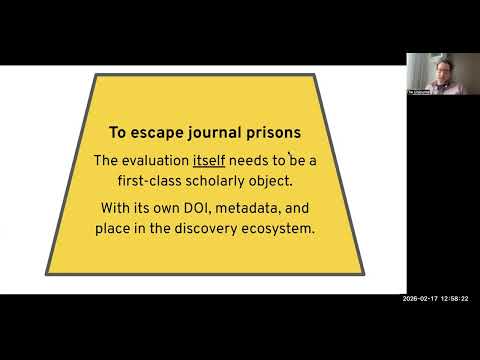
This is my pre-conference 'practice talk'; sharing it for people in parallel sessions, and who couldn't make the Baltimore conference
Sorry, more like a discussion at @nisoinfo.bsky.social considering how bibliometric standards can make journal-independent evaluations count for academic careers & trust markers.
Research evaluation doesn't need journals.
New talk: How bibliometric standards can make journal-independent evaluations count for academic careers.
🎥 http://dlvr.it/TR88Bh http://dlvr.it/TR88Bj
You are now legally obligated to become an economics journal.
We focus on research in economics, policy, and other quantitative social science with potential for global impact.
(About 80% is economics or adjacent).
We commission experts to publicly evaluate & rate research. To make impactful research more rigorous, make academic work more useful, support open science, open access, and transparency, and improve peer-review, helping align research incentives with truth-seeking and social value.