I am hiring a postdoc for scRNA-seq research in Lund, Sweden on the visual systems of non-model inverts as part of an ERC project on the evolution and ecology of advanced color and polarization vision. Apply here or share the link with someone who may be interested! 🧪
lu.varbi.com/en/what:job/...
Posts by Michael Bok
So excited to have received an #HFSPResearchGrant to study trilobite eyes with Luke Parry @oxuniearthsci.bsky.social and Gil Ju Lee (Pusan National University)!🥳
I'll be recruiting a postdoc @bristolbiosci.bsky.social - if 3D data, optical modelling, and fossils tickle your interest, stay tuned!
Thank you all! Also big thanks to @russellgarwood.co.uk and experienced HFSP-ers @mikebok.bsky.social, Dan Speiser, and Carsten Lüter for their advice on the proposal 💛
We argue that the strange arrangement of cells and circuits is the consequence of a reduction of our visual systems to a simple median eye in our ancient filter-feeding ancestors.
From our new paper out now in @currentbiology.bsky.social: www.cell.com/current-biol... w/ @neurofishh.bsky.social @gkafetzis.bsky.social @denilsson.bsky.social
Looking across animals, the vertebrate eye is an obvious outlier. Why is it so different that other highly visual animals?
Out now in @currentbiology.bsky.social!
A dive into the deep history of vertebrate vision, together with @mikebok.bsky.social, @neurofishh.bsky.social and @denilsson.bsky.social
Photo credit : Vasilis Karkalas
My collaborator at University of Copenhagen, Anders Garm, is looking for a 3 year postdoc to work on bioluminescence, neurobiology and ecology of ctenophores. More information here:
candidate.hr-manager.net/ApplicationI...
Ever wanted to know how the visual system of a long distance migratory moth looks like? Then you'll find your answers in our new paper. Finally out, after about a decade of collecting data by a group af amazing co-authors. Find it here, open access: link.springer.com/article/10.1...
Thanks so much to ASAB and the #ASABwinter2025 organisers for a cracking conference. Not sure why I’m so excited here, I guess the yoghurt and granola had just been served…
Some more shenanigans on the Ctenophora Porifera debate from @rcply.bsky.social academic.oup.com/mbe/advance-...
Big congratulations to our biology researchers @cnilsson.science and @mikebok.bsky.social – who get @erc.europa.eu Consolidator grants! Well deserved! 👏👏👏
Read the full story: www.lunduniversity.lu.se/article/thre...
Listening and #gazing at the first keynote talk from @mikebok.bsky.social from Lund University at the #biophdday_ku at @ucph.bsky.social. So interesting to hear and see the diversity of visual sensory organs from different invertebrates!
Congrats Staffan Bensch, @mikebok.bsky.social, Yedra Garcia Garcia, Dennis Hasselquist, Prof. Anders Hedenström, Lina Herbertsson, Sebastian Marquardt, Erik Selander, Ernö Vinzce, Prof. Eric Warrant, Dan-Dan Zhang and @kruthsatz.bsky.social – all awarded grants from @vetenskapsradet.bsky.social!
..with a huge payoff, in gradual steps:
✅Choice of right depth
✅Body Posture
✅Visually - guided locomotion, eventually
7/n
Extremely grateful to @wellcometrust.bsky.social @vetenskapsradet.bsky.social @erc.europa.eu @hfspo.bsky.social @ukri.org @leverhulme.ac.uk @thelisterinstitute.bsky.social for their generous support of our eye evolution endeavours 👁️🦗🐋
Very excited about our new preprint, led by @gkafetzis.bsky.social /w @mikebok.bsky.social & @denilsson.bsky.social. We suggest that the vertebrate 'duplex' retina emerged from interconnecting two ancient median-eye microcircuits. Say goodbye to the 'simplex' retina - it probably never existed!
Most bilaterians keep photoreceptor types separate.
But vertebrate eyes are a mash-up:
🪡Ciliary (rods & cones) and
💈Rhabdomeric (ganglion, amacrine, horizontal)
…all packed into a multilayered circuit.
2/n
👁️The retina — strikingly conserved across vertebrates, but an oddity among bilaterians!
So how did it evolve?
With @mikebok.bsky.social, @neurofishh.bsky.social and @denilsson.bsky.social, we argue that retinal complexity may 𝑝𝑟𝑒𝑑𝑎𝑡𝑒 𝑡ℎ𝑒 𝑒𝑦𝑒 𝑖𝑡𝑠𝑒𝑙𝑓.
www.biorxiv.org/content/10.1...
1/n
Three members of the group stand on a bridge over the ring at the BESSY II synchrotron
Fresh(ish) from the week at BESSY II @helmholtz.de looking at the changes associated with eye loss in spiders! Not pictured: our valiant night shifters, @mikebok.bsky.social, Karla Lopez Reyes, and Constance Coubris 💪🏼🌃
Very excited and proud to finally share this story! 🐙
We discovered surprising roles for dopamine and acetylcholine in the Octopus visual system…
doi.org/10.1101/2025...
I know there's a 𝒍𝒐𝒕 going on right now, but I couldn’t be prouder to share this long-incubated labor of love: the complete connectome of the male 𝐷𝑟𝑜𝑠𝑜𝑝ℎ𝑖𝑙𝑎 optic lobe 🧠🪰
🔗 www.nature.com/articles/s41...
We will peer across a 500 million year chasm of convergent evolution to discover how high resolution camera eyes in cephalopods and polychetes function without the elaborate local circuitry found in the vertebrate retina.
Super excited to have received a @hfspo.bsky.social grant with with @neurofishh.bsky.social for our proposal: Eyes inside out: Visual coding without a multilayered retina in squid and worms.
oh INTERESTING! So apparently this FOUR EYED thing is a consistent anomaly cross different strombid taxa ?!?#molluscmonday www.inaturalist.org/observations...
“We are losing sight of the academic mission: to think, to enquire, to design and perform new research, to innovate, to teach and communicate our findings for the purpose of societal improvement”
academic.oup.com/brain/articl...
Three panels: On top is a face on view of a large Tomopteris polychaete, with orange pigment spots along its long anterior antennae. Lower left shows the yellow bioluminescent emission typical of the genus Tomopteris. Lower right shows the blue bioluminescent emission of a Tomopteris species. This color is typical for marine animals, but atypical for Tomopteris, which is the odd-species-out for luminescent emission spectra. Blue-emitting Tomopteris were independently discovered by our lab in the Pacific and by Anaïd Gouveneaux working in Jerôme Mallefet's lab in Belgium. Warren determined that the chemical which gives the yellow color seems to be aloe-emodin, but the function of using yellow light rather than blue remains unknown. See the two manuscripts linked in the main text, and references therein, for more detailed info.
A fun case of usual-unusual: Most luminescence in the sea is blue-green, but Tomopteris worms emit yellow light.
With Warren Francis, we found a species that emits blue light — unusual but usual. 🦑🧪
link.springer.com/article/10.1007/s00227-016-3028-2
doi.org/10.1002/bio.2671
A polychaete worm with tiny googly eyes, drifting in the great blue.
New issue of Ecology chose one of my pictures as cover image. Amazing to see hunting broadclub on the cover!!
@drmartinjhow.bsky.social @bristolbiosci.bsky.social @ecologyofvision.bsky.social
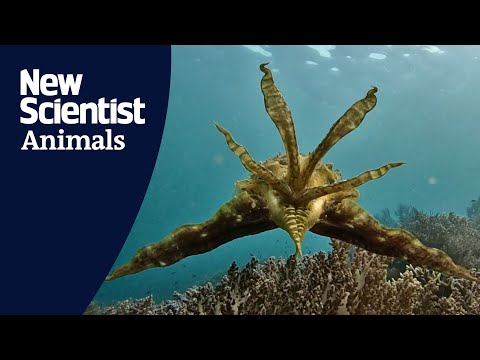
New Scientist video about our recent cuttlefish paper. @ecologyofvision.bsky.social @bristolbiosci.bsky.social @matteosanton.bsky.social