Inside you there are two wolves: one's a toilet and the other's a hydraulic press.
11 months ago
5
0
0
0
Inside you there are two wolves: one's a toilet and the other's a hydraulic press.

An excerpt from the Wikipedia page on the hydraulic press: "A hydraulic press is a machine press using a hydraulic cylinder to generate a compressive force. It uses the hydraulic equivalent of a mechanical lever, and was also known as a Bramah press after the inventor, Joseph Bramah, of England. He invented and was issued a patent on this press in 1795. As Bramah (who is also known for his development of the flush toilet) installed toilets, he studied the existing literature on the motion of fluids and put this knowledge into the development of the press." (Source: https://en.wikipedia.org/wiki/Hydraulic_press)
Today I learned that the guy who invented the hydraulic press was also instrumental in the development of the flush toilet. The Duality of Man.

A photo of my cat Alfvie lying on the wood floor while yawning -- though it looks like he's screaming.
A phenomenon that we do fully understand is the propagation of Alfvie waves across the surface of my cat. By perturbing his fur perpendicular to his stripes, we excite oscillations that propagate along his stripes. The energy in these waves is then usually converted into bites and scratches.

An artist's depiction of Alfven waves propagating outwards from the surface of the Sun. These waves carry energy and plasma into the solar corona. Source: https://www.isas.jaxa.jp/en/feature/forefront/160229.html
Alfvén waves are thought to be especially important in our Sun. By carrying energy from the solar surface to the corona, Alfvén waves may be responsible for heating the corona to its anomalously high temperature and for launching the solar wind – two processes that we still don’t fully understand.

A simple schematic depiction of Alfven waves propagating along a few distorted magnetic field lines.
Therefore, if we perturb a straight magnetic field line in the perpendicular direction, the line will want to snap back to its stable equilibrium; the field line will oscillate, launching a wave – an Alfvén wave – along the field line, much like a wave propagating along a plucked guitar string.
One phenomenon unique to MHD and incredibly important in astrophysical plasmas is known as the Alfvén wave. In my previous thread (bsky.app/profile/rgol...), I noted that magnetic field lines in MHD carry an effective tension, like taut strings.

The magnetic Kelvin-Helmholtz instability shown in a snapshot from a simulation of the solar wind -- a stream of charged particles from the Sun -- interacting with Earth's atmosphere. Near the top and bottom of the image, one can see structures (in crimson) resembling breaking ocean waves (which are caused by the hydrodynamic Kelvin-Helmholtz instability). Source: https://www.nasa.gov/image-article/simulation-of-magnetic-bubble-around-earth/
Some of these MHD phenomena resemble waves or instabilities that one might find in a neutral fluid – like the magnetic Kelvin-Helmholtz instability (depicted below in a simulation of the solar wind interacting with Earth's atmosphere) – while others are wholly unique to plasmas.
If we add magnetic fields into a fluid – that is, if we consider magnetohydrodynamics (MHD) – we’re faced with a whole new spectrum of possible waves and instabilities. (see my earlier thread for a primer on MHD: bsky.app/profile/rgol...)

Ripples (called surface gravity waves) propagating across the surface of a pond in the form of concentric rings. Source: https://tjbottles.medium.com/ripples-in-the-water-b45e55b36ae3

An ocean wave breaking due to the growth of the Kelvin-Helmholtz instability. Source: https://communitycloudatlas.wordpress.com/category/kelvin-helmholtz-waves/ (see also the gif of the developing Kelvin-Helmholtz instability at the same link)
For example, if we gently tap the surface of a body of water at rest, wave-like ripples will radiate outwards along the surface. However, if we blow air parallel to the surface of the water, the surface will quickly wrinkle and contort due to the so-called Kelvin-Helmholtz instability.
Fluids are incredibly complex dynamical systems that are subject to myriad types of perturbations, some of which produce waves – which can propagate throughout the fluid – and others of which trigger instabilities – which cause the fluid to exponentially depart from equilibrium.

A cartoon image of a ball sitting at the tip of a steep peak. In red text, the words "unstable equilibrium" are written below the ball.
It’s important to note that not all equilibria are stable – consider a ball at rest on top of a sharp peak. Perturbations to these equilibria don’t induce waves, but instead trigger runaway processes called “instabilities” (to be explored further in future threads).

This is the basic principle of a wave: if we perturb a dynamical system in stable equilibrium, the system will oscillate around its initial state in an attempt to return to stable equilibrium.
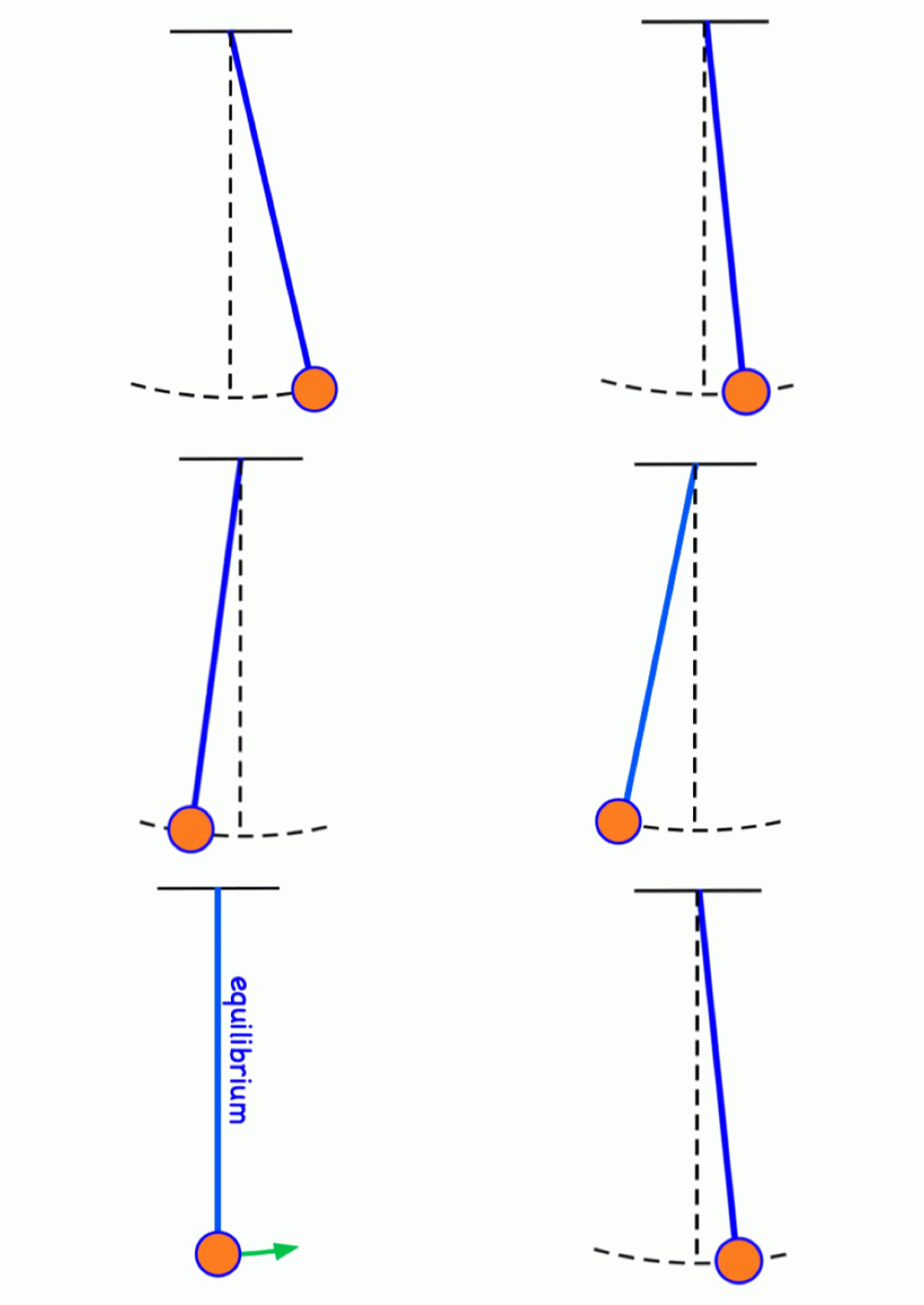
However, the ball likely won’t come to rest immediately after rolling back – it’ll probably overshoot the dip, roll back from the other side, overshoot again, and continue to oscillate back and forth before finally settling back into its stable equilibrium.

A cartoon image of a ball lying at the bottom of a valley. In red text, the words "stable equilibrium" are written above the ball.
Picture a ball at rest at the bottom of a valley. This ball is said to be in stable equilibrium: if we push this ball a little bit up the hill and then let it roll back (or, in physics speak, if we perturb this ball from its equilibrium), it’ll eventually return to rest at the bottom of the valley.

My cat Alfvie, a gray and brown tabby, lying on my side with his belly up

My cat Alfvie, a gray and brown tabby, lying on the couch with his belly up

My cat Alfvie, a gray and brown tabby, lying on a gray blanket with his belly up
This is my cat, Alfvie. When I jiggle his belly, ripples propagate across his body. Similar phenomena occur in fluids and plasmas.
A thread on Alfvén waves [12 posts]:
#astronomy #astroedu #cats

My cat Alfvie curled up in a tight ball on a bath mat

My cat Alfvie stretched out across the wood floor

My cat Alfvie twisted up and lounging in his carrier
To conclude: how does Alfvén’s theorem apply to my cat? Just as magnetic field lines are frozen into perfectly conducting plasmas, my cat’s stripes are frozen into his perfectly fluffy fur. This phenomenon – Alfvie's theorem – has been readily reproduced in laboratory experiments (see photos below).
The tension from the field lines slows the rotation of the cloud, allowing a star to form.

A rotating, collapsing cloud threaded by magnetic field lines (depicted in green). Red and blue arrows illustrate the sense of the rotation. Source: https://iopscience.iop.org/article/10.1088/2041-8205/794/1/L18/pdf
However, these clouds are threaded by magnetic field lines that are (nearly) frozen into the plasma. As the cloud spins and collapses, Alfvén’s theorem tells us that the plasma will try to twist up the field lines, but the tension in the field lines will resist this twisting.

A cartoon depiction of a rotating, collapsing cloud of plasma, forming a newborn star. Source: https://sites.ualberta.ca/~pogosyan/teaching/ASTRO_122/lect15/lecture15.html
For example, stars form when massive, spinning clouds of plasma collapse in on themselves. In the absence of a magnetic field, a cloud would spin faster and faster as it collapses, eventually yielding a centrifugal force that would tear the forming star apart.
Alfvén’s theorem allows us to intuit the behavior of a plasma (often quite accurately) without needing to consider any mathematical equations – we just need to consider the interplay between the plasma’s motions and the feedback from the plasma’s embedded field lines.

A cartoon depiction of Alfven's theorem: as a sample of plasma is deformed, the frozen-in magnetic field lines that thread the plasma are deformed in the same way. Source: https://www.youtube.com/watch?v=ZnqUh_lAWnw
Alfvén’s theorem states that, if a plasma conducts electricity perfectly (often a good approximation in astrophysical systems), then magnetic field lines are “frozen into” the plasma. If the plasma moves, the field lines move with it; if the field lines move, the plasma is dragged along, too.
Enter Alfvén’s theorem, one of the most important theorems in plasma (astro)physics.

Magnetic field lines in a plasma being deformed by the flow of the plasma (to the right); the tension in the field lines resists this deformation: Source: https://www.youtube.com/watch?v=ZnqUh_lAWnw
As such, it’s not too far-fetched to picture magnetic field lines in MHD as tensile rubber ropes threading fluid-like plasmas; as a plasma flows, it tugs on the field lines and the field lines tug back.
When we add magnetic fields to the equations of hydrodynamics, we find (mathematically) that magnetic field lines embedded in a fluid/plasma exert a pressure on their surroundings and carry an effective tension.
However, in magnetohydrodynamics (MHD), magnetic field lines act like physical structures. (see last week's thread for an intro to MHD: bsky.app/profile/rgol...)

The large-scale magnetic field of our Earth depicted using magnetic field lines. Source: https://www.shutterstock.com/image-vector/magnetic-geographical-pole-earth-106154861
In many cases, magnetic field lines are just useful visual aids; the geometry of the field lines gives us a sense of the global structure of the field, and the density of the field lines tells us where the field is stronger or weaker (regions where lines are closer together have a stronger field).

The magnetic field around a bar magnet depicted as a vector field, with many small arrows showing the local direction of the magnetic field. Source: https://www.youtube.com/watch?v=BfBQ2J1DoWM

The magnetic field around a bar magnet depicted using field lines. Instead of showing many small arrows, we "connect-the-dots," showing large-scale, smooth lines. Source: https://www.shutterstock.com/image-vector/magnetic-field-lines-around-bar-magnet-2206838577
To represent a magnetic field visually, one can draw arrows (or vectors, in math speak) at various points in space to indicate the local direction of the field; however, this can be cumbersome. Oftentimes, it’s more convenient to play connect-the-dots and trace out *magnetic field lines* instead.

Two charged particles -- one positively charged and one negatively charged -- being deflected in opposite directions by a magnetic field (indicated by x's, meaning that the magnetic field is pointing into the screen). Source: https://www.wizeprep.com/online-courses/20115/chapter/3/core/3/1
For a charged particle traveling through a magnetic field, the local direction and strength of the field (along with the particle’s charge and velocity) determine the direction and severity of the particle’s deflection.
An illustration of the magnetic vector field around a bar magnet; each arrow depicts the local direction of the field at a point in space. Source: https://www.youtube.com/watch?v=BfBQ2J1DoWM
First: what is a magnetic field? In broad terms, a magnetic field is a force field that deflects electrically charged particles. More precisely, a magnetic field is a vector field: at every point in space, the field has both a strength and a direction.

My cat Alfvie, a gray and brown tabby, stretched out on the couch with his stripes exposed.
This is my cat, Alfvie. In my last thread, I mentioned that he’s very cute – this is still true. But how are Alfvie’s stripes like the magnetic fields in a plasma?
A thread on Alfvén’s theorem [15 posts]:
#astronomy #astroedu #cats