Advertisement · 728 × 90

Posts by Joseph Ryan Kelly

Box | Login

Tried to make this case in an Op Ed last month while the TN General Assembly advanced a bill about displaying the Ten Commandments in schools. Unfortunately, they passed the bill into law, and altered the language to make these monumental displays mandatory. rhodes.box.com/s/wolk6qly8z...

2 days ago 1 0 0 0

I oppose this unconstitutional, immoral, and strategically self-defeating war we are fighting in West Asia, but not because the Bible tells me to.

1 week ago 3 1 0 0

Two things are missing here.

1) Divine warfare is not waged exclusively in the OT; read Revelation and see a divinely-led war that dwarfs anything we encounter in the OT.

2) That NT war is led by Christ, so I'm not sure how Christlike it is for the Pope to be anti-warfare.

1 week ago 1 0 1 1

What a great cover!

2 weeks ago 0 0 0 0
Finished hardwood chair pictured. The seat is slotted with a carved bowl for butt. The chair has rounded corners, sleek, mid century modern lines, and a natural wood finish leaving a slightly ambered look to the nicely figured light wood. The chair sits under direct lighting, so the slotted seat casts a slotted shadow on the grey polished concrete floor beneath it.

Finished hardwood chair pictured. The seat is slotted with a carved bowl for butt. The chair has rounded corners, sleek, mid century modern lines, and a natural wood finish leaving a slightly ambered look to the nicely figured light wood. The chair sits under direct lighting, so the slotted seat casts a slotted shadow on the grey polished concrete floor beneath it.

Here is the proof of concept chair I finished first. This one is ash with a natural tung oil finish.

2 weeks ago 1 0 0 0
In a crowded shed space are eight partially assembled chairs. They lack a back rest piece. Just two side assemblies joined to a solid seat with a carved out bowl section for the butt. Five species of wood are featured. Two light colored hard maple, two slightly darker cherry, one red oak, one even darker white oak, and two redder/darker African mahogany. A Festool domino sits in the foreground on the edge of a workbench. The end clamp on the workbench has a bench plane clamped in it with the blade facing up. In the background are yard tools and four bikes, including a green kids bike, two adult bikes hanging on the wall, one red and one purple, and one gold tandem.

In a crowded shed space are eight partially assembled chairs. They lack a back rest piece. Just two side assemblies joined to a solid seat with a carved out bowl section for the butt. Five species of wood are featured. Two light colored hard maple, two slightly darker cherry, one red oak, one even darker white oak, and two redder/darker African mahogany. A Festool domino sits in the foreground on the edge of a workbench. The end clamp on the workbench has a bench plane clamped in it with the blade facing up. In the background are yard tools and four bikes, including a green kids bike, two adult bikes hanging on the wall, one red and one purple, and one gold tandem.

Making progress on my dining room chair project. See alt text for wood species. Two ash chairs, one completed and one in progress not pictured.

2 weeks ago 2 0 1 0
A genealogy bridges the creation story and the flood. Genealogies are among the features that often discourage contemporary readers from reading the Bible straight through. Line after line of difficult names—each person living so many years before fathering another difficult name, then living hundreds more years, having additional children, and dying after an implausibly long lifespan—does not make for especially gripping reading. Yet tempting as it may be to skip over the priestly genealogy in the primeval history, it is worth persevering. When we do, we discover that it is more interesting than it first appears.

A genealogy bridges the creation story and the flood. Genealogies are among the features that often discourage contemporary readers from reading the Bible straight through. Line after line of difficult names—each person living so many years before fathering another difficult name, then living hundreds more years, having additional children, and dying after an implausibly long lifespan—does not make for especially gripping reading. Yet tempting as it may be to skip over the priestly genealogy in the primeval history, it is worth persevering. When we do, we discover that it is more interesting than it first appears.

I really love this paragraph. Particularly the third sentence!

4 weeks ago 0 0 0 0

Yahweh is not following a master plan. At every step, he improvises and solves problems as they appear. One could hardly claim that his creation is good, because he himself recognizes it is not—explicitly in chapter two and implicitly every time he changes his mind.

1 month ago 0 1 1 1

At the beginning of the story, humanity’s evil inclination fills him with regret. By the end, however, he realizes humanity is worth preserving despite their evil bent—perhaps even because of it. (The smell of a good barbeque likely helps as well.)

1 month ago 0 0 1 0

Next time it will prompt you to put in pi, unrounded, and you'll feel the infinitely authentic!

1 month ago 0 0 0 0
Advertisement
Genesis treats Cain’s murder of Abel as self-evidently sinful. But why is it wrong for Cain to kill his brother? I ask the question not because fratricide is an ethical gray area but because so many people claim the divine commands in the Bible ground their moral beliefs. Yet Yahweh hasn’t prohibited murder. In fact, he offers no prescriptions or proscriptions about human behavior, other than generically encouraging Cain to do good. The story assumes that murder is wrong even though God has not issued any command against it. Whatever one makes of the divine commands that appear later in the Bible—though the epic tradition contains no moral commands or divine laws—the story about Cain makes clear that moral obligation exists first, before any divine decree.

Genesis treats Cain’s murder of Abel as self-evidently sinful. But why is it wrong for Cain to kill his brother? I ask the question not because fratricide is an ethical gray area but because so many people claim the divine commands in the Bible ground their moral beliefs. Yet Yahweh hasn’t prohibited murder. In fact, he offers no prescriptions or proscriptions about human behavior, other than generically encouraging Cain to do good. The story assumes that murder is wrong even though God has not issued any command against it. Whatever one makes of the divine commands that appear later in the Bible—though the epic tradition contains no moral commands or divine laws—the story about Cain makes clear that moral obligation exists first, before any divine decree.

This paragraph isn't necessary the most beautiful prose I've written, but it captures in nuce the argument of the book I want to write next!

1 month ago 0 0 1 0

This looks great! Looking forward to taking a deeper dive.

1 month ago 1 1 0 0

The story of Cain, the firstborn of Eve, recounts the murder of his brother Abel and explores the beginnings of human wrongdoing. While Cain remains responsible for his sin, Yahweh fans the flames of resentment.

1 month ago 0 0 1 0
his companion among the animals. Episodes like these reveal that Yahweh is working without a master plan. He has no Platonic blueprint after which to fashion the world. Creation, in this epic strand of Genesis, unfolds through trial and error—through experimentation, missteps, and gradual refinement. Yahweh isn’t perfect, either in foresight or in execution; he is learning.

his companion among the animals. Episodes like these reveal that Yahweh is working without a master plan. He has no Platonic blueprint after which to fashion the world. Creation, in this epic strand of Genesis, unfolds through trial and error—through experimentation, missteps, and gradual refinement. Yahweh isn’t perfect, either in foresight or in execution; he is learning.

1 month ago 0 0 1 0

Very proud of the subheading I came up with last night:

When Balaam's Ass Saved His Ass

1 month ago 2 0 1 0
. . . already drawn attention to the lack of rain, yet Yahweh does cause rain to fall. Instead, he causes a subterranean source of water to well up from the ground in a mist; rain will not fall on the earth until the flood in chapter seven. Subtle though it is, creating water this way—rather than the rain the narrator describes—suggests that Yahweh’s first act of creation falls short of the ideal set up in the story itself.

. . . already drawn attention to the lack of rain, yet Yahweh does cause rain to fall. Instead, he causes a subterranean source of water to well up from the ground in a mist; rain will not fall on the earth until the flood in chapter seven. Subtle though it is, creating water this way—rather than the rain the narrator describes—suggests that Yahweh’s first act of creation falls short of the ideal set up in the story itself.

1 month ago 1 1 1 0

As in earlier epics and likewise in Plato, the epic voice in Genesis does not explore the origin of matter. The world, unformed and unfruitful, already exists at the beginning of the story. To create, in the epic imagination, is to make the barren earth bear fruit.

1 month ago 2 0 1 0

While the reasons are undoubtedly complex, one factor is the rather superficial grasp these authors had on the Bible and religion. Their arguments revealed a rather naive understanding—one unlikely to survive an introductory college course in the very subjects they sought to dismantle. ~New athiests

1 month ago 2 0 1 0
Carrie Underwood sitting at the judges desk for the show American Idol saying "Just bring it on! I love it! Your boos are feeding me!"

Carrie Underwood sitting at the judges desk for the show American Idol saying "Just bring it on! I love it! Your boos are feeding me!"

1 month ago 3 0 0 0
Advertisement

People who attend church or synagogue and confess that God is good might believe they are expressing a biblical idea, but they’re more likely to find support for their faith in the works of Plato than in the Bible.

1 month ago 6 2 1 0

I've been furiously writing the past month, and I realize I've built up quite a library of sentences I'm proud of. Some are really thoughtful, others just pretty. I may try posting one a day for a bit to preview what I'm working on. I'll begin with the hook from my proposal:

1 month ago 3 0 1 0

The title reminds me of Nathan MacDonald's CBQ article!

1 month ago 0 0 0 0

pique curiosity
stimulate imagination
discover new interests
learn how to participate in democracy
build community

1 month ago 1 0 0 0

I learn so much when I teach a course that I have developed. It's weird to say, but its true! Last semester crystalized so many things for me, and then I realized at the end of class some things weren't coming together as clearly. I learned I wasn't ready to write that part and returned to research.

2 months ago 1 0 0 0

Fuck ICE!

2 months ago 0 0 0 0

How's this for a hook?

Before it ever occurred to me as a child to ask the question, “Why does a good God allow bad things to happen to good people?” I learned the answer from a beaver bearing witness to a lion—at least, I learned an answer.

2 months ago 1 0 0 0

For my birthday yesterday, I gave myself the gift of finishing the chapter summaries for my book proposal. I first shopped the book out in 2020-21, but between COVID and a serious nerve problem, I had to put the project on hold. I've significantly revised the project and am stoaked to start writing!

2 months ago 1 0 1 0

No worries. It's a really funny skit by the comedian Gianmarco Soresi where he pokes fun at technical distinctions between attractions to different ages of children. It is very much in line with the sentiment of your original post.

2 months ago 0 0 0 0
Advertisement

Technically speaking . . .
youtu.be/nu6C2KL_S9o?...

2 months ago 0 0 1 0
Preview
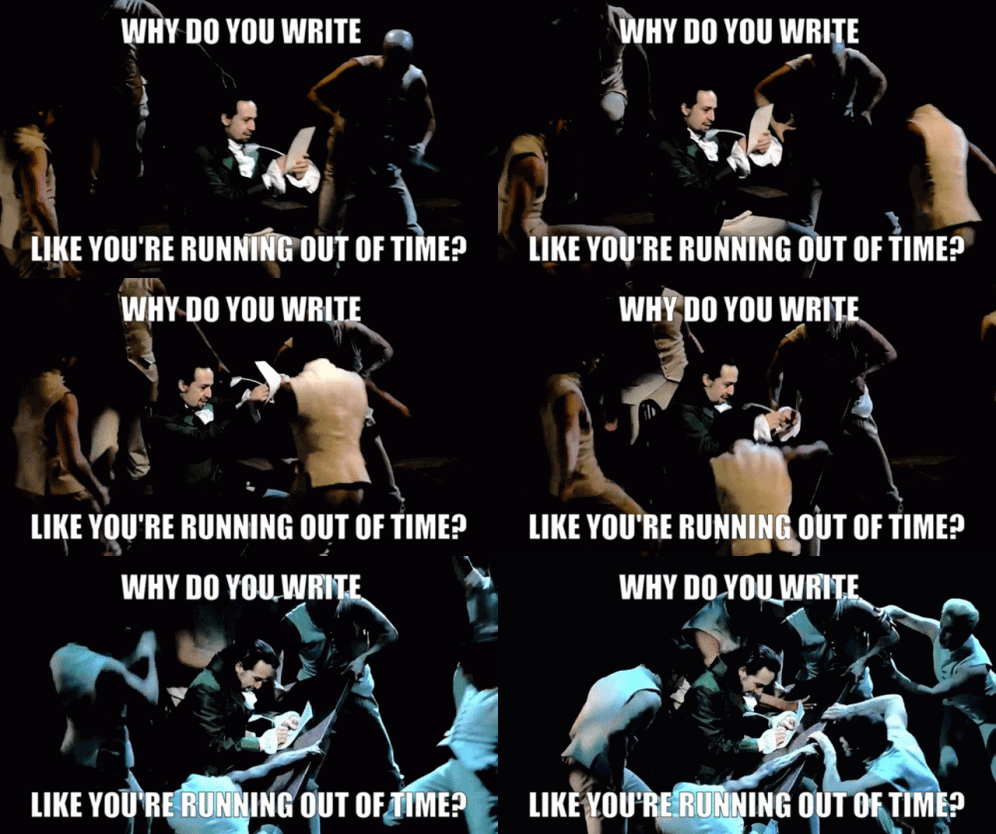
why do you write like you 're running out of time? Alt: A clip from the musical Hamilton with Hamilton holding quill and parchment in hand as actors dance around Hamilton singing "Why do you write like you're running out of time?"
2 months ago 2 0 0 0