Advertisement Β· 728 Γ— 90

Posts by GLiTRS

Northern Brown Argus butterfly on a thistle and headline 50 years of butterfly monitoring data reveal specialist species disappearing across UK

Northern Brown Argus butterfly on a thistle and headline 50 years of butterfly monitoring data reveal specialist species disappearing across UK

Pearl-bordered fritillary butterfly on bluebells

Pearl-bordered fritillary butterfly on bluebells

Extraordinary dataset of 44 million+ records of UK #butterflies collected by 782,000 volunteers in the past 50 years shows many species are in long-term decline eg Pearl-bordered Fritillary.

@ukbms.bsky.social is run by @savebutterflies.bsky.social, UKCEH, @btobirds.bsky.social, and JNCC.

πŸ§ͺ 1/

6 days ago 65 35 2 3
A bright yellow dandelion with a small hoverfly

A bright yellow dandelion with a small hoverfly

Warm enough this afternoon for my first @pomscheme.bsky.social #pollinator FIT Count of 2026. During my ten minutes this dandelion was visited by a beetle and a solitary bee πŸ˜ƒ and then this hoverfly arrived after time was up ⏰️

2 weeks ago 13 4 0 0
Preview
A global butterfly index could advance insect conservation worldwide A global butterfly index could help track butterfly populations worldwide and how environmental changes are impacting them.

A short summary of our last paper on the first attempt at a global butterfly index of population trends theconversation.com/a-global-but...

2 weeks ago 8 5 0 1
Preview
Addressing Gaps in Butterfly Population Monitoring to Catalyze Global Insect Conservation The conservation community sorely lacks a global indicator of change in insect populations. Given widespread insect declines, addressing this gap is key for conservation and policy targets. We sugges...

We’re missing a global indicator to track insects. By analyzing thousands of butterfly populations, we highlight both promising signals and key challengesβ€”showing why these taxa are strong candidates for building a Global Index to support conservation. conbio.onlinelibrary.wiley.com/doi/10.1111/...

4 weeks ago 24 17 0 1
Preview
Global Biodiversity Framework Targets Can Drive Action on Insect Declines, but Lack Robust Indicators to Prove Their Effectiveness Insects are the most diverse and functionally important animals on Earth. In at least some regions, terrestrial populations are declining. Despite this, insects are often overlooked in conservation p...

New #OA paper from the @glitrs.bsky.social project asking, how well does the Global #Biodiversity Framework address insect declines? Turns out the targets could well deliver for insects, but the indicators won't tell us whether or not they have! doi.org/10.1111/con4...

1 month ago 11 4 0 0

NEW PAPER! And what a challenging one. It has taught us a lot about how we can understand the impacts of pressures on insects, and I hope we can continue to add to it into the future. Another great output from the @glitrs.bsky.social GLiTRS project team 🌍 🐝 🐜 πŸ¦‹ 🐞

10 months ago 8 2 0 0

And there's a great opportunity to get involved in this project at the @entsocamerica.bsky.social conference in Portland, Oregon in the symposium on Evidence Synthesis πŸ§ΎπŸπŸ¦‹πŸ¦—

10 months ago 3 1 0 0

A huge amount of work by Joe and others πŸ‘ went into building the infrastructure behind the database. Including 'Dynameta', a platform for ingesting the effect sizes and a meta-protocol to coordinate the many different meta-analyses.

10 months ago 2 0 1 0
Preview
A Multithreat Meta‐Analytic Database for Understanding Insect Biodiversity Change Aim Widespread declines in insect biodiversity have been attributed to a diverse set of anthropogenic drivers, but the relative importance of these drivers remains unclear. A key reason for this unc...

New GLiTRS paper led by @joemillard.bsky.social πŸš¨πŸ“

"Our database provides a framework for the first global meta-analytic overview of the response of insects to a range of major anthropogenic drivers"

onlinelibrary.wiley.com/doi/10.1111/...

10 months ago 19 8 1 1
Preview
Bumble Bee Probability of Occurrence Responds to Interactions Between Local and Landscape Land Use, Climatic Niche Properties and Climate Change We analyse a collation of bumble bee presence and absence data from across the continents of Western Europe and North America, spanning both natural and human-modified habitats. We find that bumble b....

✨Bumble bee probability of occurrence responds to interactions between local and landscape land use, climatic niche properties and climate change🐝New paper out, led by @tnewbold31.bsky.social, & with @jetkerr.bsky.social & Peter Soroye (the result of some fantastic trips across the Atlantic πŸ‡¨πŸ‡¦) 🌎 πŸ§ͺ 🌐

10 months ago 41 17 0 1
Advertisement
Post image

Grizzled Skipper (Pyrgus malvae) had its worst year on record in the UK in 2024. It numbers at @ukbms.bsky.social monitored sites have been below average now in 20 of the last 25 years. Since 1976, its population has decreased by 49% (πŸ“·Mark Searle)

1 year ago 74 23 2 0
Preview
Here’s how to create a more nature-literate society Nature literacy has inspired creativity and innovation for thousands of years.

How do we increase nature literacy among society? Some thoughts from @waspwoman.bsky.social
theconversation.com/heres-how-to...

1 year ago 50 14 1 1
Clockwise from top left: Tenthredo sawfly, mantid, cockroaches, dragonfly

Clockwise from top left: Tenthredo sawfly, mantid, cockroaches, dragonfly

NEWS: Despite fears about insect declines, we know very little about 99% of species globally πŸŒπŸ“‰.

Scientists are proposing a new approach to get a more complete picture of insect populations and analyse how they are responding to threats.

Read more: www.ceh.ac.uk/press/some-i... πŸ§ͺ

🧡 1/

1 year ago 67 25 2 0

@qmulsbbs.bsky.social, @exeter.ac.uk, @camzoology.bsky.social

1 year ago 1 0 1 0

@andypurvisnhm.bsky.social, @ukladybirds.bsky.social, Ben Woodcock, and @drnickisaac.bsky.social

@ukceh.bsky.social, @uclcber.bsky.social, @zslscience.bsky.social, @zslofficial.bsky.social, @imperialcollegeldn.bsky.social, @nhm.org, @qmulrivercomms.bsky.social, @qmulse.bsky.social

1 year ago 4 1 1 0

Huge effort from lots of GLiTRS researchers: @r-cooke.bsky.social, @charlieouthwaite.bsky.social, Andrew Bladon, @joemillard.bsky.social, @james-rodger-za.bsky.social, Zhaoke Dong, Ellie Dyer, Siobhan Edney, John Murphy, Lynn Dicks, Cang Hui, Iwan Jones, @tnewbold31.bsky.social

1 year ago 4 0 1 0
Diagram showing how multiple evidence types feed into a synoptic overview of insect biodiversity change, facilitating projections across space and time, policy recommendations and evidence-based conservation action

Diagram showing how multiple evidence types feed into a synoptic overview of insect biodiversity change, facilitating projections across space and time, policy recommendations and evidence-based conservation action

The GLiTRS team are working to implement this approach to provide an updated overview of the state of the world's insects and how they respond to a range of human-driven threats - so watch this space for more!

πŸ”—https://glitrs.ceh.ac.uk/

(6/7)

1 year ago 4 0 1 0
A diagram showing the integration of multiple evidence types into threat response models and projections of insect biodiversity change

A diagram showing the integration of multiple evidence types into threat response models and projections of insect biodiversity change

By combining space-for-time analysis, experiments, expert elicitation and time series we can better inform assessments of insect responses to threats (5/7)

1 year ago 3 0 1 0
Advertisement
Graph showing the power of attribution versus the temporal, spatial and taxonomic coverage of different evidence types

Graph showing the power of attribution versus the temporal, spatial and taxonomic coverage of different evidence types

In this review, we propose a way forward that brings together evidence types and integrates these into one model to take advantage of the strengths of each whilst balancing out their weaknesses (4/7)

1 year ago 3 0 1 0
Collection of different insects

Collection of different insects

Ideally, we would systematically monitor insects everywhere, however, due to their sheer diversity and the fact that most have not even been named, this is just not feasible.

Rather than wait for long-term data, we must gather all information together to understand the status of insects (3/7)

1 year ago 6 1 1 0
Preview
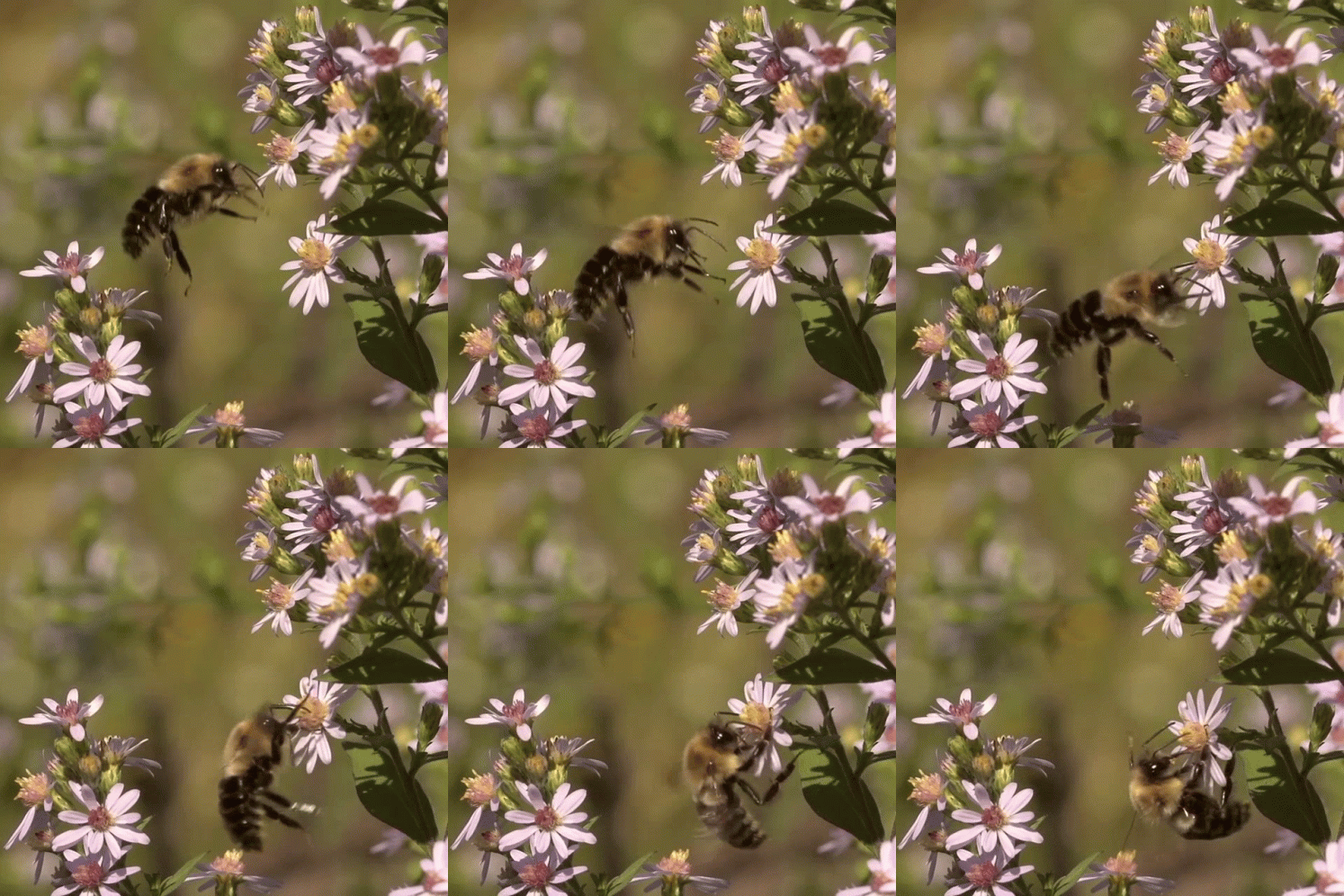
a bee is flying over a bunch of small flowers Alt: a bee is pollinating a bunch of small flowers

Insects are incredibly important; they provide a range of services that us humans would find it pretty hard to live without. Yet they are in decline across many regions of the world πŸ“‰πŸŒ and it is unclear what is causing this at the global scale (2/7)

1 year ago 4 0 1 0

NEW PAPER from the GLiTRS team! πŸŽ‰

We review how best to use different types of evidence to better understand global insect declines πŸ¦—πŸͺ³πŸͺ²πŸ¦‹πŸ›πŸœ

"Integrating multiple evidence streams to understand insect biodiversity change" published in @science.org

πŸ”— tinyurl.com/mr35bdaa

A summary 🧡 below (1/7)

1 year ago 42 27 1 4
Preview
Emerging technologies for pollinator monitoring Efficient tools for monitoring pollinator populations are urgently needed to address their reported declines. Here, we review advanced technologies fo…

Great to be at the #FutureforButterflies. Tomorrow I will speak about this new paper and our work with #biodiversitymonitoring using #Insect #cameratraps and #AI as part of @mambo-project.eu @onestop-project.eu and @insectai.bsky.social www.sciencedirect.com/science/arti...?

1 year ago 14 10 0 1
Screenshot from the cover page of the paper

Screenshot from the cover page of the paper

A map of the world showing fly migration study locations and estimated routes

A map of the world showing fly migration study locations and estimated routes

A close up photo of Eristalinus taeniops the stripey eyed hoverfly on a yellow flower in Cyprus

A close up photo of Eristalinus taeniops the stripey eyed hoverfly on a yellow flower in Cyprus

A close up photo of the locust blowfly Stomorhina lunata on a rock. My favourite fly

A close up photo of the locust blowfly Stomorhina lunata on a rock. My favourite fly

It's published!
The largest research work I've ever undertaken:

Lords of the flies: dipteran migrants are diverse, abundant & ecologically important

Published in Biological Reviews: onlinelibrary.wiley.com/doi/full/10....
Thanks so much to co-authors @koralwotton.bsky.social & Myles Menz
1/x

1 year ago 277 95 7 9
Orange-tip butterfly on flower

Orange-tip butterfly on flower

Bumblebee on flower

Bumblebee on flower

Infographic with weather conditions for carrying out Flower Insect Timed Counts (FIT Counts)

Infographic with weather conditions for carrying out Flower Insect Timed Counts (FIT Counts)

😎 It's 1 April and that can only mean one thing... yes, insect survey season is back in earnest!

🐝πŸͺ° Check out @pomscheme.bsky.social to help monitor #pollinator abundance with 10-minute Flower-Insect Timed Counts

πŸ¦‹ And see @ukbms.bsky.social for getting involved with #butterfly transects

1 year ago 38 13 1 1
Preview
UK Moth Recorders' Meeting 2025 Our annual UK Moth Recorders' Meeting took place online on 25 January 2025. Chapters: 00:00 - Intro 06:39 - National Moth Recording Scheme Update by Zoe Randle 29:53 - Charismatic Clearwings in mid Wales by Norman Lowe 53:29 - Can we measure the impact of insect change on bird and bat populations? By Luke Evans. 01:20:15 - Surveying Argyll's rare moths 01:45:56 - Understanding why artificial lights trap flying insects using high-speed videography. By Dr Sam Fabian. 02:15:18 - Moths and light pollution. By Dr Avalon Owens. Thumbnail image by Patrick Clement #MothsMatter

The recording of the @savebutterflies.bsky.social 2025 UK Moth Recorders' Meeting is available to watch here: bit.ly/43315yr

1 year ago 7 6 0 1
Advertisement

Our new paper thinking about bias in population monitoring using @ukbms.bsky.social data πŸŒπŸ¦‹

1 year ago 27 12 0 1