Thanks for the invite! Really looking forward to this
3 days ago
7
1
0
0
Thanks for the invite! Really looking forward to this
1/N: Dear colleagues, I would like to share a new paper on the subiculum, part of my PhD with the Neural Computation Group @andrejbicanski.bsky.social @mpicbs.bsky.social . We present “A theory of subicular function and generalized vector coding” that we call Disco. www.biorxiv.org/content/10.6...

My first-author review ‘Determinants of individual navigation ability’ is out in Nature Reviews Psychology, co-authored with the inspiring @hugospiers.bsky.social!!!! 🎉🧠
➡️ rdcu.be/e7KxG
#Neuroscience #Navigation @nature.com @natrevpsychol.nature.com @sfn.org @fens.org @ucl.ac.uk
Also, a shoutout to BERG for making these models much easier to use in practice. If you work on brain encoding or related problems, it’s definitely worth checking out. They already host a range of very useful models: gifale95.github.io/BERG/

The model is already integrated into BERG, so using it takes only a few lines of code.
If you try the model or go through the tutorial, I’d love to hear your feedback.
Thanks as well to @alessandrogifford.bsky.social and Domenic for including it in BERG.

The smallest model is only 52M parameters, and can predict responses to a 10-minute stimulus in a few seconds on your Mac.
It performs above the baseline model overall (with significantly less compute) and is close to SOTA in the auditory cortex and language-related regions.

The data come from the Algonauts 2025 challenge, in which 4 subjects watched Friends episodes and Movies during fMRI recording.
I’m also releasing a collection of trained models with different compute budgets:
huggingface.co/collections/ShreyDixit/text2fmri

The tutorial shows how to train a transformer model from scratch on ~50 hours of fMRI data from 4 subjects in about 30 minutes, using only free Google Colab GPUs.
Tutorial:
github.com/ShreyDixit/Text2fMRI
Can whole-brain fMRI responses to naturalistic video stimuli be predicted using only transcripts?
Last year, I gave a tutorial on exactly that. Since the response was very positive, I’ve now released both the tutorial notebook and the trained models publicly.
Now out in Hippocampus. Fei Wang‘s model of Trace Vector Cells and intra-subiculum processing, consistent with know effects in CA1.
onlinelibrary.wiley.com/share/CPZPYM...
Reminds me of a similar game I played at the Jew museum in Berlin on being a Jew before and during the Holocaust.
It's sad going through it but it's also important to understand.
Excited to give a talk at #Cosyne2026 about my PhD work!
We show that RNNs trained on visual search converge on brain-like solutions, producing primate-like behavior and neural representations. Happy to chat if you're at Cosyne!
📅 March 15, 2026
📍 Lisbon, Portugal
www.biorxiv.org/content/10.1...

DNN models of the brain are getting bigger. Are we replacing one complicated system in vivo with another in silico?
In new work, we seek the *smallest* DNN models of visual cortex, balancing prediction with parsimony.
It turns out these compact models are surprisingly small!
rdcu.be/e5H8G

1/9 New paper with @gonzalezgarcia.bsky.social and @lindedomingo.bsky.social : “Characterising semantic prioritisation in visual working memory.”
Core question: when we hold visual info briefly in mind, what gets accessed first: perceptual details or semantic meaning?
Our new preprint is out on bioRxiv! @doellerlab.bsky.social
We show that eye-movement sequences actively organize information by aligning with underlying structure and flexibly adapting to cognitive demands in working memory.
www.biorxiv.org/content/10.6...
Excited to see what comes out of it. Having worked on a similar problem during the Algonauts Challenge, I was quite surprised by the results in the paper.
neuroAI comparisons of ANNs to brains do have a range of problems. Even more than I had realized. And I was worried before: www.biorxiv.org/content/10.1...

🧠 The Mind Meeting Series is back!
Organized by us & Bicanski Lab, featuring leading scientists in cognitive and computational neuroscience.
Our first speaker is @lukaskunz.bsky.social (University Hospital Bonn).
🗓 February 12 | 3:00 PM
📍 In person (Zoom available)
We look forward to seeing you!
Ending up in the space between fields where you have no way of effectively communicating your work has always driven me right back into my discipline…

𝗦𝗰𝗵𝗲𝗺𝗮-𝗯𝗮𝘀𝗲𝗱 𝗮𝗰𝘁𝗶𝘃𝗲 𝗶𝗻𝗳𝗲𝗿𝗲𝗻𝗰𝗲 𝗮𝗻𝗱 𝗳𝗿𝗼𝗻𝘁𝗮𝗹 𝗰𝗼𝗿𝘁𝗶𝗰𝗮𝗹 𝗰𝗼𝗱𝗶𝗻𝗴 𝗼𝗳 𝗮𝗯𝘀𝘁𝗿𝗮𝗰𝘁 𝘀𝘁𝗿𝘂𝗰𝘁𝘂𝗿𝗲
Giovanni Pezzulo et al introduce hierarchical model of goal attainment in PFC.
Looks very impressive.
#neuroskyence
arxiv.org/abs/2601.189...
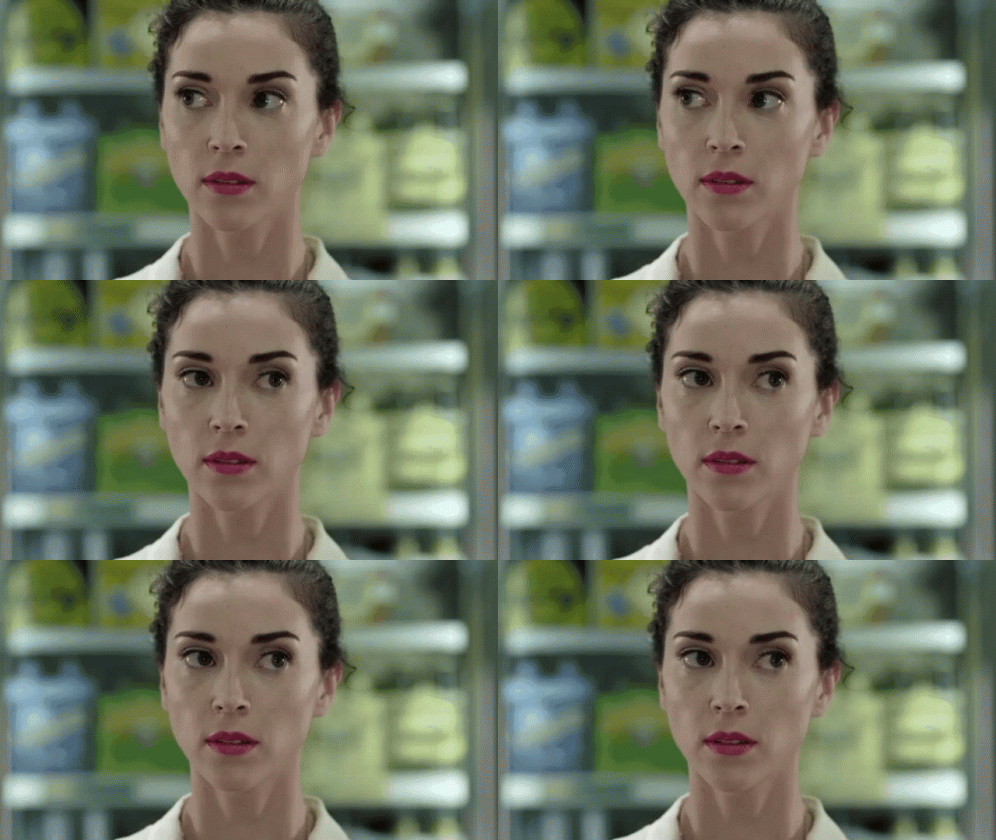
We make about 3-4 fast eye movements a second, yet our world appears stable. How is this possible? In a preprint led by @lucakaemmer.bsky.social we test the intriguing idea that anticipatory signals in the fovea may explain visual stability.
www.biorxiv.org/content/10.1...

"How much of the brain's learned algorithms depend on the fact it is a brain?" arxiv.org/abs/2601.02063 The brain is a neural network, but also a biological organ (unlike artificial neural networks). How much does this matter to cognition?

At @elife.bsky.social you can now include explainer videos with every figure. Like going to a seminar while you engage with the paper. First example here elifesciences.org/articles/106...
Click the arrows next to each figure to get a video of @mathiassablemeyer.bsky.social explaining it for you!

Close reading is a technique for careful analysis of a piece of writing, practiced by many ancient cultures, major religions, & academic scholars. The latest fastai course experimented with using AI to go deeper when reading. 1/
www.fast.ai/posts/2026-0...

Are connectome-based network mapping methods and the >200 papers that have used it invalid?
New paper out in
@NatureNeuro
says YES. nature.com/articles/s41...
I have concerns about this new paper's methods and conclusions, but am biased. What do others think?
I have a PhD opening for my #VIDI BrainShorts project 📽️🧠🤖! Are you or do you know an ambitious, recent (or almost) MSc graduate with a background in NeuroAI and interest in large-scale data collection and video perception? Check out our vacancy! (deadline Feb 15).
werkenbij.uva.nl/en/vacancies...

Our new paper, now published in Cell Reports, asks how the brain adaptively shapes its representations according to the statistical structure of the environment to overcome the limits of working memory capacity.
www.cell.com/cell-reports...

Really thrilled that this paper led by @neurozz.bsky.social is now published in its final version in @elife.bsky.social!!
This is a memory-focused (as opposed to RL-focused) account of the detailed characteristics of forward and backward awake and sleep replay!
elifesciences.org/articles/99931

Another cool paper from Iran: nature.com/articles/s41... Prenatal stress makes mouse offspring more anxious, hyperactive, forgetful, and more drawn to morphine while laterodorsal tegmentum cholinergic neurons become hyperexcitable. From Kerman, a city with reported violent crackdowns on protests.

Front page of the website for the book: Practical Spiking Neural Networks
The field of #neuromorphics is lacking *accessible*, *intuitive*, and *practical* introductions. Ramashish Gaurav, Petruț Antoniu Bogdan, and I are setting out to fix this with a book on Practical Spiking Neural Networks! ✅
Any and all contributions are welcome! 💕
Early access at: snnbook.net