As a field, can we please stop interpreting statistical insignificance as evidence that an effect doesn’t exist? Pretty please?? Like, with a cherry and everything??? #PsychSciSky
1 year ago
7
1
2
1
As a field, can we please stop interpreting statistical insignificance as evidence that an effect doesn’t exist? Pretty please?? Like, with a cherry and everything??? #PsychSciSky

Against a colourful background of abstract shapes, a large speech bubble is displayed with the following text: "Research study now recruiting participants. If you are a HCPC-registered counselling psychologist who has used expressive arts activities within trauma-focused psychological interventions with adult clients... We want to hear about your experiences!" Elsewhere in the image is guidance: "Around 2 hours of participation in total. Sign-up and earn a £10 e-voucher following your participation as a token of thanks" A QR code is displayed with guidance "Use the QR code or click on the link in the post to find out more..." The Glasgow Caledonian University logo is displayed, alongside information: This study is being conducted by Karen E. Thomson as part of her final stage of doctoral training as a counselling psychologist at Glasgow Caledonian University (Ethics approved 01/11/24, approval code HLS/PSY/24/023). The study is being supervised by Dr. Kevin Hogan.
*Please consider and kindly *repost* for further reach!*
If you're a HCPC-registered (UK-based) counselling psychologist, who has used expressive arts in trauma focused psychological interventions (even ONCE!) please scan QR code or go to forms.gle/sHsJBBXyTGay... #psychology #PsychSky #PsychSciSky
Obsessed with the term "neuromyths" 🧠
#education #psychsky #neuroscience #neurosky #neurosci #psychscisky #brainscience #edsci #research #educatorsky #neuroskyence
Absolutely! Lovely to virtually meet you too! :) 💫
(3/3) Please click on the URL in OP or scan the QR code to find out more about getting involved! Thanks in advance! 🙏
(2/3) For example, did you/the therapist make use of music in session, or encourage you to draw your feelings out? Or perhaps you worked with an art therapist and art-making featured loads in your therapy? 🎨🎶🎭
We want to hear from you! 💬

Research study now recruiting participants. If you are someone who has had trauma-focused psychotherapy that featured using the expressive arts within your therapeutic process (e.g., drawing, dance, or music)... We want to hear about your experiences. Around 2 hours of participation in total. Sign up and receive a £10 e-voucher following your participation as a token of thanks. A QR code is displayed in the image which can be scanned to take you to the sign-up form. Alternatively a URL is available within the post. This study is being conducted by Karen E. Thomson as part of her doctoral training as a counselling psychologist. This study was granted ethical approval on 1st November 2024 (ethics approval code pending). This study is being supervised by Dr. Kevin Hogan.
🧠 RESEARCH RECRUITMENT: PLEASE CONSIDER AND SHARE💫 (1/3)
Have you completed psychotherapy in the UK that has addressed or sought to address traumatic experiences? Did the therapy use expressive arts? @bpsofficial.bsky.social @academic-chatter.bsky.social #PsychSciSky forms.gle/bbJeM8WqjVuu...
Interests include:
🎨 creativity within psychological/psychotherapeutic practice
💭 philosophy of science
🤔 existential philosophy
🐶 Dogs
🐢 Animals in general
🌈 The Good Place (TV show) (and anything else Michael Schur)
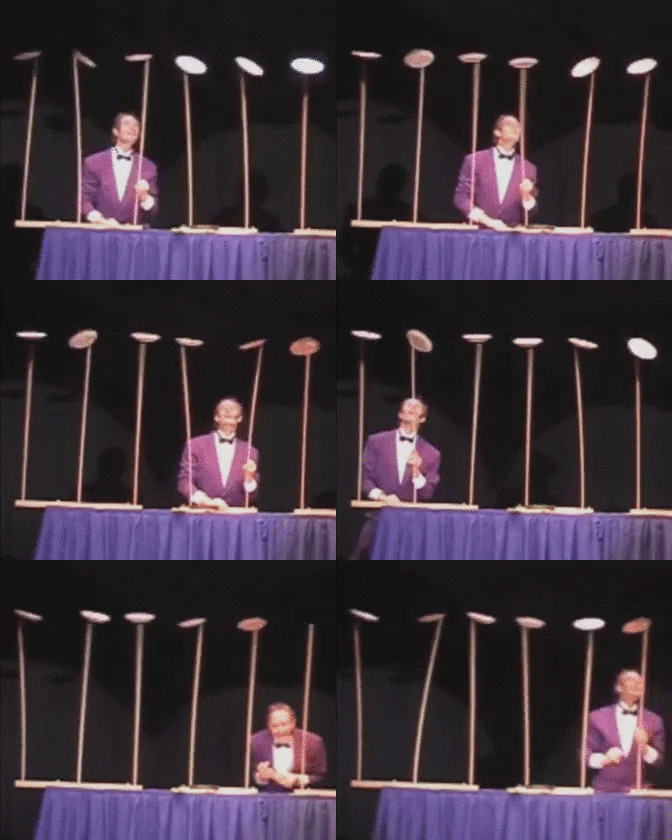
Here goes, first post! I'm a trainee counselling psychologist in Scotland, hopefully will qualify in a year. Spinning a million plates, and have discovered bluesky, so why not spin one more? 😅 This place seems a bit less of a cesspit than 'the bad place'...? 🤞

Still makes me laugh

An anthropological critique of psychiatric rating scales Neil Armstrong and Nicola Byrom This article discusses sceptical arguments about measurement scales. Measurement scales are part of a promising agenda of openness, transparency and patient and public involvement (PPI) in medical research, but have received critical, sometimes hostile attention from anthropologists. This is because scales repackage localised cultural assumptions about distress as something universal and pan-human and have the capacity to reshape people's interior lives in unhelpful, possibly harmful ways. We take as an example the Patient Health Questionnaire-9 (PHQ-9). Use of the PHQ-9 is currently mandated by major funders. But its history suggests flawed PPI and a lack of openness. The article suggests a constructive role for anthropology in mental health research, using ethnographic evidence and theory to show how, although they have their uses, mental health scales should not be regarded as inert or harmless.
"A person’s own sense of their life, their trajectory and commitments and emotions are first reduced to nine questions and then to a single number"
Fascinating paper by Armstrong & Byrom, reflecting on the PHQ-9 and using this as the standardised measure of depression
tinyurl.com/mr3w3bnm
