Registration is open for the 2026 Global Lake Ecological Observatory Network (GLEON) All-Hands’ Meeting taking place at Lake Banyoles, Spain from August 30 - September 4, 2026! Participation support for students/ECRs is available through the Freshwater Futures Fellowship (deadline April 24). 🌎🌍🌏
4 days ago
4
3
1
0
Just in case you had any doubts that ChatGPT is still hallucinating.
2 weeks ago
0
0
1
0

😂😂😂😂😂😂😂😂😂😂
2 weeks ago
1
1
1
0
Quick experiment: Please take a moment and ask ChatGPT in conversation mode (use voice) how many "R's" there are in the word "strawberry." Comment here what answer it gives.
2 weeks ago
1
1
1
0

After two years of focusing my aquatic ecology class almost entirely on lakes, I’m excited to expand into stream ecology this year. We will compare and contrast depth gradients in lakes with elevation gradients in a nearby stream which climbs from 312 m to 659 m, all within just 3 km of campus.
2 weeks ago
7
1
0
0

Seasons and seasonality in lakes: A synthesis amid global change
Seasonality in environmental conditions plays a fundamental role in shaping lake ecosystems. However, patterns of seasonality vary worldwide, and these patterns are shifting over time amid global cha...
In aquatic ecology, what is “spring”? A calendar date, a daylength threshold, or the moment lake ice melts? Led by @aslewis.bsky.social , we show how seasonal definitions fundamentally shape our understanding of climate change impacts on waterbodies. dx.doi.org/10.1002/lol2...
3 weeks ago
4
1
0
0

Fundamentals of Data Visualization
A guide to making visualizations that accurately reflect the data, tell a story, and look professional.
@kjhealy.co makes some of the best open free online guides to data visualization #datavis. I’ve always loved and used clauswilke.com/dataviz/ in my teaching and research, but this one looks even simpler and more user-friendly. Definitely worth checking out.
1 month ago
7
1
0
0

Data Visualization
A Practical Introduction
Here’s a full draft of the upcoming second edition of my “Data Visualization: A Practical Introduction”: socviz.co
1 month ago
571
185
13
14

A black-and-white xkcd-style comic. Two stick figures stand talking. One says, “Lake classification is second nature to us limnologists, so it’s easy to forget that the average person probably only knows one or two trophic states.” The other replies, “And mixing regimes, of course.” A caption below reads: “Even when they’re trying to compensate for it, experts in anything wildly overestimate the average person’s familiarity with their field.
Generate your own: marshdeer.github.io/xkcd2501-gen...
2 months ago
10
3
0
0
Advertisement

#WARR
@carowinter.bsky.social + Ashley Helton on
water quality (C, N, salts, ..) in troubled waters during #floods #droughts
Register: psu.zoom.us/meeting/regi...
www.cee.psu.edu/events/women...
@devonkerins.bsky.social @margaretzimmer.bsky.social @waterbarnes.bsky.social @agu-h3s.bsky.social
2 months ago
9
7
0
0
Here's why you'll want to be there:
💧Inspiring speakers: Prof. Dr. Julia Knapp and Dr. Joachim Rozemeijer
💧Two full days of oral and poster presentations
💧Excursion (tentative) to our Ecosense field site
💧Potential for a community paper
📢Spread the word!
We look forward to seeing you!
2 months ago
4
3
1
0

Five people bundled up in cold weather gear stand on the ice in front of a military cargo plane, in Antarctica
K051 (my “event number”, the unique identifier for each science project) made it to Antarctica! Flew on a C17, only delayed by an hour, too. Thanks US Air Force and Antarctica NZ, now the fun begins.
🧪🦑🦊🦉🌎
5 months ago
47
4
1
0
This @gleonetwork.bsky.social workshop series is aimed at limnologists but it's open to all. We are targetting PhD students and postdocs across the environmental sciences.
7 months ago
2
2
1
0

Poster for 90 minute workshop on HOW TO DESIGN BETTER EXPERIMENTS, by Mridul Thomas & Ravi Ranjan.
Details: September 23rd 16:00 CEST ; 14:00 UTC
Description:
Experimental designs can make or break an experiment. A good experiment has a clear goal and efficiently uses experimental resources to achieve that goal. In this workshop, we will review what experiments are for, basic and advanced principles of designing experiments, and how to use simulations to evaluate designs before actually doing the
experiment. We’ll do a moderate amount of coding in R and so experience with this would be helpful but is not required. We intend to have small-group discussions to help participants develop their own experiments, and encourage participants to think of a specific question they would like to answer with an experiment.
@raviranjan.bsky.social & I are teaching a free online workshop with on experimental design for environmental scientists on the 23rd.
We'll focus on using simulations to evaluate how well different experimental designs help achieve your goals.
Please sign up & share! forms.gle/MZTxeQs4UpMr...
7 months ago
27
21
2
2

Clarifying the trophic state concept to advance macroscale freshwater science and management
For over a century, ecologists have used the concept of trophic state (TS) to characterize an aquatic ecosystem's biological productivity. However, multiple TS classification schemes, each relying on....
It takes patience to have a conversation about definitions as a collaboration begins... but it is important!
"Trophic state" in lakes is one of those concepts! It really makes a difference which definition we use... @mishafredmeyer.bsky.social
esajournals.onlinelibrary.wiley.com/doi/10.1002/...
7 months ago
11
6
0
1

📢 Job alert 📢
Doctoral position at the University of Freiburg in the DFG Research Training Group FORESCALE (Scale Effects in the Forest Adaptation to Climate Change) on the topic of water quantity and quality 🍁💧🍁
For details see: uni-freiburg.de/stellenangeb...
7 months ago
4
5
2
1
Advertisement

Historical satellite imagery provides crucial insights, not only for penguin colonies but also for establishing realistic baselines to support conservation efforts and effective management across broad spatial scales. academic.oup.com/bioscience/a...
8 months ago
13
8
0
0

We've detected penguin guano stains across Antarctica with cold-war era spy satellites. Remarkably, data from the Cape Washington colony shows exceptional stability, defying decades of environmental change. www.biorxiv.org/content/10.1...
8 months ago
4
2
1
0

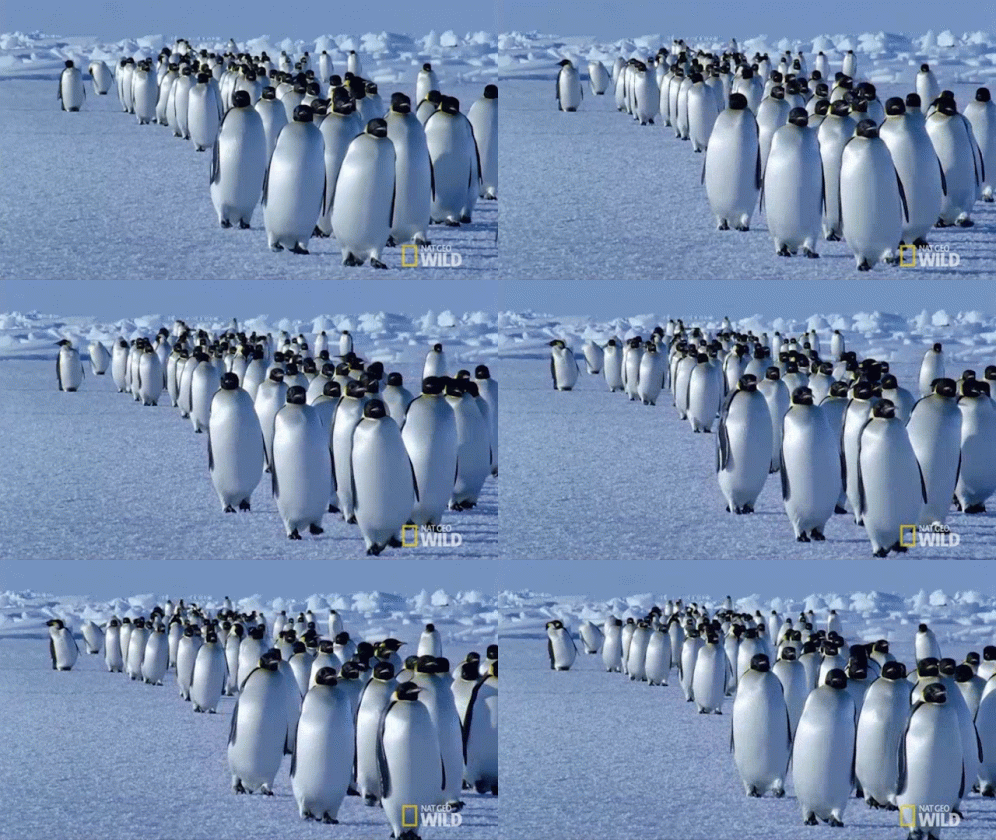
a large flock of penguins are walking in the snow with national geographic wild written on the bottom right
ALT: a large flock of penguins are walking in the snow with national geographic wild written on the bottom right
Analog US spy satellite images from the 1960s are revealing unexpected surprises—this time, it's penguin poop! So, what does the poop tell us in our latest preprint? Work lead by Martynas Bielinis, @drmichellelarue.bsky.social, myself, and Catalina Munteanu
8 months ago
14
8
2
3
A couple of forthcoming workshops on experimental design and data analysis, taught by @christinamcgraw.bsky.social, Peter Dillingham, @sineadcollins.bsky.social, Sam Dupont, and me.
9 months ago
5
4
0
0


Back in my happy place: sending more fully equipped students out to explore lakes in the Black Forest—waters which, to my knowledge, have never been touched by aquatic ecologists. Let the discoveries begin. 🛶🧪🌲
9 months ago
5
0
1
0
"Absolute teaching bliss" ☺️ is sending two bachelors students in a kayak to collect the first ecological data in over 70 years from a lake so protected, swimming and boating are off-limits. With special permission granted, they’re experiencing something virtually no living human has experienced.🚣♀️⛰️🌊
9 months ago
7
2
2
0

Researchers launch study of hundreds of Adirondack lakes
A consortium of scientists and other researchers are starting a three-year survey of hundreds of Adirondacks lakes and ponds
Extremely proud to be working on the Survey of Climate and Adirondack Lake Ecosystems (SCALE)! Check out this article which highlights what we will be doing.
www.adirondackexplorer.org/stories/rese...
10 months ago
7
1
1
0
Registration
Conference Template
I'm very excited to share that Hacking Limno + DSOS are coming back for the FIFTH time 21-25 July! If you're interested in #machinelearning #remotesensing #modeling #limnology #oceanography, this is for YOU! Registration is FREE + open to ALL! #DSOS25 aquaticdatasciopensci.github.io/registration/
10 months ago
20
15
1
4
So happy to share the news that we’re hosting the FIFTH iteration of Hacking Limnology/DSOS this summer! It will be a fest!
10 months ago
7
3
0
0
Advertisement
"If you're already trying to live low-impact—recycling, avoiding plastic, limiting flights—here’s a chance to make a meaningful tech choice that aligns with those values. LLMs aren't evil by default, but they’re energy-intensive, and we need to ask whether the benefits we get justify their costs."
11 months ago
1
0
3
0
"ChatGPT, how could I reframe my post so that it is more constructive and persuasive?"
11 months ago
4
0
1
0