Camera trap photo of a capuchin monkey. Courtesy of Zoë Goldsborough.
🎉 The winner of the 2nd Frans de Waal PhD Dissertation Prize is the brilliant @zoegoldsborough.bsky.social. Congratulations!
Her 2025 thesis “Cracking Capuchins” dives deep into how tool use shapes survival and evolution. Some capuchins wield stones like pros, others don’t.
1 day ago
19
4
1
1


Our new paper is out in @intjprimatol.bsky.social!
Huge credit to Luca Wienand for an excellent bachelor's project on spatial and sociosexual behavior in common marmosets!
Read all about it here: shorturl.at/R5eju
@primatenzentrum.bsky.social @nccrlanguage.bsky.social @evocoggroup.bsky.social
1 week ago
6
2
0
0

We are offering two 4-year PhD positions in our new SNF project "The Evolutionary Roots of Altercentrism"
1 week ago
36
49
0
1
In turn, these methods should bring us closer to mapping animal combinatoriality and understanding the roots of complex communication.
3 weeks ago
0
0
1
0
This approach gives researchers a much more rigorous way to study how animals combine signals, and opens the door for investigating how socioecological differences between cohorts of animals influence how they communicate.
3 weeks ago
0
0
1
0

a couple of small monkeys sitting on a wooden ledge
ALT: a couple of small monkeys sitting on a wooden ledge
As a case study, we looked at vocal sequences in common marmosets. Males and females mostly use similar call combinations; however we found some subtle, potentially female-biased patterns.
3 weeks ago
0
0
1
0
Advertisement
We validated the use of MDCA-Pr on animal datasets using a mixture of simulations and real animal data. Overall, MDCA-Pr performed well, even with relatively small or recombinatorial datasets, as well as during intercohort comparisons.
3 weeks ago
0
0
1
0
These statistical improvements also let us apply MDCA-Pr to questions which have thus far been inaccessible using animal collocation analysis, including comparing how different cohorts of animals (e.g. sexes, age classes, or populations) vary in their use of signal combinations.
3 weeks ago
0
0
1
0
MCDA-Pr has advantages over existing forms of animal collocation analysis because it can: [1] Account for uncertainty for signal combinations; [2] Avoid false positives when evaluating many different types of signals; [3] Handle repeated measures from the same individuals.
3 weeks ago
0
0
1
0
In this manuscript, we re-evaluate an increasingly popular set of methods for identifying signal combinations in animal communication (collocation analysis). We draw on recent advances in distributional linguistics, to validate an improved method for animal collocation analysis (MDCA-Pr).
3 weeks ago
2
0
1
0
Accurate characterization of animal signal combinations is also critical for comparative research into the origins of human language, which is an enduring scientific mystery.
3 weeks ago
0
0
1
0
Figuring out which signal combinations represent repeatable behavioural patterns for animals (i.e. they happen more than expected by chance) is challenging. However, this is a necessary first step to understand how animals combine signals to convey different types of information.
3 weeks ago
1
0
1
0

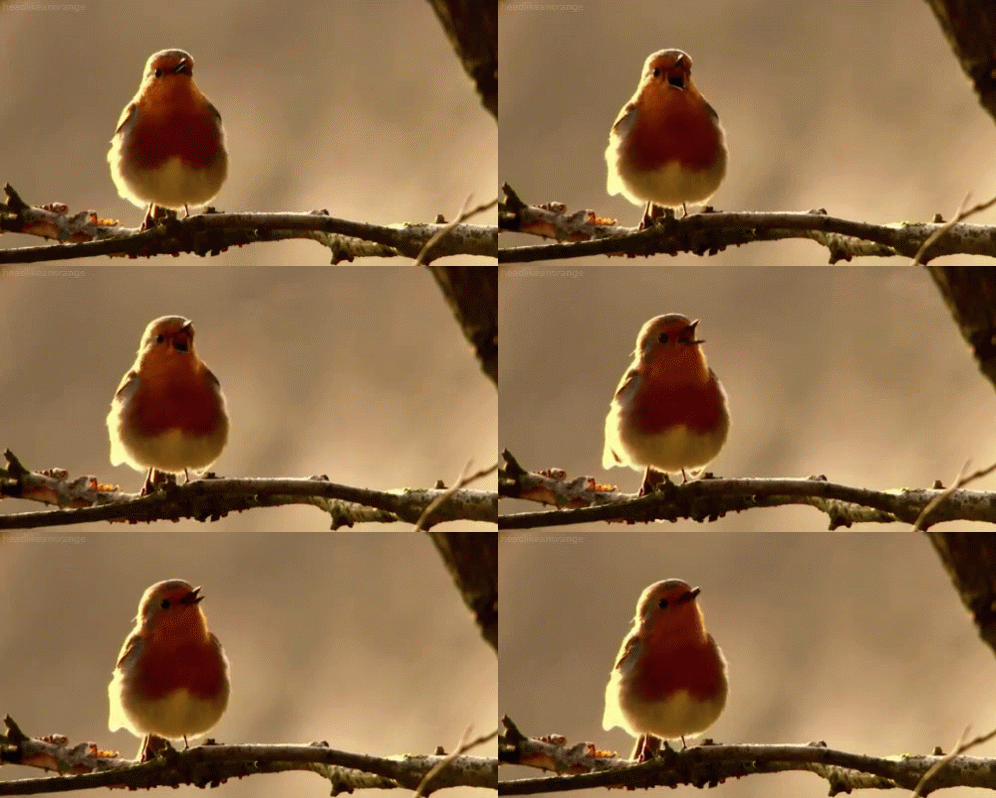
a small bird is perched on a tree branch with its beak open .
ALT: a small bird is perched on a tree branch with its beak open .
Animals use a variety of different communicative signals (calls, gestures, facial expressions, etc.), and growing evidence suggests that many different animal species combine these signals flexibly into sequences.
3 weeks ago
0
0
1
0
Advertisement
Our new preprint is out! Animal collocation analysis 2.0: improving statistical inference and applications for cohort comparisons. 🥳 Check it out here, or read our summary below: www.biorxiv.org/content/10.6...
3 weeks ago
11
5
1
2

Evolutionary Anthropology seminars
Exploring the evolutionary roots of human behaviour, biology, and culture through interdisciplinary research and debate.
UCL Evolutionary Anthropology seminars starting up again for the new term every Tuesday pm. Anthropology Dept. 14 Taviton St. DFL 3.30-5pm followed by 🍷. All welcome.
www.ucl.ac.uk/social-histo...
3 months ago
15
11
0
5
Statistical Rethinking 2026 - Lecture B01 - Multilevel Models
YouTube video by Richard McElreath
Statistical Rethinking 2026 Lecture B01 Multilevel Models is online. This is the first lecture of the "experienced" section, in which we start with multilevel models and venture into vast covariance spaces. Full lecture list still here: github.com/rmcelreath/s...
3 months ago
97
17
0
1

Making faces
Facial expressions are produced through a coordinated system of voluntary and emotional pathways
Our Science Perspective on Ianni et al - neural control of facial expressions involves voluntary pathways
@jamiewhitehouse.bsky.social
www.science.org/eprint/EKJTZ...
3 months ago
24
16
0
0

Last years field assistant holding a Manx Shearwater on the isle of Rum (under a towel), retrieving a GPS device after a bird has returned from a foraging trip!
We are looking to hire a Seabird Field Assistant for 2026 for our Manx Shearwater research project.
Please share this to anyone who'd like to get out in the field this summer and learn about biotelemetry, bird handling and research into animal behaviour.
drive.google.com/file/d/1SGZt...
3 months ago
70
74
1
4
CORVIDATA: A global dataset of morphology, ecology, sociality, and life-history in Corvidae - Scientific Data
Scientific Data - CORVIDATA: A global dataset of morphology, ecology, sociality, and life-history in Corvidae
If you work on corvid ecology, behaviour, cognition, or conservation, this might be useful for you 👇
I’ve just published CORVIDATA in Scientific Data 🐦
doi.org/10.1038/s415... (1/4)
3 months ago
73
57
2
1
The original paper is open access and we touch on this in the discussion briefly. Mainly, we argue that upregulating exploration to compensate for small diets (that lacked cultural input during development) in adulthood is likely risky due to inedible/toxic foods in the environment, (1/2)
3 months ago
1
0
1
0
Have you been too busy to read our recent paper on orangutans' culturally-dependent diets? 😔 Never fear, we have published a two-page research briefing to give you a quick overview of our paper's aims, findings, and implications! 🤩 Check it out here: www.nature.com/articles/s41...
3 months ago
11
3
1
0
Advertisement

📢 Calling all primatologists 📢
EFP2026 in Montpellier is now open for abstracts & registration!
🗓 Deadline for abstract : 13 March 2026 (before if mobility grant application)
Submit: www.alphavisa.com/efp/2026/abs...
Register: www.alphavisa.com/efp/2026/reg...
All abstracts will be accepted!
4 months ago
32
20
0
3

course schedule as a table. Available at the link in the post.
I'm teaching Statistical Rethinking again starting Jan 2026. This time with live lectures, divided into Beginner and Experienced sections. Will be a lot more work for me, but I hope much better for students.
I will record lectures & all will be found at this link: github.com/rmcelreath/s...
4 months ago
662
235
12
20
New paper out today w @dalmaijer.bsky.social @barbaraklump.bsky.social and @lucymaplin.bsky.social as part of the Phil Trans special issue doi.org/10.1098/rstb.... Over 2 years, we studied a population of cockatoos thought to be the source of the innovation of bin-opening.
4 months ago
105
42
3
8

Picture of front cover of Theme Issue entitled "Transforming cultural evolution research and its application to global futures." The image on the front cover is of a Yao honey hunter in Mozambique holding retrieved honeycomb.
Today sees the publication of the Theme Issue featuring the CES Transformation Fund grant scheme. Enjoy! royalsocietypublishing.org/rstb/issue/3...
@durhamdcerc.bsky.social @durhamanthropology.bsky.social @cultevolfunding.bsky.social @culturalevolsoc.bsky.social
4 months ago
51
30
1
6