Advertisement · 728 × 90

Posts by Chris Hackney

Post image Post image

A challenge for students on the @ncl-geography.bsky.social Netherlands fieldtrip today with ~1m storm surge completely inundating de Slufter field site - great resilience reconsidering what was possible, and retargeting some of their project work. Fantastic to show this dynamic environment in flood!

3 weeks ago 6 2 1 0
Biological Invasions

Biological Invasions

This study from 'Biological Invasions' shows invasive non-native plants indirectly destabilise riverbanks by suppressing native vegetation, increasing bare ground, and reducing winter shear strength by around 30%. bit.ly/4qJilB3 @zarahpattison.bsky.social @drchrishackney.bsky.social #bioinvasions

3 months ago 9 3 0 0
Post image Post image Post image

🚨 4 days left to enter 🚨 submit your photos and drawings of geomorphological features by midnight on Friday tagging us and the tag #BSGAC25 to win up to £100 🥇 last years winners and runners up for inspiration ⬇️

3 months ago 5 5 1 1
Preview
Invasive non-native plants indirectly destabilise riverbanks - Biological Invasions Invasive Non-Native Plant species (INNPs) establishment along rivers continues to accelerate globally, with potential consequences for riverbank stability, ecosystem functions and services. Riverbank ...

My third PhD chapter has just been published, we assessed the impact of Himalayan balsam invasion on riverbank stability. A massive thanks to @zarahpattison.bsky.social @drchrishackney.bsky.social @dralanlaw.bsky.social

link.springer.com/article/10.1...

3 months ago 22 13 1 3
View of the Tonle Sap River in Cambodia with several boats, including a floating restaurant, amidst a calm water setting.

View of the Tonle Sap River in Cambodia with several boats, including a floating restaurant, amidst a calm water setting.

A study co-led by our experts highlights how sand mining is endangering the normal functioning of the Tonle Sap Lake, the largest freshwater lake in Southeast Asia, potentially affecting 23 million people.

Read more here. ⬇

https://bit.ly/47V2Eza

#WeAreNCL

5 months ago 7 2 0 1

Important work here from @drchrishackney.bsky.social and colleagues -

5 months ago 2 2 0 0

The Junior Deputy Chair (JDC) assists the Chair and Senior Deputy Chair with the day to day running of the society. The JDC is an elected one-year role, with the incumbent assuming the role of Senior Deputy Chair in the subsequent year, and then the role of Chair in the year after.

8 months ago 1 1 1 0
Advertisement

Outreach Vice Chair is responsible for coordinating the Outreach Committee’s activities, including promoting geomorphology to the public and encouraging the teaching of geomorphology at schools, colleges, universities, and to the wider public. The position is held for a three-year term.

8 months ago 1 1 1 0

⏰ We are still looking to fill the positions of Junior Deputy Chair and Outreach Vice Chair on our Executive Committee starting in September. Please get in touch if you are interested in applying! Brief descriptions for the roles can be found below ⬇️

8 months ago 4 7 1 0
Preview
China rare earths: The BBC visits the world's mining capital for the metals - BBC News The price of the rare earth metals the world buys from China

China rare earths: The BBC visits the world's mining capital for the metals - BBC News www.bbc.co.uk/news/resourc...

9 months ago 2 0 0 0
A graphic showing the title page of Area on a black background with a large 'A' on the right hand page. On the left hand page are seven tiles with the names of papers in a Special Section titled 'Rivers as Borders'. The papers are: 
1) Rivers as borders? Navigating in-between the tensions of water-state-society geographies
Rebekka Kanesu,  Vanessa Lamb,  Eva McGrath
2) Median line: A century of border violence and the alluvial geopolitics of the Evros/Meriç/Maritsa River border
Ifor Duncan,  Stefanos Levidis
3) Slow violence on the Yarmouk River: Encounters from the river-border environments
Muna Dajani
4) Migrating sands: Refocusing transboundary flows from water to sediment
C. R. Hackney
5) Crossing riverborderscapes and a view from in-between: Passenger ferries in South West England
Eva McGrath,  Richard Yarwood,  Nichola Harmer
6) Liquid lines: Exploring the Moselle River between France, Luxembourg and Germany
Rebekka Kanesu
7) Caring for the river-border: Struggles and opportunities along the Salween River-border
Vanessa Lamb

A graphic showing the title page of Area on a black background with a large 'A' on the right hand page. On the left hand page are seven tiles with the names of papers in a Special Section titled 'Rivers as Borders'. The papers are: 1) Rivers as borders? Navigating in-between the tensions of water-state-society geographies Rebekka Kanesu, Vanessa Lamb, Eva McGrath 2) Median line: A century of border violence and the alluvial geopolitics of the Evros/Meriç/Maritsa River border Ifor Duncan, Stefanos Levidis 3) Slow violence on the Yarmouk River: Encounters from the river-border environments Muna Dajani 4) Migrating sands: Refocusing transboundary flows from water to sediment C. R. Hackney 5) Crossing riverborderscapes and a view from in-between: Passenger ferries in South West England Eva McGrath, Richard Yarwood, Nichola Harmer 6) Liquid lines: Exploring the Moselle River between France, Luxembourg and Germany Rebekka Kanesu 7) Caring for the river-border: Struggles and opportunities along the Salween River-border Vanessa Lamb

A graphic showing the title page of Area on a black background with a large 'A' on the right hand page. On the left hand page are eight tiles with the names of papers in the issue. The papers are: 
1) On undevelopment and de-development: A geographical critique on perpetual growth and resource-based accumulation
Gertjan Wijburg
2) Place, institutional spatiality, and the localisation of financial calculative practices
Leqian Yu
3) Claim-making in hydrosocial spaces: The temporality of displacement around Kenya's Masinga Dam reservoir
Arne Rieber,  Benson Nyaga
4) Deliberative approaches to the climate crisis: Adapting Climathons for rural communities
Philippa Simmonds,  Damian Maye,  Julie Ingram,  Abigail Gardner,  Sofia Raseta
5) Ethnographic fingerprints: Examining co-participation, positionality, and interpersonal relationships in diary method
Julius Baker
6) A whole island approach to scoping renewable energy sites and yields
Ben Watt,  Robert L. Wilby
7) Past, present, future: The RGS-IBG political geography research group within British political geography
Daniel Hammett
8) Visualising an undergraduate geography field class using generative AI: Intent, expectations and surprises about the racial depiction of students
Terence Day,  James Esson

A graphic showing the title page of Area on a black background with a large 'A' on the right hand page. On the left hand page are eight tiles with the names of papers in the issue. The papers are: 1) On undevelopment and de-development: A geographical critique on perpetual growth and resource-based accumulation Gertjan Wijburg 2) Place, institutional spatiality, and the localisation of financial calculative practices Leqian Yu 3) Claim-making in hydrosocial spaces: The temporality of displacement around Kenya's Masinga Dam reservoir Arne Rieber, Benson Nyaga 4) Deliberative approaches to the climate crisis: Adapting Climathons for rural communities Philippa Simmonds, Damian Maye, Julie Ingram, Abigail Gardner, Sofia Raseta 5) Ethnographic fingerprints: Examining co-participation, positionality, and interpersonal relationships in diary method Julius Baker 6) A whole island approach to scoping renewable energy sites and yields Ben Watt, Robert L. Wilby 7) Past, present, future: The RGS-IBG political geography research group within British political geography Daniel Hammett 8) Visualising an undergraduate geography field class using generative AI: Intent, expectations and surprises about the racial depiction of students Terence Day, James Esson

📢June Issue of Area📢

This latest issue pulls together the fully #OpenAccess 'Rivers as Borders' Special Section alongside papers on topics including de-development, AI, and diary methods.

Read all the papers here: rgs-ibg.onlinelibrary.wiley.com/toc/14754762... #geosky

9 months ago 19 8 1 2
Post image Post image Post image

We also announce this year's photo competition winners: congratulations @thapasara.bsky.social, Stephen Tooth. @drchrishackney.bsky.social 🥇🥈🥉

10 months ago 7 3 1 1

Based on work in Vietnam, we explore how place-based, intergenerational storytelling can drive real momentum and sustain engagement.

@parsnipsparsons.bsky.social @bedforms.bsky.social @drchrishackney.bsky.social @lisa-jones7.bsky.social, Thu Vo, Hue Le, Anh Nguyen, Alison Lloyd Williams

9 months ago 3 2 0 0
Post image

This means they provide more friction and resistance to the flows of water in the river, and change the dynamics of suspended sediment flowing over them.

10 months ago 4 0 0 0

In this new work we quantify the geometry of a range of natural dunes and bedforms impacted by sediment extraction along the Mekong River in Cambodia. Anthropogenic bedforms are larger and steeper than natural sand dunes.

10 months ago 3 0 0 0
Post image Post image

🚨New paper alert 🚨 Ever wondered how sand extraction may be altering the bed of sandy rivers? How these changes influence flow and sediment transport? Well wonder no more!

agupubs.onlinelibrary.wiley.com/doi/10.1029/...

10 months ago 46 19 3 2
Preview
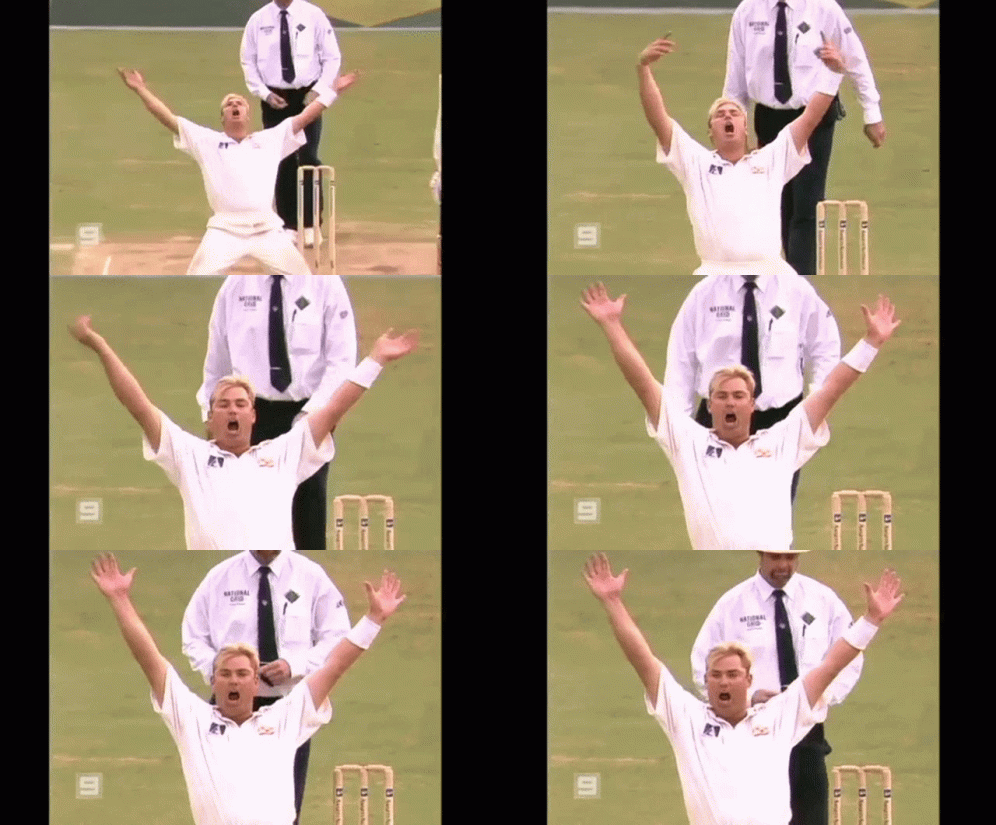
a man in a white shirt and tie is standing on a cricket field with his arms in the air . ALT: a man in a white shirt and tie is standing on a cricket field with his arms in the air .

Test match special back on whilst marking - must be summer!

11 months ago 5 0 0 0
Advertisement
Black tile with a quotation taken from the introduction to this Special Section on 'Rivers as Borders' by Kanesu, Lamb & McGrath (2025): "As dynamic, multidimensional moving environments, rivers are not suitable for rigidly defining and delimiting geographical space"

Black tile with a quotation taken from the introduction to this Special Section on 'Rivers as Borders' by Kanesu, Lamb & McGrath (2025): "As dynamic, multidimensional moving environments, rivers are not suitable for rigidly defining and delimiting geographical space"

Seven tiles on a black background listing the papers in this Special Section:
1) Rivers as borders? Navigating in-between the tensions of water-state-society geographies
Rebekka Kanesu, Vanessa Lamb & Eva McGrath
2) Median line: A century of border violence and the alluvial geopolitics of the Evros/Meric/Maritsa River border
Ifor Duncan & Stefanos Levidis
3) Slow violence on the Yarmouk River: Encounters form the river-border environments
Muna Dajani
4) Migrating sands: Refocusing transboundary flows from water to sediment
C.R. Hackney
5) Crossing riverborderscapes and a view from in-between: Passenger ferries in South West England
Eva McGrath, Richard Yarwood & Nichola Harmer
6) Liquid lines: Exploring the Moselle River between France, Luxembourg and Germany
Rebekka Kanesu
7) Caring for the river-border: Struggles and opportunities along the Salween River-border
Vanessa Lamb

Seven tiles on a black background listing the papers in this Special Section: 1) Rivers as borders? Navigating in-between the tensions of water-state-society geographies Rebekka Kanesu, Vanessa Lamb & Eva McGrath 2) Median line: A century of border violence and the alluvial geopolitics of the Evros/Meric/Maritsa River border Ifor Duncan & Stefanos Levidis 3) Slow violence on the Yarmouk River: Encounters form the river-border environments Muna Dajani 4) Migrating sands: Refocusing transboundary flows from water to sediment C.R. Hackney 5) Crossing riverborderscapes and a view from in-between: Passenger ferries in South West England Eva McGrath, Richard Yarwood & Nichola Harmer 6) Liquid lines: Exploring the Moselle River between France, Luxembourg and Germany Rebekka Kanesu 7) Caring for the river-border: Struggles and opportunities along the Salween River-border Vanessa Lamb

New Special Section in Area!

'Rivers as Borders', edited by Rebekka Kanesu, @drvanessalamb.bsky.social & Eva McGrath, features 6 #OpenAccess papers on river-borders from the Yarmouk and Salween to the Moselle and Torridge.

Read all papers here ⬇️
rgs-ibg.onlinelibrary.wiley.com/doi/toc/10.1... #geo

11 months ago 9 5 1 1
Preview
a man in a suit and tie is standing in front of a crowd . ALT: a man in a suit and tie is standing in front of a crowd .
11 months ago 2 0 0 0

Good good. Got to protect junior colleagues IP 😉

11 months ago 2 0 1 0

Shame you didn't see the no photos sign on the poster @geomorphicjosh.bsky.social

11 months ago 0 0 1 0
Preview
Vietnam Is Running Out of Sand to Fuel an Economic Boom A new crop of factories requires roads, and that means sand. To keep up, the country is importing from Cambodia on a massive scale

Booming factory growth in Vietnam is requiring more sand to be imported from its neighbours www.bloomberg.com/graphics/202...

11 months ago 1 2 0 0
Men mining sand by hand. This back breaking work, often undertaken by the world's poorest people, supplies the right consistency of sand needed to make concrete. Desert sand, for instance, is too smooth to be useful for building. Sand can be pounded into the right shape but that's an expensive process. So, instead, river beds, sea beds, estuaries, lake beds, are being dug for sand - harming wildlife, creating deeper water bodies more susceptible to algal blooms, & causing the erosion of banks, with the loss of people's homes & some of the world's finest farmland. This erosion encourages salt water ingress - making well water undrinkable.

Men mining sand by hand. This back breaking work, often undertaken by the world's poorest people, supplies the right consistency of sand needed to make concrete. Desert sand, for instance, is too smooth to be useful for building. Sand can be pounded into the right shape but that's an expensive process. So, instead, river beds, sea beds, estuaries, lake beds, are being dug for sand - harming wildlife, creating deeper water bodies more susceptible to algal blooms, & causing the erosion of banks, with the loss of people's homes & some of the world's finest farmland. This erosion encourages salt water ingress - making well water undrinkable.

As the world constructs ever more buildings, we're destabilising rivers, lakes, deltas & loughs to gather the sand we need for all that concrete. What harm are we causing? How can we reduce that harm? Can we use alternative materials in concrete or reduce the amount of concrete we use?

1 year ago 52 22 2 0
Preview
Malawi's women sand miners trapped in climate change dilemma | Context by TRF More women in Malawi turn to sand mining after drought, floods hit incomes but the practice makes land less resilient to disaster

'She mines sand at the Mwamphanzi River, even though she knows this makes the flooding worse.

"We don't have any other choice. Like today, I left early in the morning leaving children without even porridge"'.

The women mining sand to make our concrete:

www.context.news/socioeconomi...

1 year ago 49 37 2 2
Advertisement
Post image Post image

A beautiful morning setting up for today’s Young Coastal Scientists’ & Engineers’ Conference here at @newcastleuni.bsky.social Dove Marine Lab! We’re delighted to welcome 30 early career researchers and practitioners to our little corner of paradise!! @hassfacultyncl.bsky.social @sagencl.bsky.social

1 year ago 7 2 0 0
Flood hazard amplification by intra-event sediment transport Rivers are dynamic, with channel size and shape adapting to fluctuations in water and sediment supplied from their upstream catchments. These changes directly affect flood conveyance capacity, yet sed...

Interested in the role of sediment transport processes on increasing #flooding?

Our new preprint that systematically explores the role of #rainfall on amplifying flood hazard is out!

doi.org/10.21203/rs....

@floodskinner.games @drchrishackney.bsky.social Matt Perks & @bedforms.bsky.social

1 year ago 17 8 3 1
Preview
International Geomorphology Week: BSG Seminars - British Society of Geomorphology

Teams information shown on the advert & on our website www.geomorphology.org.uk/2025/02/19/i... @rgs-ibghe.bsky.social @rgs-ibgschools.bsky.social @rgsibg.bsky.social @hywelgriffiths.bsky.social @aockelford.bsky.social @sgrieve.bsky.social @drchrishackney.bsky.social @geomorphicjosh.bsky.social

1 year ago 7 4 0 0
Post image Post image

Next week we are hosting two talks to celebrate International Geomorphology week. Dr Lynda Yorke will discuss inclusive fieldwork in the geosciences on Wednesday. On Friday, Gwyn Nelson from the Wales Coastal Monitoring Centre will present a national approach to communicating coastal change.

1 year ago 6 3 1 1
Video

And so...after 13 years on short term contracts in academia, I can finally enjoy an open ended contract. Time to change the email signatures and social media handles #academia #science @newcastleuni.bsky.social

1 year ago 39 1 3 0
Video

And so...after 13 years on short term contracts in academia, I can finally enjoy an open ended contract. Time to change the email signatures and social media handles #academia #science @newcastleuni.bsky.social

1 year ago 39 1 3 0