I'm a bit late to this announcement but wanted to share that the newest issue of the JJS is now out! Very proud of the essays and book reviews inside. My coeditor Sabine Frühstück, the book review editor Jessamyn Abel, and our managing editors David and now Athena all did incredible work.
Posts by Morgan Pitelka
People study things that are not themselves. Crazy, I know.
New issue of the Journal of Japanese Studies is out! Highlights include articles on kanpu masatsu, war photography, empire paranoia, Italian-Japanese children's lit, Seidensticker’s style, and a bonus piece on Black Rain and ritual. Don’t miss it!
I was thrilled to work with Archaeology Magazine to help bring this story about Ichijōdani, the palace city from 16th-century Japan that I wrote about in _Reading Medieval Ruins_, come to life for their readers. Check it out! #archaeology #japan
Alexander Murphy won the 2024 Pyle Prize for his essay on rumor and radio in interwar Japan, praised for its innovative approach and concept of "paranoid listening."
Keisuke Yamada and Andrew Niess received an honorable mention for their essay on factory music and labor management in Japan.
Excited for the Centennial Meeting of the Medieval Academy of America, starting tomorrow! I present on the archeology of late medieval Kyoto on a panel titled "Moving Earth, Rivers, & Waves: Medieval Archaeology in Japan." Thanks to Jon Thumas, our organizer, & fellow presenter Michelle Damian!
For no particular reason, re-reading this article by Andrew Gordon and Michael Reich, "The Puzzle of Vaccine Hesitancy in Japan," from @jjs-jrnl.bsky.social (2021) 47 (2): 411–436: online.ucpress.edu/jjs/article-... (this is paywalled, so access through your university library if that's an option)
CFP for an edited collection: “Japanese Video Games and Critiques of the Western Aesthetic Tradition.” call-for-papers.sas.upenn.edu/cfp/2025/02/...
If interested, send abstract (300 words) & CV to DA Hall & Austin Anderson (japanesegamestudies@gmail.com) by 31 March 2025. Please share!
cover image of the journal of Japanese studies, volume 51, number 1, winter 2025
The newest issue of @jjs-jrnl.bsky.social is live, w/ amazing articles on Zen violence & calligraphy, transnational Japanese cuisine, Genroku commercial fiction, pan-Asianism & imperialism in pop culture, fascism in Kimi no na wa, & hospitality in imperial Japan. Plus must-read book reviews!
Hey Japanese studies friends: please follow the JJS here on BlueSky. Our new issue is now live!
Here at UNC-Chapel Hill, I have recently joined the Curriculum in Archaeology, which means I am affiliated with three different academic units. (Uh oh.) I'm excited to work with my new colleagues and students on global material culture, the history of ceramics, and medieval/historical archaeology.
Grateful for the MIT News covering the ongoing exhibit I’ve had the pleasure of curating:
news.mit.edu/2024/from-sa...
I implore historians #skystorians, if you’re making starter packs for historical topics or time periods, remember that most of the world exists outside of the US and Western Europe, and they don’t only exist in relation to or intersection with “the West.”
My book _Reading Medieval Ruins_ uses archaeological and archival materials to tell the story of daily life and destruction in a late medieval palace city. In Japan! I had hoped it would get more attention from European medievalists but it’s hard to reach beyond the Asian studies bubble.
The Journal of Japanese Studies is excited to announce that Coeditors Sabine Frühstück and Morgan Pitelka are now joined by Book Review Editor Jessamyn Abel from Penn State. The JJS is now published by UC Press; our new Managing Editor is David Staloch. Our new website is online.ucpress.edu/jjs/
I had the chance to talk to Marco Werman on The World about the historical accuracy of Shōgun in the wake of the show’s many Emmy awards: theworld.org/segments/202...
ok new list is here!
go.bsky.app/6TE7o75
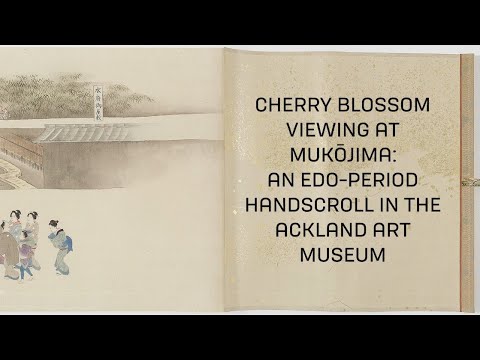
My lab had the wonderful opportunity to examine and study a late Edo-period handscroll in the collection of @AcklandArt over the past year. Our team included undergrads, PhD students, and scholars from Japan. Check out the video about our research! youtu.be/8Tq9WkyhNuA?...
Ooof, sorry. What viewers in Japan are used to hearing as authentic historical dialogue . . .
....as authentic historical dialogue based on Taiga drama, they became less interested and cut the whole conversation. I think the language used in the show is an entirely pragmatic compromise, a bit like using "Thee" and "Thou" and a British accent to signify "the past" in Anglophone dramas.
Interesting! In the interview I did, the main focus initially was on the supposed authenticity of the language. But when my comments were clearly dismissing any notion of historical authenticity, and instead emphasized that what Sanada had done was introduce some of what viewers in Japan (cont)
(Sorry my mind is on my books, obviously! “Read” in my comments above should be “watch.”)
Indeed, some viewers of this show have said that it is unrealistic, and it gets many things wrong based not on any kind of historical research but on watching Taiga dramas. TV genre and the historical past are thus fundamentally mistaken for one another and, perhaps we could say, misremembered.
The contrast with the historical epics that regularly appear on Japanese television is an interesting and an important one. Because those shows shape the understanding of history and indeed the historical imagination of viewers in ways that are sort of pernicious. Those are works of art too.
And I think it put something in the world that is useful for Japanese historians. But it’s hardly required reading. I will note that I have heard something similar to your reaction from some friends and colleagues in Japan, who have managed to see it.
Thanks for sharing your thoughts on the experience of trying to watch the series! I agree that if you don’t like it, you don’t need to read it. I’m not sure I like it either. But I did watch it because it connects so directly to my research and teaching.
Finally joining this side of social media! 👋 Special greetings to any fellow scholars in digital anthropology, Black Studies, and Japanese Studies!
My friend Hiromu Nagahara has curated a wonderful online exhibition about the first Japanese students at MIT. Check it out:
It sure is!
My book _Reading Medieval Ruins_ uses archaeological and archival materials to tell the story of daily life and destruction in a late medieval palace city. In Japan! I had hoped it would get more attention from European medievalists but it’s hard to reach beyond the Asian studies bubble.