Fun observation about computer speeds. Figure for my PhD required a 500 term sum evaluated at 1500 frequencies (750,000 calculations). In 1995 my NeXTstation Turbo (33MHz CPU) took 53 hours to generate the plot. Today my 2021 MacBook Pro laptop (Apple M1 chip) did it in 5 minutes.
Posts by Dan Russell (Dr. Batman)
photo of J.R.R. Tolkien at his desk . . . with the quote ". . . I was never obliged to teach anything except what I loved (and do) with an inextinguishable enthusiasm." -- J.R.R. Tolkien, Letter 250
Saw this quote from J.R.R. Tolkien posted somewhere a while ago . . . for the last 15 years as a Teaching Professor of Acoustics in the Graduate Program in Acoustics at Penn State, this has been true for me also.
Yup. I have a couple of things for that space that I just haven’t hung yet. 🤣
My campus office when I moved in (summer 2024) and now (spring 2026)
First torsional mode for a free-free bar
Third bending mode for a free-free bar
Second bending mode for a free-free bar
First bending mode for a free-free bar
I have a new M.S. student working with me - exploring vibroacoustic behavior of ping-pong paddles (including the new 7-sided STIGA Cybershape). He's learning how to do experimental modal analysis - some of the cleanest free-free bar data I've seen a new student collect.
#iTeachPhysics
Dan Russell pointing to a spectogram, explaining how the lines in the spectrogram represent the frequency content of my voice.
Dan Russell (with spectrogram in the background) explaining how the frequency content of my voice changes after filling my lungs (and vocal tract) with helium instead of air.
One of my graduate students is making a website with some useful interactive tools for teaching acoustics concepts . . . today in my undergrad Intro to Acoustics class, I used his online web-based spectrogram for a demonstration. What a useful tool!
www.acs.psu.edu/noahparker/a...
Better plot:
1st results of the Torpedo bat study by Lloyd Smith, @drussell@engr.psu.edu, and me. Measurements done at WSU Sports Science Lab and PSU. Will be presented at ISEA Conference in June. BBCOR, a surrogate for exit velocity, measured for Standard and 2 Torpedo bats via high-speed impact.
The last several times I have been asked to review manuscripts for a journal, I find myself having to play the role of Reviewer #2 => pointing out fatal flaws, potential plagiarism concerns, incorrect statements, insufficient literature cited. Sigh. I'd like to be Reviewer #1 sometime.
Robert Keolian's apparatus for demonstrating how the Basilar membrane works - the von Békésy "place theory of hearing".
Robert M. Keolian, "A demonstration apparatus of the cochlea," J. Acoust. Soc. Am., 101, 1199–1201 (1997).
youtu.be/MV-XbzLPijA?...
Paper 1-cent bill from Hong Kong in the 1970’s
Now that the U.S. is no longer making the 1-cent penny coin, I was reminded of these 1-cent paper bills we used to use in Hong Kong in the 1970’s.
I contacted Beth. AJP doesn't have paper records from 1998, and double blind review process prevents identifying reviewers. My LinkedIn post made its way to the 2nd author faculty advisor of student who plagiarized my work. He emailed me to apologize. Still don't know how they got those plots.
That's the only explanation I can think of. Back in 1998, there was no electronic submission. I mailed 4 paper copies to editor, who kept one and sent 3 out for review. I'm guessing one of the reviewers kept a copy? Was this author a reviewer? (unlikely), but perhaps saw a copy the reviewer had?
Holy plagiarism, Batman!
I just found a 2020 book chapter that plagiarized my data originally submitted (paper copies only!) to the American Journal of Physics in 1998 before the editor asked me to rotate the plots for publication.
How did these authors obtain my original unpublished plots?
Agreed. I also really prefer white for ambient. I wonder if BuVe is available as a color map option in the current version of Mathematica?
I have tried a Pink-White-Green colormap that also seems to work for most color-blind cases:
www.acs.psu.edu/drussell/Dem... (see the comparison at the bottom)
I need to spend more time here on your 🦋 pages looking through your new animations. These look really useful. I really hope you are able to gather your all amazing animations together on a website someday.
yes. I've started using a similar "cividis" color map for many of my animations for similar color-blind accessibility reasons -- but haven't had time to go back and re-create all of my animations that use RWB yet.
scan of two pages from "Wind Waves" by Kinsman showing a full-page footnote that describes several humorous anecdotes about the Bernoulli family history related to mathematics and fluid dynamics theory.
I've always been a huge fan of the extensive footnotes in Allan Pierce's "ACOUSTICS" textbook . . . but I've found a new favorite: "Wind Waves" by Blair Kinsman. His writing style is delightfully refreshing for a textbook, but this full-page footnote on the Bernoulli family history is amazing!
Those are awesome! I did the same thing (showing the oscillation paths and elliptical motion) for a couple of "particles" in the animations I created for my website in 2014:
www.acs.psu.edu/drussell/Dem...
I really like the RWB coloring addition to the "Sparrowgram" particle motion on yours.
Time for another fun movie trailer to entice interest in the first-year graduate course in Acoustics that I'll be teaching for the Graduate Program in Acoustics at Penn State in the Fall 2025 semester. Simultaneously offered online through our distance education program!
youtu.be/fKPA5HL76Ps?...
photo of Dan Russell (white male, approximately 30 years old, blond hair and glasses, wearing a red shirt) sitting to the right of a computer monitor.
photo of Dan Russell (white male, approximately 55 years old, gray hair, beard, and glasses, wearing a checkered shirt) standing to the left of a computer monitor.
30 years of making animations . . . I'm updating HTML code for my Acoustics and Vibration Animations website (for WCAG accessibility and HTML5) and found an archive of my original website from 25 years ago with a photo of me in my office at Kettering University.
www.acs.psu.edu/drussell/demos.html
Yessir.
Thanks! I learned that technique from Tom Rossing in 1990 while I was working on my MS with him.
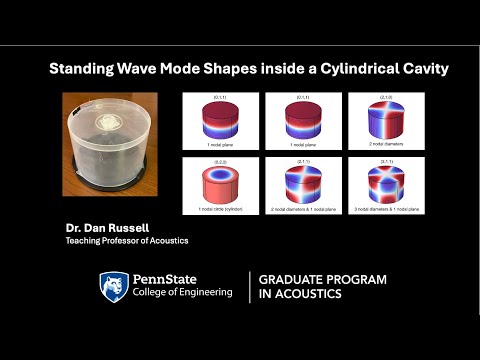
Brand new video demonstration . . . Standing Waves inside a Cylindrical Cavity. Finding nodal surfaces for acoustic standing wave mode shapes inside a cylinder with "rigid" walls -- a plastic CD container. #iteachphysics #acoustics
youtu.be/-4IqtGhWe2U?... via @YouTube
Except that this thesis explored computer models of hollow aluminum bats that were rigidly clamped at the handle which is completely wrong. So the results of her models are pretty much useless for predicting handle vibration in actual bats or sweet spot location.