Looking so much forwards to this (even if it means I may have to go by plane). I'll be speaking about letters to Santa, with the great @cerihoulbrook.bsky.social ! 🥳 #folklore #museumlife
1 day ago
8
3
1
0
Looking so much forwards to this (even if it means I may have to go by plane). I'll be speaking about letters to Santa, with the great @cerihoulbrook.bsky.social ! 🥳 #folklore #museumlife


Back in my favourite place in Manchester @porticolibrary.bsky.social for the TSF conference on Women and Folk Song this Saturday 😍

Listen now: Dr. Paul Robichaud explores how ancient monuments have been reimagined across the centuries in folklore, literature, art and popular culture with New Books Network
🔉 buff.ly/2eciBPl
📚 buff.ly/40Xse4B

Image of a monument of two curved shape stacks of stones, pulled apart to reveal a view of the sea beyond. To the right of the image, on an orange background, white text reads Community, Resistance and Resilience: Celebrating 50 years of The Making of the Crofting Community, Thursday 11 and Friday 12 June 2026, The Social Club Dornoch, £20/£40. Logo for UHI Centre for History in the bottom right hand corner.

Orange background with white text reads: Speakers include Thursday 11 June Andrew Mackillop, Gemma Smith, Iain MacKinnon, Mairi McFadyen and Raghnaid Sandilands, Interview with Jim Hunter. Friday 12 June Ewen Cameron, Ailsa Raeburn, Domhall Uilleam Stiubhart, David Taylor, Col Gordon. Logo for UHI Centre for History in the bottom right corner.
We are excited to share details on some of the speakers who will be delivering papers at our June conference, Community, Resistance and Resilience: Celebrating 50 years of 'The Making of the Crofting Community'! Tickets are available to purchase on Eventbrite, uhihistory.short.gy/HKxw0T

We were lucky enough to have Simon Bailes of Dunton Folk pop into our MA Folklore Studies workshop to talk about his work on wassails (that's him in the BBC picture mid-wassail). We're hoping that our own inaugural wassail will make it into his forthcoming book 🤞 www.bbc.co.uk/news/article...
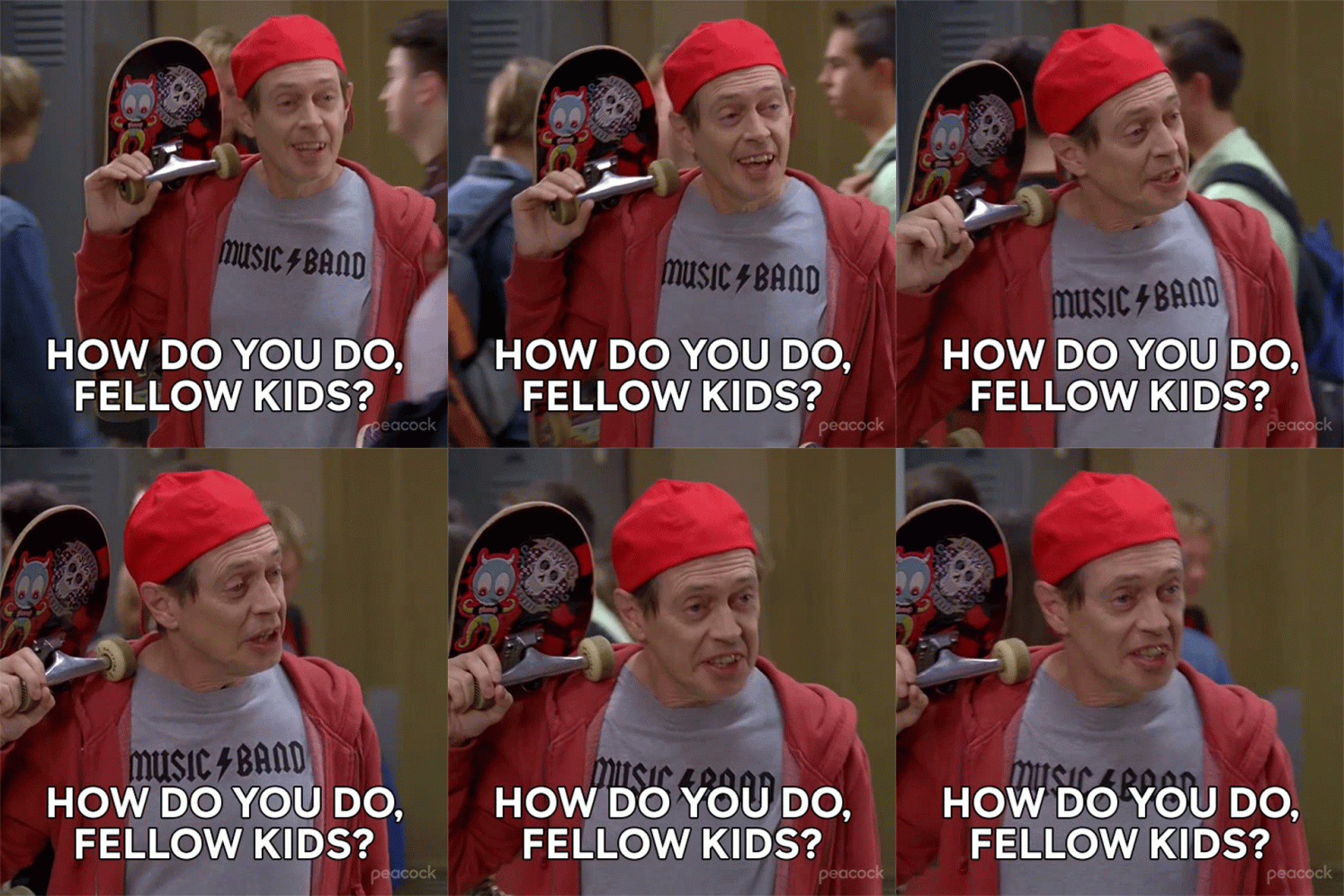
With Erasmus+ happening, this be me so I can can get back the lovely freedom of living and working in the EU that I enjoyed for decades...
With Erasmus+ happening, this be me so I can can get back the lovely freedom of living and working in the EU that I enjoyed for decades...

Looking forward to chairing the next @folkloresociety.bsky.social online seminar by Helen Frisby on 'Picturing the Dead: Spirit Photography'. Intrigued? Get your tickets here: www.eventbrite.co.uk/e/picturing-...

Our online talk WALKING THE WEIRDSTONE on Alan Garner and Archaeology, with @jpwarchaeology.bsky.social this Saturday at 8pm is so popular that it sold out.
So we extended the event capacity and made more tickets available!
Book now while you can at
www.eventbrite.co.uk/e/walking-th...

Photograph of the statue of Alice Nutter (woman wearing bonnet and period costume with her hands in chains)
The Pendle witches have long captured our imagination, but how do their stories play out in the landscape of rural Lancashire? Hannah Singleton investigates, in our Contemporary Legend themed issue of Revenant.

Dans ses illustrations d’astronomie, Lucien Rudaux (1874-1947) mettait magnifiquement en scène les paysages de l’espace. Ici, un coucher de Terre vu de la Lune, à comparer aux récentes photos de la Nasa !
🌚 Sur les autres mondes, 1937 c.bnf.fr/X6d
@julien-bobroff.bsky.social @ericlagadec.bsky.social

When Thomas Ellwood repeatedly flouted his father’s command in 1659 to stay away from the Quakers, his behaviour provoked bitter family quarrels and a beating, until his father eventually found a surprising solution: he confiscated all his son’s hats. Thomas became in effect a prisoner in the house, accepting that it would be unthinkable to go outside without a hat. However strange to us today, this made perfect sense to contemporaries, and such episodes remind us that the multifaceted conventions surrounding dress played an important role in early modern culture. When, where, and how hats were worn, and the gestures in which they featured, conveyed signals about identity and status, could sustain, display, or defy social hierarchies and relationships, and asserted political or religious loyalties.
📣Out now on #firstview
Bernard Capp @uni-of-warwick.bsky.social on 'The Cultural, Social, and Ideological Role of the Hat in Early Modern England'
#Hat #Identity #Social #Clothing #Religion #Family #History 17thc 🎩👒🗃️
👉Read open access: www.cambridge.org/core/journal...

Man Who Threw Molotov Cocktail At Sam Altman’s Home Claims He Was Following ChatGPT Recipe For Risotto
Man Who Threw Molotov Cocktail At Sam Altman’s Home Claims He Was Following ChatGPT Recipe For Risotto theonion.com/man-who-threw-molotov-co...

@richardhuzzey.bsky.social and @katrinanavickas.bsky.social offer some suggestions about how historians can reinvigorate and realign the study of politics at all levels in Britain and Ireland in the long nineteenth century. Read their #OpenAcess article here: onlinelibrary.wiley.com/doi/10.1111/...

30th October 1981 The Editor, The Unexplained Orbis House 20-22 Bedfordbury London WC2N 4BT Issue 55 'Under the Greenwood Tree Dear Sir, Having recently studied the article featuring the so-called 'weird' events in Clapham Woods, north of Steyning in West Sussex, my wife and myself decided, during a brief holiday, to visit the village and arrived there on Tuesday 27th October. We were lucky to meet Mr. John Cornford, the local farmer mentioned in the article, and learnt of the true nature of some of the incidents described by the young and perhaps gullible writers Hamish Howard and Toyne Newton. The body of the Revd. Neil Snelling was discovered in the Chestnuts' area only three weeks ago, a few feet from his normal route from Worthing. He had been prone to heart attacks for some time and presumably had suffered another on the day of his 'mysterious disappearance'. The horse which 'vanished was probably stolen by the same characters who purloined an oak table and some leaden pipes from the Church and as for the peculiar actions of dogs and the disappearnce of Mr. Cornfords' own collie, he suggested that a local game-keeper might be responsible. It is known that he was erecting an electrical fence to protect his pheasants from predators and certainly disliked dogs. Concerning the 'mysterious' crater, it might well have been caused by a bomb containing phosphorous, which would account for the lack of vegetation in the area, or if it were indeed caused by a small meteorite, then sulphur from it could also provide the answer, neither of which are causes for amazement'. As regards the photo of the goats head', it is of such a poor quality, the shape of the mist (what else) could be of anything. Reports of 'black shapes' and 'UFO's' are common these days, especially among the young, and certainly provide no cause for believing that Clapham Woods are any more peculiar than any others. May I trust that future articles are treated less sensationally and are a …
Andrew Green's letter to the Unexplained in October 1981 - about the "Weird Events" of Clapham Woods.
I believe it went unpublished.
I was very fond of Andrew. He was always Team Sceptic, and would gently chide me if he felt I was veering towards supernaturalism...

Journalists know that losing the Wayback Machine would be a nightmare: www.wired.com/story/the-in...
👋🏻

A major blow for the obscurely funded think tanks & private companies waging the right wing culture war in Britain too. Hopefully the Mathias Corvinus Collegium will be dismantled soon.
www.bbc.co.uk/news/live/c2...

Had a great day yesterday co-hosting the online Festival of Magical History with @witchesetc.bsky.social @magicnotwitches.bsky.social and @traceynormanauthor.bsky.social
Four more talks on witchcraft, Herne, Pan and ghosts today and still time to join us:
www.eventbrite.co.uk/e/festival-o...
Thank you!

Boramani Labyrinth: India's largest known ancient circular labyrinth, a 15-circuit stone structure measuring approximately 50 by 50 feet (15 by 15 metres) has been discovered in India.


A small part of the UFO magazines that I am filing. So much energy, curiosity, enthusiasm and action. These iamges are from the 1950s, 1960s and 1970s.
Why is Aylesbury the county town?

The variety of German bees before the Industrial Revolution (187, top) vs after the introduction of pesticides (43, bottom), DHM

Ghost postcard genre. A favourite from my collection - "It Appears...". 1930s.
Yep. Well said Jo. "Caliban and the Witch" set back public understanding of witchcraft several decades. It's a farago of a book when it comes to the witch trials.
Silvia Federici is one hundred percent wrong about the witch trials (not even a weak argument: her work is based on utter fantasy) and Caliban and the Witch has done incalculable damage to the discourse around this topic, especially in left-wing circles.


I'll be talking about 'These Isles: A People's History of England, Ireland, Scotland and Wales' at Sherburn & Villages U3A, North Yorkshire, on April 16th, 2pm. Eversley Park Centre, Sherburn in Elmet. All welcome, £1. www.sherburnu3a.org/home
Erm. Every Easter there is imagery confusion on here between hares and rabbits. Just saying.
Boosting again for those who’ve missed this call to action. Please submit a public comment before Easter if you can! You can do it at the link in the first post which has a script, or scroll down for the direct link to the Bureau of Land Management page.
