
6 hours ago
0
0
0
0
Posts by Alejandro Berrio Escobar
This work was supported by the National Institutes of Health NIH and to the National Science Foundation
We're grateful for the support that makes long term, data rich developmental biology possible.
#NIH #NSF #FundedScience #DevelopmentalBiology
11 hours ago
0
0
0
0
We'd love to hear what you discover in the data!
#SeaUrchin #WntSignaling #DevelopmentalBiology #GRN #ScienceCommunication
11 hours ago
0
0
1
0
We published this work in the journal @dev-journal.bsky.social
doi.org/10.1242/dev.20...
Want to explore the data yourself?
Check out our Shiny app for hourly scRNA-seq, interactive UMAPs, co-expression, trajectories:
urchinatlas.biology.duke.edu:3838
11 hours ago
1
0
2
0
Nodal isn’t just patterning, it’s a gatekeeper of developmental commitment.
And if you’re interested in GRN flexibility, see our earlier paper on embryonic transfating:
📜https://doi.org/10.1242/dev.203152
4 days ago
0
0
1
0
This may explain why Nodal was so important in our transfating paper.
When we manipulated nodal signaling, GRN states that are normally stabilized during development became plastic again, allowing cells to reprogram.
4 days ago
0
0
1
0

When the dance reaches the mouth, a new partner steps in: nodal.
Wnt1 enables anterior wnt8, and wnt8 both directly activates foxA (via β‑catenin/TCF) and induces nodal at the stomodeum.
Nodal then brings in gooscoid, which is required for foxA and brachyury
4 days ago
0
0
1
0

Despite all the apparent rings, there is only one truly sharp boundary:
Wnt1 outside the blastopore. Wnt6/7/16 inside.
Elsewhere, expression is graded and overlapping
4 days ago
0
0
1
0
Advertisement

🪩wnt1 KD fails to block the pattern of wnt1 expression
🪩wnt8 KD reduces but fails to block the pattern of wnt8 expression
🪩wnt7 KD inhibits foregut expression of wnt5 but has no effect on wnt5 expression in the ectoderm
🪩wnt5 KD reduces foregut-midgut expression of wnt7
4 days ago
0
0
1
0

And the dancers cue each other.
Wnts don’t just pattern tissues, they regulate other Wnts. We tested this by perturbing Wnts with morpholinos and RNAi
4 days ago
0
0
1
0

Indeed, there is not one signal at a time.
Our temporal scRNA‑seq showed that many cells co‑express multiple Wnts simultaneously, and that co‑expression changes over time. #scRNAseq #bioinformatics
4 days ago
0
0
1
0

Inside the Wnt1 ring, the choreography calls a figure switch.
At the blastopore, cells momentarily express Wnt6, Wnt7, and Wnt16.
Crossing into the archenteron, they cast off Wnt6 and Wnt16 but retain Wnt7, making moves to the next figure in the GRN.
4 days ago
0
0
1
0

Before gastrulation, the Wnt1 ring expands outward as neighboring cells activate it and inner cells extinguish it.
During gastrulation, the ring shrinks, tracking the blastopore as Veg1 cells converge, express Wnt1, then turn it off inside
#gastrulation
4 days ago
0
0
1
0
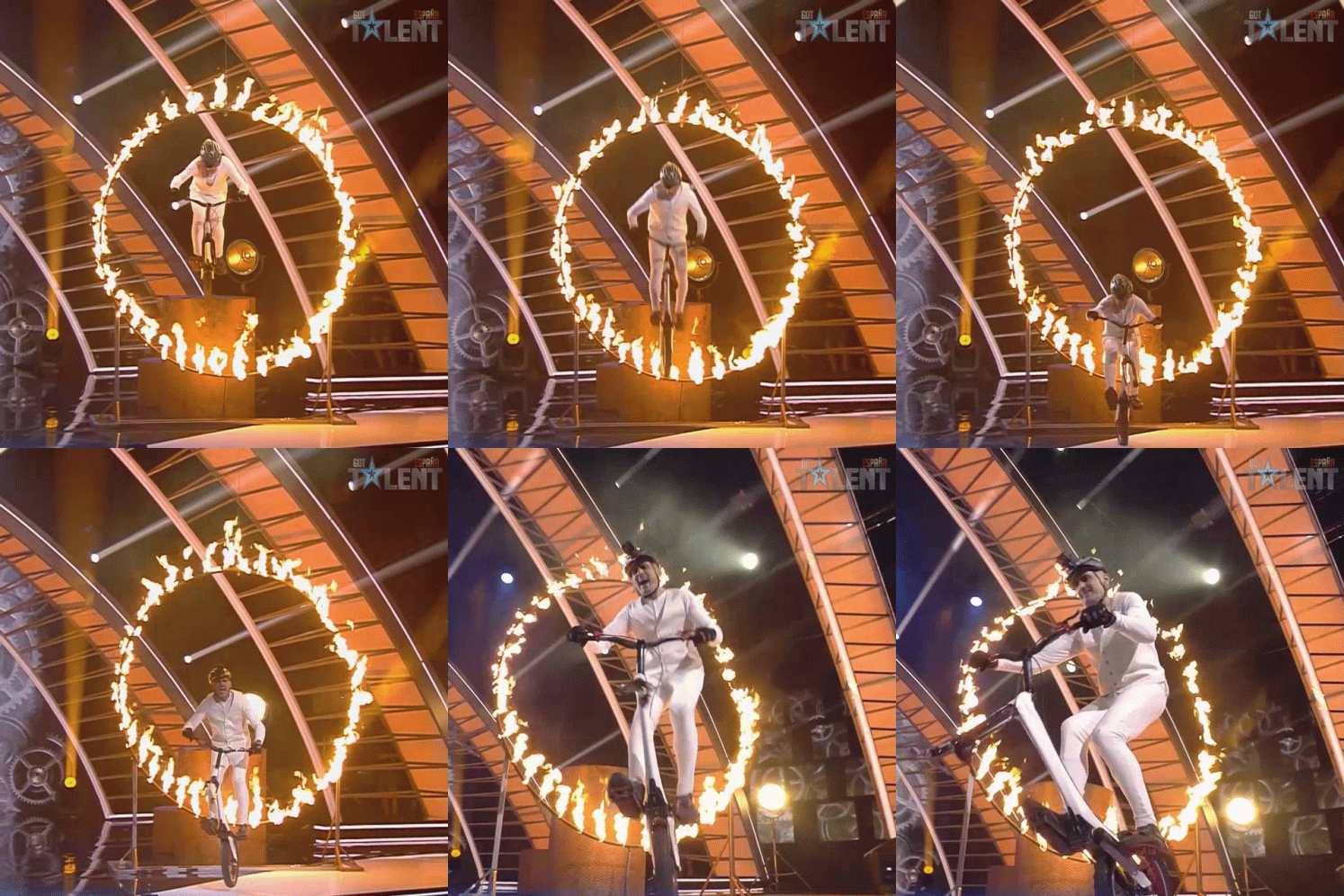
At start, one ring takes the lead. Wnt1 forms the sharpest boundary just outside the blastopore and every endoderm cell expresses it briefly before entering the gut. This is the embryo’s Ring of Fire.
You pass through once, and you don’t come out the same.
#Morphogenesis
4 days ago
0
0
1
0

We used multiplex HCR‑FISH, and mapped six Wnts (Wnt1, 5, 6, 7, 8, 16) across developmental stages.
Each gene turns on at a different time, then appears sequentially in neighboring cells, producing rings of expression around the blastopore. #HCR #FISH
4 days ago
1
0
1
0

During gastrulation, cells don’t just change position they change state.
As endoderm cells move toward and through the blastopore, the signals they receive change over time, advancing their gene regulatory networks (GRNs) step by step. #GRN #WntSignaling
4 days ago
0
0
1
0

It takes two to tango but gastrulation is a contra dance
Cells move through changing partners and signals, and many Wnts act together to keep the choreography coordinated in space and time.
That’s the core idea behind our new paper on gut formation in #seaurchins 🧵
4 days ago
3
1
1
1

Before gastrulation, the Wnt1 ring expands outward as neighboring cells activate it and inner cells extinguish it.
During gastrulation, the ring shrinks, tracking the blastopore as Veg1 cells converge, express Wnt1, then turn it off inside
4 days ago
0
0
0
0
Advertisement
The first ring leads the way. Wnt1 forms the sharpest boundary and every endoderm cell expresses it briefly before entering the gut
This is the embryo’s Ring of Fire. You pass through once and you don’t come out the same.
4 days ago
0
0
1
0
We used multiplex HCR‑FISH, and mapped six Wnts (Wnt1, 5, 6, 7, 8, 16) across development.
Each gene turns on at a different time, then appears sequentially in neighboring cells, producing rings of expression around the blastopore.
4 days ago
1
0
1
0
During gastrulation, cells don’t just change position, they change state.
As endoderm cells move toward and through the blastopore, the signals they receive change over time, advancing their gene regulatory networks (GRNs) step by step.
4 days ago
0
0
1
0
Here at #DBSUMI2025 and excited about the new methodologies coming to the community. Automated HCRs, so cool and necessary to screen many genes in parallel
1 year ago
0
0
0
0

A very appropriate citation report email I got today. Happy Valentine's y'all.
1 year ago
2
0
0
0

Time-lapsed video of the first cleavage in a Heliocidaris erythrogramma embryo. Taken in my last research trip to Australia.
1 year ago
0
0
0
0

The best howls are critically endangered Red Wolf howls 🐺
1 year ago
1814
271
24
18

Dreaming of a world where every wolf is respected 🐺
1 year ago
2229
281
17
13

Best PPE gift from my bestie at work!
1 year ago
1
0
0
0
I'll be sharing my passion for sea urchins, science, bicycles, cheese, baking, nature, and standing up against narcissistic personalities from any side in the political compass. For them, I'll be nothing but gray rocks 🪨 and 🙄
1 year ago
0
0
0
0
Advertisement

Lone wolf and gravel bike in a french beach full of sea urchins, ai generated
1 year ago
0
0
0
0