[New Paper] Provides the first description of cold seep fauna in the Sea of Japan, revealing just a few species living in very cold water. We also found a new snail species -- named Provanna cocytus after the icy hell in Dante's "Divine Comedy"!
OPEN ACCESS: onlinelibrary.wiley.com/doi/10.1155/...
1 month ago
20
7
1
2

A graphic with text that says where are you sitting for your flight? There are four rows of blue seats filled with animals and plants from the Monterey Bay
You’ve got a 5-hour flight over the holidays with some fronds from the Monterey Bay Aquarium. Who’re you sitting next to? 🦦🦀🦈🪱
Let us know in the comments below!
4 months ago
490
106
136
85
This has made working on expansions for Finspan so difficult. #finspan
4 months ago
19
4
3
0

Why do we see so few squid in the abyss? Because they hide from us, pretending to be sponges!🦑 New paper by @alemejiasaenz.bsky.social captures a potential new whiplash-squid species that burrows between nodules at the #CCZ, world's largest region targeted for #deepseamining doi.org/10.1002/ecy....
4 months ago
27
9
0
2

Three-dimensional management needs of deep-sea hydrothermal vent ecosystems
Deep-sea hydrothermal vents form small, unique, and fragile ecosystems that are widely recognized as sites in need of protection. Deep-seabed mining (…
On the 3-D mgmt needs of deepsea hydrothermal vent ecosystems, where science supports protection of subseafloor, seafloor, AND water column, intl law supports global protection of all active vents, BUT current protection from #deepseamining insufficient.
www.sciencedirect.com/science/arti...
🌊 🦑 ⚒️
4 months ago
20
4
0
0
wake up babe, new taningia observation dropped
one of my faves, great piloting by the ROV folks at @schmidtocean.bsky.social
4 months ago
21
7
0
0
Advertisement

Have a great weekend everyone 😁
8 months ago
4
1
0
0

The hexagonal fossil on stone.
Take the case of paleodictyon. One of my favourite deep-sea mysteries. *Something* creates these hexagonal traces. Below is a trace fossil (a fossil imprint left behind by the activity of an organism).
📷Falconaumanni
10 months ago
56
12
1
2
My first paper is out! 🥳🐠🐟
11 months ago
21
12
1
0
True Facts: How A Species Gets A Name!
YouTube video by Ze Frank
Masterful outreach strategy by @oceanspecies.bsky.social to get @zefrank.bsky.social on (the advisory) board! #taxonomy m.youtube.com/watch?v=yn7k...
1 year ago
2
2
1
0


Interested in the #DeepSea and/or #IndianOcean?
Check out our new review of the Indian Ocean’s diverse deep-sea ecosystems 🌊
Feat. straightforward knowledge summaries, cool maps & awesome deep-sea critters
👉 doi.org/10.1016/j.sc...
1 year ago
13
5
1
0
🌊 Deepness alert! 🌊 Join the launching of EMB’s Future Science Brief. It highlights the need to expand our knowledge on the largest biome of our 🌍 and how science, global cooperation and policy engagement are crucial to ensure its sustainability. #FutureOcean #OceanGovernance #DeepOceanExploration
1 year ago
7
1
0
0

Stared too long into the abyss. Now the abyss wants snacks.
1 year ago
2
1
0
0

A new study led by NOC has revealed the long-term impacts and first signs of biological recovery in deep-sea mining tracks, 44-years after deep-sea trials in the Pacific Ocean. 🔍
Learn more about the long term impacts of the trials on our website 📰 noc.ac.uk/news/new-stu...
1 year ago
71
23
3
2
Advertisement
Deep-Sea Ecosystems
Attention UK researchers interested in the deep ocean - if you haven't already done so, please join the Challenger Society Deep-Sea Ecosystems Group (www.challenger-society.org.uk/DeepSea_Ecos...)
1 year ago
1
2
1
0

VOTE NOW! Mollusc of the Year 2025
Arctica islandica - world’s oldest mollusc
Cellana exarata - Hawaiian limpet
Glaucus atlanticus - blue dragon
Muusoctopus sp. - Dorado Octopus
Xenophora conchyliophora - shell / collector
YOU decide - we do its genome
moty.senckenberg.science
@cgreve.bsky.social
1 year ago
69
40
3
10
Will wonders ever cease? Crocheted coral on display in our halls!
1 year ago
40
8
2
0

The scaly-foot snail doesn’t bow to pressure—it thrives under it. Living in toxic hydrothermal vents, it armors itself with iron, turning the very forces that should destroy it into protection. That’s how you resist oppression—adapt, fortify, and endure. 🐌🔥 #MolluscMonday #Resist
1 year ago
181
48
6
7

A deep-sea researcher is standing outside on the deck of a boat, smiling in a green hardhat, rain gear and blue latex gloves. She has a sea star laying in her outstretched palm. The deck of the ship is a dark green, and you can see the ocean on the horizon. Photographer credits: Morgan Trimble, PhD.
Hey members!
Did you know? #DSBSoc launched an online mentoring network for #DeepSea scientists in 2018!
There are 10 groups worldwide, each with 2 senior & 4-6 early-career researchers. Meetings are usually monthly or bimonthly, covering career advice, paper writing, work-life balance & more.
1 year ago
20
7
2
0

And that’s a wrap on my last day at @noc.ac.uk! I’m truly going to miss working there and collaborating with such amazing colleagues. Grateful for all the great science we accomplished together—excited for our upcoming publications! 🦑🦐🧽🪨
1 year ago
2
0
0
0

Chondrocladia sp. (Carnivorous sponges) – When the system refuses to feed you, you adapt. These sponges don’t rely on passive filtration like their kin—they snare and digest prey directly. Fascism thrives on controlling resources. Some revolutionaries build alternatives. Photo from MBARI.
1 year ago
77
20
3
1

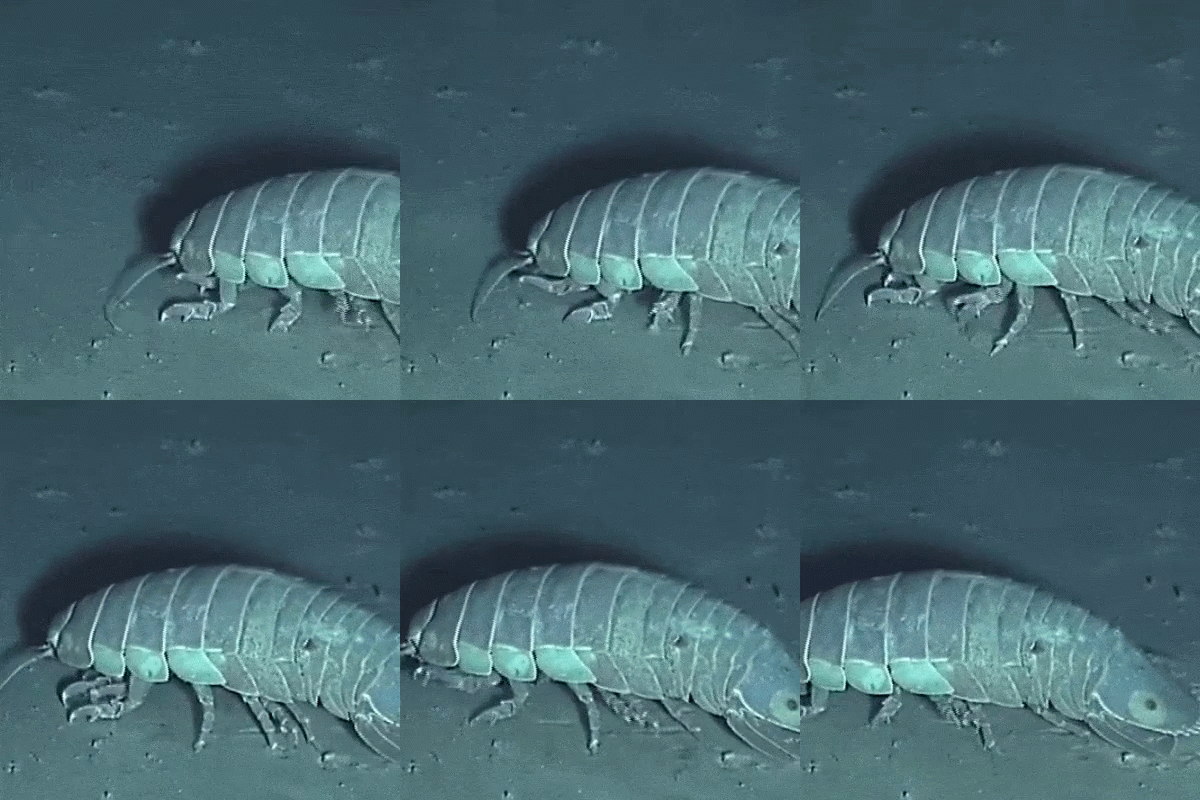
a large bug is crawling on the ground in the dark
ALT: a large bug is crawling on the ground in the dark
Giant isopods (Bathynomus giganteus) – Slow-moving but unstoppable, they scavenge and recycle, ensuring nothing goes to waste. The revolution will be efficient. 🌊🦐 #DeepSea #Ecology
1 year ago
78
6
1
3
Advertisement

I love seafood and federal science.
1 year ago
402
79
6
2

A pile of simply drawn cuttlefish of many colors, lying on and embracing each other. Their eyes are closed and they look happy.
Cuttlefish cuddle pile! Thank you!!
1 year ago
52
13
1
0
If you want to read more about the #jellyfish -hugging deep-sea #octopus, here is the original paper:
🧪🌊🦑
www.nature.com/articles/sre...
1 year ago
93
26
0
0
gorgeous!! Here's the model Barbie Pig
1 year ago
75
25
1
3