#PersonalCausation
#Importance
Personal causation can be strengthened by a range of strategies & interventions.
Social interventions can 'enhance mental well-being via their positive effects on self-efficacy and self-esteem'
(Rippon et al, 2024, p721)
#PersonalCausation
#PersonalCausation
#Importance
Personal Causation is related to self-esteem, health & well-being.
The World Health Organisation's definition of mental health (2022) starts by saying it is, 'A state of well-being in which the individual realizes his or her own abilities ...'
#PersonalCausation
#Importance
Personal Causation supports motivation to master tasks and improve competence.
Realistic judgements motivate people to persist in the face of obstacles (Bandura, 1982) & avoid costly mistakes (Carter & Dunning, 2008)
#PersonalCausation
#Importance
Personal Causation contributes to hope and a more optimistic identity.
Hope centres on specific goals while optimism is more generalised, and both are associated with well-being (Gallagher & Lopez 2009)
Cover of the Remotivation Process manual
Cover of the Volitional Questionnaire manual
#PersonalCausation
#Importance
Gage et al (1994) noted a discrepancy between a person's performance in #OccupationalTherapy & real life.
They were concerned self-efficacy was not fully understood or assessed in OT.
#MOHO's Remotivation Process & Volitional Questionnaire can rectify this situation
#PersonalCausation
#Research
Optimism influences a person's expectations when they believe they have little control over a situation. Hope influences a person's expectations when they believe they have more control.
- Shanahan et al.,2020
#PersonalCausation
#Research
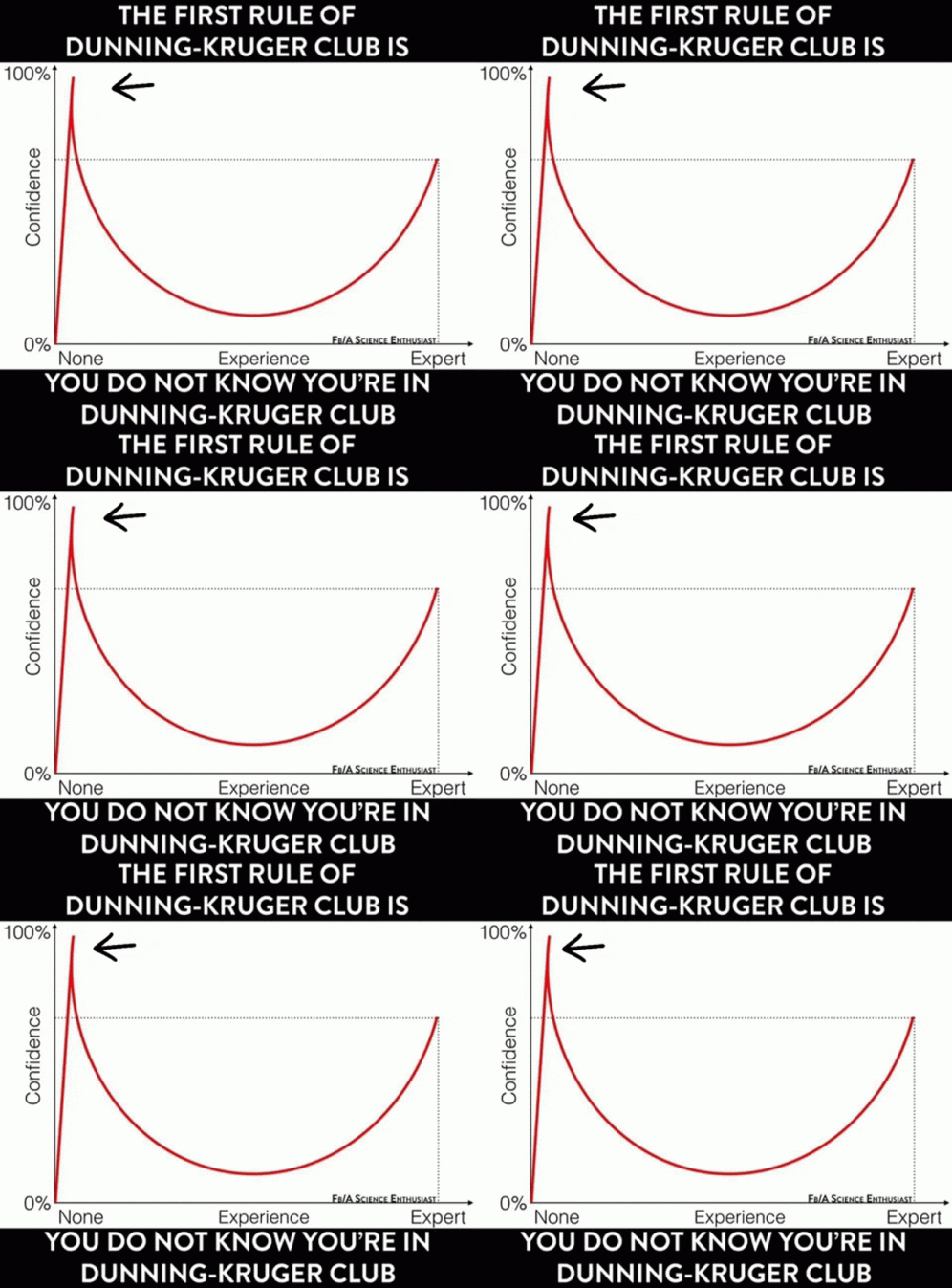
Kruger and Dunning (1999) found that students in the 12th percentile for tests of logic, grammar and humour overestimated their ability to such an extent that they estimated themselves to be in the 62nd percentile.
#DunningKrugerEffect
#PersonalCausation
#Research
Zhang et al (2019) investigated why people fail to enact their healthy intentions and confirmed the importance of self-efficacy at the motivational phase (expectations of outcomes, action self-efficacy & risk) and volitional phase (recovery self-efficacy & planning)
#PersonalCausation
#Research
Students with higher self-efficacy are more likely to adopt mastery goals (focused on personal improvement and learning new skills) than performance goals (focused on achieving a certain standard).
- Babenko & Oswald, 2019
#PersonalCausation
#Research
Children developed #SelfEfficacy in self-directed learning when short-term (proximal) sub-goals were set. Longer-term (distal) goals had no effect on their mastery.
-Bandura, 1982.
#PersonalCausation
Sell-Determination Theory 'recognizes and researches the "dark sides"of human motivation, and our vulnerabilities to being passive, controlled, defensive, dysregulated and antisocial'
Ryan et al., 2023
#PersonalCausation
'individuals play a very agentic role in co-constructing with others beliefs about what they are good at ... This can be done through ... actively seeking out particular experiences'
Eccles, 2009.
#PersonalCausation
' #Agency is a universal human attribute, but it presents an important sociological puzzle of why people so rarely exercise this existential freedom ... we make decisions based on reflection and the internalization of our social realities'
Hitlin & Elder, 2007
#PersonalCausation
#Agency
'self agency is central to Bandura's sociocognitive theory of self-efficacy, which views people as agentic, self-reflecting, self-regulating, creative and proactive'
Gecas, 2003
#PersonalCausation
'Debates over the nature of #agency remain quite abstract' - Hitlin & Elder, 2007.
'significant research in a number of disciplines centers on the concept of the sense of #agency. ...[M]any of these studies cut across disciplinary lines' - Gallagher, 2012.
#PersonalCausation
'Whereas #OutcomeExpectancies refer to the perceptions of a behaviour (eg better health ...), #self-efficacy refers to personal control over the execution of the behaviour. Both ... predict health behaviours well'
(Warner and Schwarzer, 2020)
#PersonalCausation
'social cognitive theory is founded on an agentic perspective to human self-development, adaptation and change. ... This theory specifies 4 core features of human agency, which include intentionality, forethought, self-reactiveness and self-reflectiveness' (Bandura & Locke, 2003)
#PersonalCausation
'Whatever other factors serve as guides & motivators, they are rooted in a core belief that one has the power to produce desired effects ... Self-Efficacy beliefs regulate human functioning through cognitive, motivational, affective & decisional processes' (Bandura & Locke, 2003).
#PersonalCausation
Judgements of self-efficacy, whether accurate or not, are based on observing other people, social feedback, our physiological capacity and - most importantly - how well we perform tasks, activities and occupations (Bandura, 1982)
#MOHO retains the term #PersonalCausation (DeCharms 1968) but many more general terms have been used by others, inc: self-confidence; self-awareness: self-motive; self-esteem.
#MOHO distinguishes between #PersonalCausation & the subjective element of performance capacity.
The former 'refers to the cognitive awareness of one's ability'. The latter 'is what a person feels or experiences in the midst of the actual moment of doing' (Taylor, 2018).
#PersonalCausation
#MOHO
Both our sense of capacity and self-efficacy' may change over time based on new experiences and encounters and the various occupations we engage in (Lee and Kielhofner, 2024).
#PersonalCausation in #MOHO involves two components called 'sense of personal capacity' and self-efficacy' in the textbook (eds. Taylor et al., 2024) or 'appraisal of ability' and 'expectation of success' in the MOHO Screening Tool (Parkinson et al., 2006)
#PersonalCausation
DeCharms (1968) rejected the idea that we have power to 'cause' our own behaviour. Instead, the process of 'causation' means using the personal knowledge we have of ourselves to initiate behaviour with the intention of producing a change in our environment.
#PersonalCausation
Let's start with #MOHO which notes that we discover how we can make things happen from a very early age. We grow in experience over the years and discover what we are capable of doing and how effective our actions can be.
#PersonalCausation
#SenseOfCapacity
#SenseOfEfficacy
Yesterday was a good day for my literature search. Thanks for the reposts.
I think I've made some progress.
... Now, I just have to try and make sense of what I've found.
#PersonalCausation
#SenseOfCapacity
#SenseOfEfficacy
One more question:
It looks like there's a lot of theory but not a lot of research regarding the importance of the above concepts for mental health - do you know of any relevant research? If so, please let me know.
#PersonalCausation
#SenseOfCapacity
#SenseOfEfficacy
There are so many related terms: self-efficacy; agency; hope; expectation of success: appraisal of ability; self-awareness.
If anyone knows of a text that critiques or makes sense of the terminology, please let me know!
#PersonalCausation
#SenseOfCapacity
#SenseOfEfficacy
My literature search (searching for personal causation beyond #MOHO ) is getting a bit muddled so if anyone has some good recommendations, I'd love to hear from you.
#PersonalCausation
#SenseOfCapacity
#SenseOfEfficacy
I have a feeling that this might be the toughest #MOHO concept to explore.
Wish me luck!