Advertisement · 728 × 90
#
Hashtag
#biocollections
Advertisement · 728 × 90
Video

Some snippets of the displays we created for our Spook-tober Tours!

Look forward to more events to come! We are so grateful for your eagerness and enthusiasm with this debut!

#asubiocollections #spooktobertours #biocollections #naturalhistorycollections #spooktober #insects #vertebrates #lichens

0 0 0 0
Video

Some snippets of the displays we created for our Spook-tober Tours!

Look forward to more events to come! We are so grateful for your eagerness and enthusiasm with this debut!

#asubiocollections #spooktobertours #biocollections #naturalhistorycollections #spooktober #insects #vertebrates #lichens

0 0 0 0
Post image

Yeah! New @bioeconomyscience.bsky.social logo, which compliments our Brahms database for #BioCollections perfectly. 🎉🧪

2 1 0 0
Post image

Just updated @bioeconomyscience.bsky.social's National Forestry Herbarium data on GBIF! 🌿
Fresh records for researchers, conservationists & biodiversity enthusiasts. Explore the richness of our collections to unlock new insights and create impact.
#BioCollections #GBIF #Herbarium #BiodiversityData

4 1 0 0
Index - BRAHMS Online NZFRI specimens

Leveraging the BRAHMS database at the National Forestry Herbarium @scionresearch.bsky.social boosts efficiency in managing #BioCollections. Linking duplicates to a single event streamlines data and reduces redundancy. This integration leads to more reliable data and improved research outcomes. 🌿📊🧪

0 0 0 0
Preview
Millions of ‘cloud trees’ are being planted in the Andes | CNN Constantino Aucca Chutas is leading a group of conservationists on mission to restore forests of the world’s highest-altitude trees.

I wonder how Polylepis (Rosaceae) fairs at lower altitudes? It seems like a must for keen gardeners. I did a quick search of Scion's #BioCollections, we have a wood sample of Polylepis incana Kunth in the National Forestry Xylarium.

1 0 0 0
BRAHMS: Software for Natural History Management BRAHMS is database software for managing taxonomy, botanic gardens, seed banks and museum collections including herbaria, entomology collections and fossils.

Putting Brahms to good use. One #BioCollections database for plants, fungi and insects at New Zealand Forest Research Institute.

1 0 0 0
Post image

My new favourite from #NationalForestryHerbarium. Echium plantagineum, commonly known as Paterson's curse, indigenous to Eurasia and northern Africa. Earliest collection in NZ from 1893. Farmers hate them, bee keepers love them. #BioCollections

3 1 0 0
Post image

Wahoo! #BioCollections data refresh from National Forestry Herbarium @ Scion Research supplied to Australasian Virtual Herbarium. See biocache.ala.org.au/occurrences/...

0 0 0 0

New Zealand's Science System Advisory Group online news page last updated in April 2024. I worry about the future of #BioCollections in this country.

1 0 0 0

I always wondered if there was a critical mass that would "guarantee" the survival of a #herbarium. Going on by what is happening to the Duke Herbarium, perhaps 1 million plus species is the magic number? What about other #BioCollections?

1 0 1 0
Preview
Global beta-diversity of angiosperm trees is shaped by Quaternary climate change Quaternary climate change reduced and homogenized angiosperm tree diversity across large landscapes worldwide.

“Small in size, mighty in impact." Every institution, no matter its scale, is a vital cog in the grand machinery of scientific progress. Stoked to see #BioCollections data from the National Forestry Herbarium at Scion contributing to this study.

4 0 0 0
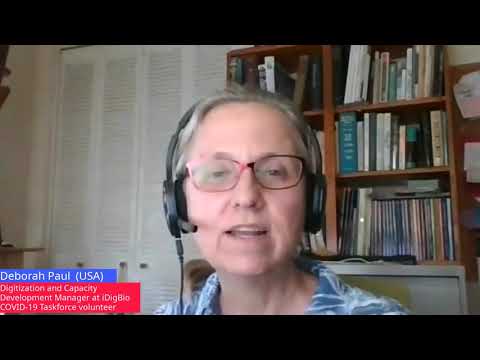
Covid-19 TaF experience #3: A silver lining for new multidisciplinary relationships
Covid-19 TaF experience #3: A silver lining for new multidisciplinary relationships Deborah Paul (Florida State University) is working as Digitization and Capacity Development Manager at iDigBio (Integrated Digitized Biocollections: the National Resource for Advancing Digitization of Biodiversity Collections (ADBC) funded by the National Science Foundation). (https://www.idigbio.org/). She is one of the 61 volunteer experts that formed the CETAF/DISSCO COVID-19 Task Force meeting every Friday since the very beginning of April. Their objectives: to share expertise and knowledge and undertake tangible actions towards the understanding, monitoring and prevention of viral outbreaks. Meet her, together with all the participants of the Task Force during our public event on Friday 17 July at 2 pm CEST ! Where? https://bit.ly/3ebGRoL (zoom) The event will be introduced by Dr Pam Soltis (curator of Molecular Systematics & Evolutionary Genetics at the Florida Museum of Natural History at the University of Florida. and Director for Research Activities for iDigBio) that will give us the context and challenges of such initiative. This will be followed by presentations by the 4 Activity leaders who will share their work. Following the presentations, you will have the opportunity to engage with the COVID-19 Task Force volunteers and all the rest of participants. The community of scientists linked to natural sciences collections represent a strong community that has created over decades a powerful knowledge-base that can be instrumental to understand the origin and causes of zoonotic infectious diseases as well as the processes and mechanisms that should be put in place to complement the efforts made in other disciplines, as biomedical sciences. Researchers from collections-linked organizations from all over the world have joined forces around the COVID-19 TaF and are willing to contribute to give a scientific-led response to the pandemic with a two-folded objective: 1) To identify the areas and topics to which we can contribute as to find the treatments, drugs and vaccines necessary faster and more effectively; 2) to anticipate and prevent the occurrence and propagation of a health crisis as the one our world is currently facing caused by SAS-CoV-2.a Do you want to learn more about the COVID-19 initiative? Take a read here: https://cetaf.org/covid19-taf-communities-taking-action Contact: info@cetaf.org

How #biocollections and related #publicationdata can highlight current & future #pathogen relationships & #zoonotic pathogen emergence? Meet @idbdeb, one of the dedicated experts of the #eurotaxonomy @DiSSCoEU #COVID19 Task Force, sharing her experience:

youtu.be/n_Q5IIMruxo

0 0 0 0