Advertisement · 728 × 90
#
Hashtag
#peptide2drug
Advertisement · 728 × 90
Post image

This Thursday, I will present @UNSWBABS our research on #MachineLearning guided peptide design and how we monitor existing #bias in biological data and tackle it to develop more informed ML/DL models. #XAI #AMR #peptide2drug

0 0 0 0
Frontiers | Antimicrobial peptides in livestock: a review with a one health approach Antimicrobial peptides (AMPs), often referred to as nature’s antibiotics, are ubiquitous in living organisms, spanning from bacteria to humans. Their potency...

With @OscarRoblz, @osunasquare and Dra. Carolina Barrientos Salcedo, we reviewed the applications of AMPs in livestock #peptide2drug #AMR #OneHealth #FoodSecurity - finally out @FrontiersIn Cellular and Infection Microbiology - check out

doi.org/10.3389/fcimb.…

0 0 0 0
Responsible AI x Biodesign Community Statement on the Responsible Development of AI for Protein Design

I am proud to have signed thecommunity statement and initiated @UWproteindesign on Community Values, Guiding Principles, and Commitments for the Responsible Development of AI for Protein Design. #peptide2drug #responsibleAI #biodesign #ethicaltech

responsiblebiodesign.ai

0 0 0 0

- Structure-specific models outperform parent models - - Structure-agnostic models (using data reduction) lead to information loss.

#artificialintelligence #peptide2drug #explainableai
#alphafold #AMR
(3/3)

0 0 0 0

Applying #AI #MachineLearning for #peptide2drug, you have a few more days to submit your articles to our research topic in Frontiers in Drug Discovery. Visit

frontiersin.org/research-topic…

0 0 0 0
Accelerating the Discovery and Design of Antimicrobial Peptides with A Peptides modulate many processes of human physiology targeting ion channels, protein receptors, or enzymes. They represent valuable starting points for the development of new biologics against communicable and non-communicable disorders. However, turning native...

Happy Monday! @sakmae @lncancelarich @marielamarani @delafuenteupenn Our book chapter "Accelerating the Discovery and Design of Antimicrobial Peptides with Artificial Intelligence" is finally out. #AMR #MachineLearning #peptide2drug Read more at

doi.org/10.1007/978-1-…

0 0 0 0
Mapping the structure–activity landscape of non-canonical peptides with MAP4 fingerprinting Peptide structure–activity/property relationship (P-SA/PR) studies focus on understanding how the structural variations of peptides influence their biological activities and other functional properties. This knowledge accelerates the rational design and optimisation of peptide-based drugs, biomaterials, or d

Excellent collaboration with @difacquim @EdgarLpezLpez10 & @OscarRoblz on "mapping the structure-activity landscape of peptides with non-canonical residues" #peptide2drug #MRSA #dataviz

doi.org/10.1039/D3DD00…

0 0 0 0
Post image

With the goal to develop #MachineLearning models to design cell-selective anticancer peptides, this study explores the potency and selectivity of 138 mACPs towards 77 cancer cell lines using pIC50 values. #peptide2drug

0 0 1 0
Deconstructing the potency and cell-line selectivity of membranolytic anticancer peptides Current cancer treatments damage healthy cells and tissues, causing short-term and long-term side effects. New treatments are desired that show greater selectivity toward cancer cells and evade the common mechanisms of multidrug resistance. Membranolytic anticancer peptides (mACPs) hold promise against cancer and multidrug resistance. The amphipathicity, hydrophobicity, and net charge of mACPs are all known to play a role in their respective interactions with cell membranes and the overall biological inhibition of cancer cells, but they are insufficient to explain their cell-line selectivity. To support the design of cell-line selective mACPs, we investigated the relationships that peptide features (amino acid composition, physicochemical properties, sequence motifs and sequence homology) could have with their potency and selectivity towards several healthy and cancer cell lines. Hydrophobicity, net charge and the presence of small and aliphatic residues influenced the potency and selectivity of mACPs across cancer cell lines in a cell-specific manner.

With two of my students, @sakmae & Cristina Martínez-Hernandez, we explore the potency and cell-line selectivity of membranolytic peptides across 77 cancer cell lines #peptide2drug #DataScience #eda Available in @ChemRxiv

chemrxiv.org/engage/chemrxi…

1 0 1 0
Post image

Excited to be presenting "#AI-driven peptide design - opportunities and limitations" @cimatoficial as part of the @muframex 2nd Thematic School on Deep Generative Models #machinelearning #GenerativeAI
#peptide2drug #AntimicrobialResistance

0 0 0 0
AI, AMPs, and Peptide Discovery by Exploration Science with Dr. Wendy Hartsock and Dr. Diedra Shorty In this episode of Exploration Science, Professors César de la Fuente from the University of Pennsylvania and Fabien Plisson from CINVESTAV discuss their pursuit of antimicrobial agents and the utility of AI/ML for peptide discovery. Links: Juan CarlosGuido-Patiñoa and FabienPlisson. Profiling hymenopteran venom toxins: Protein families, structural landscape, biological activities, and pharmacological benefits. Toxicon: 10, 14 (2022), 100119. https://doi.org/10.1016/j.toxcx.2022.100119 https://delafuentelab.seas.upenn.edu/research/

I felt honoured to participate in @HartsockWendy podcast "Exploration Science" alongside @delafuenteupenn, talking about the emerging field of #AI peptide design and its applications in human health, livestock and agriculture #peptide2drug #peptide4crops

ow.ly/3uw550LwT4J

1 0 1 0

Two days of #DíaAbierto @CinvestavIra and @uga_langebio teaching families, young scholars and parents the beauty of peptides and proteins in nature #venom #antibiotics #peptide2drug #peptide4crops with a series of activities 1/n

0 0 1 0
Post image

Now, @DanielAldas is introducing #MachineLearning algorithms to predict the antimicrobial activity of peptide sequences #RIIAA2022 Summer School #peptide2drug . To DIY with Google Colab, follow our Github repo

github.com/plissonf/RIIAA…

0 0 0 0
Post image

Very pleased to see @TheCraikGroup @ARC_CIPPS leading the production of cyclic peptides in plants for the development of affordable & edible therapeutics #peptide2drug. A great way to tackle #T2DM and #obesity crises in most countries including Mexico.

0 0 0 0
Post image

Seeing the research advances of our collaborator @PaulaGomes_FCUP presenting the discovery of antimicrobial and antileishmanial peptides from the Amazon amphibians and reptiles #EPS2022 @EurPepSoc #peptide2drug

0 0 0 0
Markus Muttenthaler | Neuropeptide Research Lab | Queensland | Vienna The Neuropeptide Research lab led by A/Prof Markus Muttenthaler has expertise in probe development,peptide drug discovery,medicinal chemistry & chemical biology

Very glad to see the research advances of long-time friend Markus Muttenthaler @ARC_CIPPS and his lab on the discovery and design of highly stable peptides to treat gut-related disorders #peptide2drug #EPS2022 @EurPepSoc

neuropeptidelab.com

0 0 0 0

...and as potential Cystic Fibrosis treatment #peptide2drug

0 0 0 0
Post image Post image Post image

Come and see our #EPS2022 posters P345-P347 @EurPepSoc talking about #MachineLearning in AMP design & ant venomics #peptide2drug

0 0 0 0
Post image

Nice surprise today in the mail , @RoySocChem these books made it to Mexico. Perfect addition to our @peptidicos lab's book collection #peptide2drug #membranopathy

0 0 0 0
Post image Post image

Retour aux sources pour montrer les pouvoirs et limites de l'#intelligenceartificielle appliqués aux peptides devant ami(e)s et connaissances de longue date @VezenkovL @enscmchimiemtp @TeamPeptide #peptide2drug #Artificial_Intelligence #MachineLearning

0 0 0 0
Post image

Excellente visite @ICSN_lab pour discuter #intelligenceartificielle en #naturalproducts #drugdiscovery avec Dr. Fanny Roussi et Dr. Sandy Desrat (photo) et parler synthèse et peptides vectorisés avec Dr. Stéphanie Deville-Foillard #peptide2drug

0 0 0 0
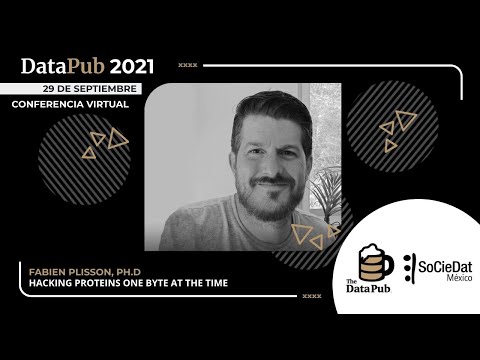
The Data Pub Septiembre 2021: Hacking proteins one byte at the time
The Data Pub Septiembre 2021: Hacking proteins one byte at the time En esta ocasión traemos al Dr Fabien Plisson, quien nos deleitará con un tema por demás apasionante: "Protein Engineering" , un campo prometedor para aplicar algoritmos de Machine Learning. Las proteínas son macromoléculas que regulan diferentes procesos en nuestro organismo. Algunas nos ayudan a crecer, otras nos defienden de infecciones bacterianas o virales. La mayoría de las proteínas que encontramos en la naturaleza deben enfrentar numerosos obstáculos para permitir sus aplicaciones como medicamentos o vacunas contra enfermedades humanas. La ingeniería de proteínas (o diseño de péptidos) es el proceso para convertirlas en sus formas útiles o valiosas. Una aplicación prometedora de los algoritmos de aprendizaje automático se encuentra en la ingeniería de proteínas; las relaciones entre las secuencias de proteínas y las respectivas mediciones funcionales (es decir, actividades biológicas) permiten la optimización de las funciones de las proteínas. Esta charla presentará cómo (1) aprender la gramática de proteínas para aplicaciones ML y NLP, (2) predecir funciones biológicas a través de modelos predictivos y (3) diseñar proteínas novedosas con algoritmos generativos. El Dr. Fabien Plisson es químico y científico de datos. Durante los últimos 15 años, Fabien ha contribuido a varios programas de investigación en el descubrimiento de fármacos entre instituciones académicas y socios de la industria en todo el mundo: Jaspars Group (Universidad de Aberdeen) - Aquapharm biodiscovery (Escocia), CNRS - Pierre Fabre (Francia), Capon Group (Universidad de Queensland, Australia) -Noscira Pty Ltd (España), Fairlie Group (Universidad de Queensland) - Pfizer (EE.UU.), Grupo Gonda (Universidad de Queensland) - Protagonist Therapeutics (Australia). Su trabajo combina estrategias de laboratorio y computacionales que incluyen estadísticas avanzadas y algoritmos de aprendizaje automático para necesidades médicas insatisfechas: resistencia a los antimicrobianos, tratamientos contra el cáncer, diabetes tipo 2, trastornos neurodegenerativos y malaria. Su grupo combina los campos de la ingeniería de proteínas, el descubrimiento de fármacos y la inteligencia artificial para descubrir y diseñar terapias novedosas.

Gracias @thedatapub por la invitación. Me gusto mucho presentar nuestro trabajo de investigación @peptidicos mezclando ingeniería proteíca #peptide2drug y inteligencia artificial #machinelearning #AI

youtu.be/sgO_dmmYvFY

0 0 0 0