Like mushrooms 🍄, telescopes atop ESO’s La Silla Observatory are bathed in the dim light of the sunset.
👈 The Danish 1.54-metre telescope
👉 The 3 BlackGEM_Array telescopes
Which cosmic signals do they hunt for? Find out: https://www.eso.org/public/images/potw2453a/
📷 ESO/I. Saviane
1 year ago
55
14
3
2

President Jimmy Carter has passed away at the age of 100. He was a symbol of what is best about America: kindness, compassion, duty and service. He will be missed, most of all by those who long for a return of that kind of country, led by a man with such strength of character.
1 year ago
43883
7313
1080
539
Holy cow, look at that primary mirror! It's the same size as Hubble's (2.4m) but 4x lighter. And its field of view is 100x wider than Hubble (compare the small box versus the full color image in the picture below), with Hubble's resolution.
1 year ago
77
19
0
2

This stunning infrared image from JWST's NIRCam reveals the turbulent environment surrounding the Wolf-Rayet star WR 124. The image showcases a complex, asymmetric nebula of gas and dust expelled by the star's powerful stellar winds, glowing brightly in infrared light. These intricate structures offer valuable insights into the late stages of massive star evolution, specifically the process of mass loss that enriches the interstellar medium with heavy elements. The high resolution of NIRCam allows scientists to study the composition and dynamics of this ejected material in unprecedented detail, providing a deeper understanding of how massive stars contribute to the evolution of galaxies.
Wolf-Rayet star WR 124.
WR stars are one of the most hottest stars in the universe.
Processed JWST/NIRCam data by @thocarp.bsky.social
www.flickr.com/photos/19746...
🔭 🧪
1 year ago
875
85
6
4

This stunning composite image from the James Webb and Chandra telescopes reveals the intricate details of NGC 602, a young star cluster nestled within the Small Magellanic Cloud. Webb's infrared observations pierce through dust to reveal nascent stars and intricate dust structures, while Chandra's X-ray data highlights the hot gas sculpted by powerful stellar winds and supernova explosions from the cluster's massive stars. The resulting image showcases a vibrant tapestry of colors, with swirling patterns of red, green, and blue illuminating the interplay between star formation and the surrounding interstellar medium, offering valuable insights into the evolution of star clusters and their impact on galactic environments.
The stars in NGC 602 have fewer heavier elements compared to the Sun and most of the rest of the galaxy. Instead, the conditions within NGC 602 mimic those for stars found billions of years ago when the universe was much younger.
chandra.harvard.edu/photo/2024/n...
🔭 🧪
1 year ago
2131
231
31
10

A black crow struts across a wooden deck
Head into next week with the confidence of a crow. 🪶
1 year ago
15450
1663
244
78
Just simply wow 💫😲💫😲💫😲💫
Millions of galaxies using real data from the DESI telescope (Dark Enegy Spectroscopy) mapping entire superclusters of the observable Universe.
1 year ago
2538
367
77
31

IT WAS 62 YEARS AGO TODAY that we became an interplanetary species.
12/14/1962 Mariner 2 flyby of Venus revealed Earth's sibling planet to be a hellishly hot greenhouse world, ushering in an age of comparative planetology which has taught us so much about planets including Earth.
1 year ago
35
4
1
1

Testing bot @kat-astro-bot.bsky.social
1 year ago
4
0
1
0
Advertisement

This Hubble image shows, in ultraviolet wavelengths of light, a
spectacular star cluster, known as NGC 346, nested within the Small
Magellanic Cloud. Dozens of hot, blue, and high-mass stars shine
within NGC 346.
1/11 🧪 🔭 #extragalactic
This gem, released by Hubble last August, gives us a unique ultraviolet view of the active star cluster NGC 346.
Image source and info➡️ science.nasa.gov/centers-and-...
Observations in ultraviolet light⤵️
1 year ago
89
26
2
1

A black and white photo of Max Planck. His arms are crossed and he is looking at the camera. Planck has a substantial mustache and his hair is receding. He is wearing a heavy, dark suit with a high-collared white shirt and a small black bowtie.
Happy #QuantumDay to all who celebrate!
Max Planck submitted work on blackbody radiation to the German Physical Society #OTD in 1900.
His novel “quantum hypothesis” suggested that matter emits and absorbs light with frequency f only in discrete chunks of energy E=hf. 🧪 ⚛️ (1/n)
Image: AIP
1 year ago
295
99
7
6

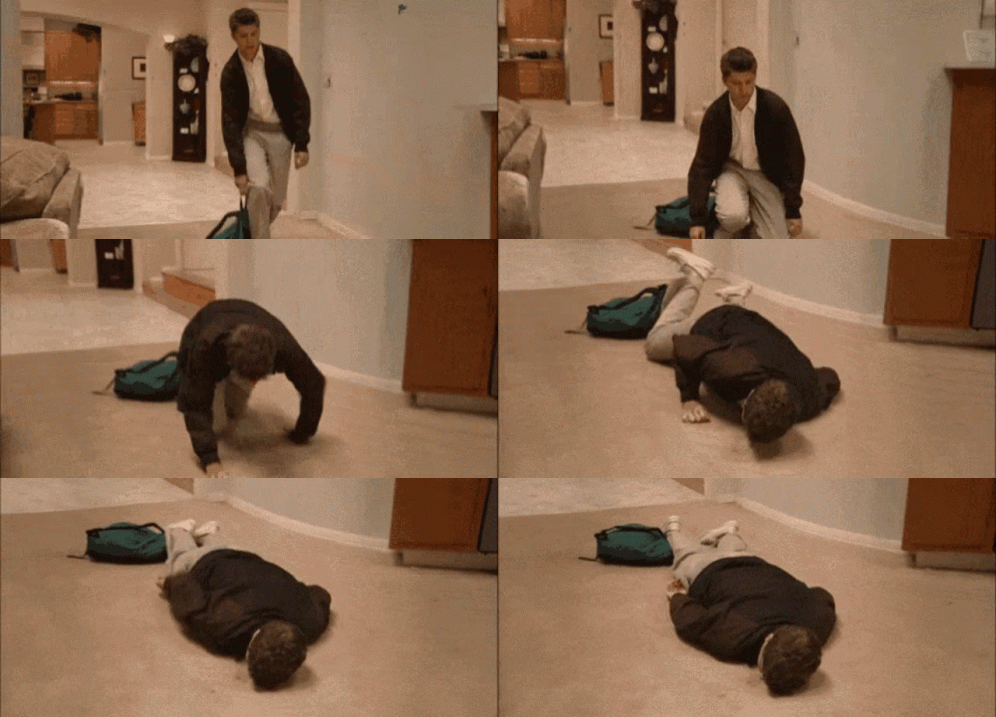
a man is walking down a hallway with a suitcase and a backpack .
Alt: George Michael walks down a hallway and falls face down on the floor
Today's NASA Exoplanet Archive release included:
- 19 new planets! 🎉
- 1 demoted planet 😭
- atmospheric spectra for four planets 🌈
- updates for three dozen known planets 🪐
- the first release of data from a whole new mission - the Colorado Ultraviolet Transit Experiment (CUTE), a NASA CubeSat! 🛰️
1 year ago
126
14
4
2

A captivating image of the Cartwheel Galaxy, captured by NASA's James Webb Space Telescope. The galaxy resembles a wagon wheel, with a bright central hub and multiple rings of stars and dust. The inner ring is a region of intense star formation, while the outer ring is expanding outward, pushing into the surrounding gas and triggering star formation in its path. The image also reveals distant galaxies in the background, showcasing the vastness of the universe.
NIRCam view of Cartwheel galaxy.
Processed by @thocarp.bsky.social
www.flickr.com/photos/19746...
🔭 🧪
1 year ago
3201
259
58
20

Today is Grace Hopper Day! As a pioneer in computer science, Grace Hopper showed us that nothing is impossible with determination and creativity.
What can we do today to inspire the next generation of innovators like Grace Hopper?
#GraceHopperDay #STEMEducation #SchoolLeaders #WomenInSTEM #EduSky
1 year ago
50
14
1
1
Advertisement

James Webb telescope just dropped its latest image, Neptune, and its rings.
1 year ago
13303
1319
180
81

A zoomed in view of the area around the Firefly Sparkle galaxy. There are two smaller circles flanking a larger oval at the center. The central oval is labeled Firefly Sparkle galaxy. Within it is a long line, roughly pointing from bottom left to top right that contains 10 circular star clusters in pink, purple, and blue. The galaxy to the bottom left is labeled Companion 1 and looks like a bright red dot. At top right, Companion 2 is lighter red and surrounded by a red disk.
NEW WEBB DISCOVERY!!! ✨
FOR THE FIRST TIME, JWST HAS DETECTED A GALAXY FORMING STARS 600 MILLION YEARS AFTER THE BIG BANG THAT WEIGHS AS MUCH AS THE YOUNG MILKY WAY! 🌌
1 year ago
453
63
9
3

BREAKING 🚨: NASA dropped a new James Webb telescope deep space image 💫💫💫
All the eight-sided features are stars in the Milky Way, everything else is a galaxy 🤯
1 year ago
11115
1176
213
113

Black and white photo of Max Born. He appears to be in his forties or early fifties. His hair is receding a bit, and he wears a dark gray suit with white shirt. Born is looking directly at the camera.
Physicist Max Born was...born... #OTD in 1882.
In 1926 he formulated a rule for the statistical likelihood of a measurement on a quantum system yielding a particular outcome. Born’s rule says the probability is the square of an amplitude obtained from the system’s wave function. (1/n)
🧪 ⚛️
1 year ago
139
35
4
6

JWST: Yup, the Universe is expanding weirdly
The Hubble tension is alive and well: JWST appears to confirm the cosmic expansion is different closer to us than farther away
Aw, Universe, why do you have to be this way?
We've been suspicious for a while that the expansion of the cosmos is doing weird stuff, and new results from JWST seem to confirm it.
badastronomy.beehiiv.com/p/jwst-yup-t...
🧪🔭
1 year ago
2435
280
114
13
I remember several years ago in a CS class the prof. Told us that this will take off quickly once the hardware catches up.
And here we are! What a time to be alive :D
1 year ago
1
0
0
0

Macro photo of a leggy dark brown ant in side view standing on sand, holding a clump of wet sand about the size of its own head in its mandibles.
A Camponotus melanoticus worker ant carries a bit of sand up from a nest excavation in a fragment of the Brazilian cerrado. #insects
1 year ago
70
7
0
0
Advertisement
Yes, we MUST do better to ensure information is available to drive policy. Engaging National Labs is important as well.
1 year ago
1
0
0
0
I’m really excited about this project !! It’s so cool we can still see the afterglow — most GRBs are only followed to ~ 12 days in the optical
🔭 #highenergyastro
et al. incl. @pjvphotography.bsky.social
@tanmoylaskar.bsky.social
@danmil.bsky.social @bmetzger.bsky.social
+ others offline✨
1 year ago
33
7
2
1
Jupiter and its moons last night. Taken with my iPhone :)
1 year ago
2
0
0
0