Advertisement ยท 728 ร— 90

Posts by Ted Stankowich

Post image

We have a super tautonym: ๐ถ๐‘œ๐‘ก๐‘ข๐‘Ÿ๐‘›๐‘–๐‘ฅ ๐‘๐‘œ๐‘ก๐‘ข๐‘Ÿ๐‘›๐‘–๐‘ฅ ๐‘๐‘œ๐‘ก๐‘ข๐‘Ÿ๐‘›๐‘–๐‘ฅ, the nominate subspecies! It occupies most of the European breeding range & represents the classic form described by Linnaeus in 1758, linking modern pops to the origins of zoological nomenclature
#TautonymTuesday #Systematics Photo: Waarneming.nl

2 hours ago 2 0 0 0
Post image

๐ถ๐‘œ๐‘ก๐‘ข๐‘Ÿ๐‘›๐‘–๐‘ฅ ๐‘๐‘œ๐‘ก๐‘ข๐‘Ÿ๐‘›๐‘–๐‘ฅ is a compact, streaked brown bird built for life in grasslands. It forages on seeds and insects, relying on camouflage rather than flight to avoid predators. During migration, however, it journeys all the way across the Mediterranean!
#TautonymTuesday #Systematics Photo: baldcoot

2 hours ago 1 0 1 0
Post image

Itโ€™s #TautonymTuesday! Meet ๐ถ๐‘œ๐‘ก๐‘ข๐‘Ÿ๐‘›๐‘–๐‘ฅ ๐‘๐‘œ๐‘ก๐‘ข๐‘Ÿ๐‘›๐‘–๐‘ฅ, the ๐œ๐จ๐ฆ๐ฆ๐จ๐ง ๐ช๐ฎ๐š๐ข๐ฅ. This small, groundโ€‘dwelling galliform bird breeds across Europe & W Asia and migrates to Africa for winter. Itโ€™s one of the few truly longโ€‘distance migratory gamebirds.
#TaxonomyTuesday #Systematics Photo: christoph_moning

2 hours ago 3 0 1 0
Biological Armorsโ€“Evolution, Materials, and Bioinspiration 
Karly E Cohen , 
Cassandra M Donatelli , 
Andrew K Schulz , 
Julia B Teeple , 
Theodore Stankowich , 
E W Misty Paig-Tran
Integrative and Comparative Biology, Volume 65, Issue 6, December 2025, Pages 1649โ€“1666, https://doi.org/10.1093/icb/icaf074

Biological Armorsโ€“Evolution, Materials, and Bioinspiration Karly E Cohen , Cassandra M Donatelli , Andrew K Schulz , Julia B Teeple , Theodore Stankowich , E W Misty Paig-Tran Integrative and Comparative Biology, Volume 65, Issue 6, December 2025, Pages 1649โ€“1666, https://doi.org/10.1093/icb/icaf074

ICB
"#Bioinspired designs informed by natural armor have led to innovations in impact-resistant materials, flexible ceramics, and modular protective systems."

#Biological Armorsโ€“Evolution, Materials, and #Bioinspiration
doi.org/10.1093/icb/...
@karlycohen.bsky.social et al

1 week ago 4 1 0 0
Fig. 2.
Comparative osteoderm morphology of fossil and extant armadillos, highlighting the structural conservation of body armor across evolutionary time. (A) Extant screaming hairy armadillo (Chaetophractus vellerosus) with inset showing a close-up of its osteoderms. (B) Fossil Glyptodon sp. osteoderm, exhibiting a rosette-like pattern characteristic of glyptodonts. (Cโ€“D) Fossil osteoderms of Glyptotherium floridanum, showing variation in surface texture and overall shape. (Eโ€“I) Fossil osteoderms of Holmesina floridanus, demonstrating rectangular morphology and diverse surface ornamentation. The arrangement showcases the remarkable continuity in osteoderm shape and function from extinct armored xenarthrans to their modern relatives. Fossil specimens were donated for scanning by T. Stankowich. Chaetophractus vellerosus specimen was donated to M. Paig-Tran from the Orange County Zoo and Scott Weldy, DVM.

Fig. 2. Comparative osteoderm morphology of fossil and extant armadillos, highlighting the structural conservation of body armor across evolutionary time. (A) Extant screaming hairy armadillo (Chaetophractus vellerosus) with inset showing a close-up of its osteoderms. (B) Fossil Glyptodon sp. osteoderm, exhibiting a rosette-like pattern characteristic of glyptodonts. (Cโ€“D) Fossil osteoderms of Glyptotherium floridanum, showing variation in surface texture and overall shape. (Eโ€“I) Fossil osteoderms of Holmesina floridanus, demonstrating rectangular morphology and diverse surface ornamentation. The arrangement showcases the remarkable continuity in osteoderm shape and function from extinct armored xenarthrans to their modern relatives. Fossil specimens were donated for scanning by T. Stankowich. Chaetophractus vellerosus specimen was donated to M. Paig-Tran from the Orange County Zoo and Scott Weldy, DVM.

Methods used to study these systemsโ€”CT scanning, histology, finite element analysis, & mechanical testingโ€”directly influence how the biological principles of armor are defined and understood.
@karlycohen.bsky.social
@cmdonatelli.bsky.social
@schulzscience.bsky.social et al
doi.org/10.1093/icb/...

6 days ago 7 3 0 0
Fig. 4
Micro to Macro Case Study. (A) Photo of Bathyagonus alascansus. (B) Micro-CT scan of B. alascansus. (C) Single scale (see blue highlighted region in B, E) showing hexagonal shape. (D) Idealized hexagonal models tessellated for 3D printing. (E) Three scales in a single row showing overlap (see dotted box in B). (F) Histology of overlapping scales (see white box in E). (G) Side profile of our idealized CAD models (D) showing overlap profile. The top and bottom (light gray) are perfect hexagons, and the middle (darker grays) is interpolated between them. (H) Force required to bend differently shaped models with a 30% overlap profile. Models were tested in three-point bending on a material testing system. Max load (N) was extracted from the data and plotted. (I) Model of shape, orientation, and overlap plotted on a log-log scale. MF is a dimensionless metric ((d + Overlap%)/L) where d is the distance between the tile border and bending axis and L is the length of the tile border (see inset). The unitless metric can be measured on models of all shapes from triangle to octagon. Using that metric, plus the coefficients resulting from the logarithmic fit in the figure, we can estimate the force required to bend models not physically tested in this study.

Fig. 4 Micro to Macro Case Study. (A) Photo of Bathyagonus alascansus. (B) Micro-CT scan of B. alascansus. (C) Single scale (see blue highlighted region in B, E) showing hexagonal shape. (D) Idealized hexagonal models tessellated for 3D printing. (E) Three scales in a single row showing overlap (see dotted box in B). (F) Histology of overlapping scales (see white box in E). (G) Side profile of our idealized CAD models (D) showing overlap profile. The top and bottom (light gray) are perfect hexagons, and the middle (darker grays) is interpolated between them. (H) Force required to bend differently shaped models with a 30% overlap profile. Models were tested in three-point bending on a material testing system. Max load (N) was extracted from the data and plotted. (I) Model of shape, orientation, and overlap plotted on a log-log scale. MF is a dimensionless metric ((d + Overlap%)/L) where d is the distance between the tile border and bending axis and L is the length of the tile border (see inset). The unitless metric can be measured on models of all shapes from triangle to octagon. Using that metric, plus the coefficients resulting from the logarithmic fit in the figure, we can estimate the force required to bend models not physically tested in this study.

This ICB paper #Biological #Armors โ€“ #Evolution, Materials, and #Bioinspiration
by
@karlycohen.bsky.social
@cmdonatelli.bsky.social
@schulzscience.bsky.social
@tedstankowich.bsky.social
et al
doi.org/10.1093/icb/...
has incredible figures
like fig 4's Micro to Macro Case Study

4 days ago 3 1 0 0
Post image

And we have a super #tautonym: ๐‘€๐‘’๐‘™๐‘’๐‘  ๐‘š๐‘’๐‘™๐‘’๐‘  ๐‘š๐‘’๐‘™๐‘’๐‘ , the nominate subspecies. It occupies much of western and central Europe and is noted for its relatively large size and dense fur, traits that help it thrive in cooler, temperate climates.
#TautonymTuesday #TaxonomyTuesday #Systematics Photo: Chris P.

4 weeks ago 3 1 0 1
Advertisement
Post image

๐‘€๐‘’๐‘™๐‘’๐‘  ๐‘š๐‘’๐‘™๐‘’๐‘  is famous for its complex burrows, or setts, which can be occupied by generations of #badgers over decades. Mostly nocturnal, it feeds on earthworms, insects, fruits, and small vertebrates, adjusting its diet seasonally.
#TautonymTuesday #TaxonomyTuesday #Systematics Photo: Carolyn Legg

4 weeks ago 3 1 1 0
Preview
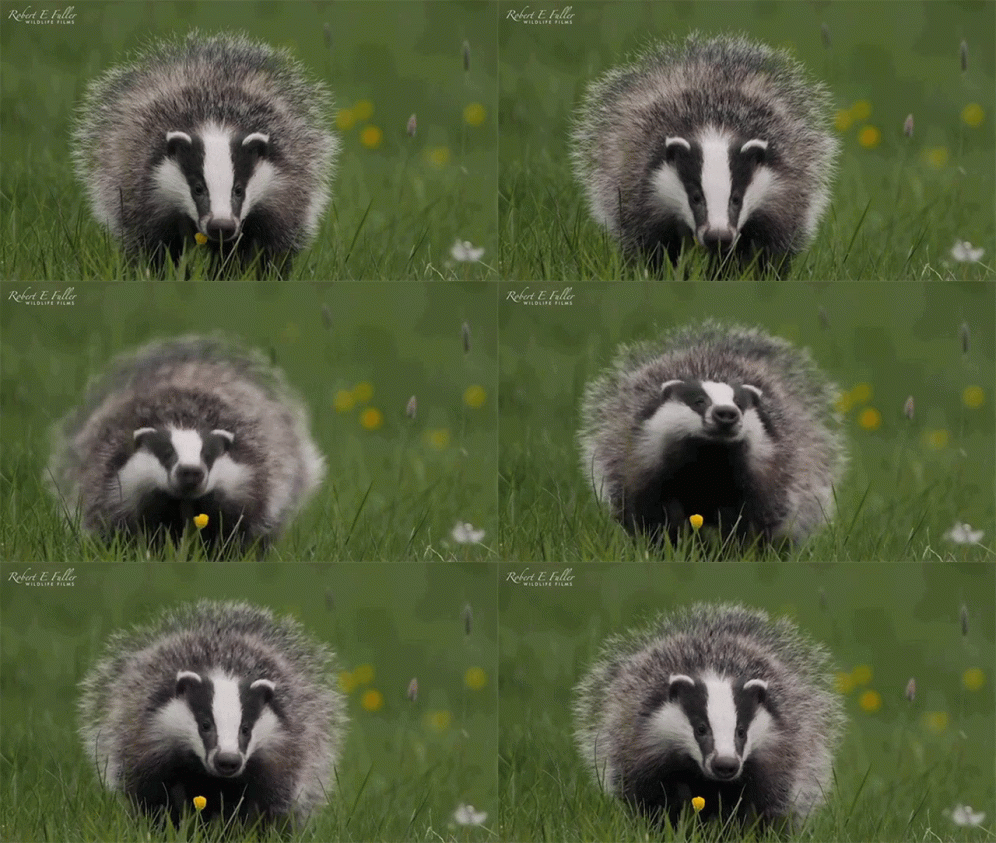
a badger is standing in a field with robert e. fuller wildlife films written on the bottom ALT: a badger is standing in a field with robert e. fuller wildlife films written on the bottom

Itโ€™s #TautonymTuesday! Meet ๐‘€๐‘’๐‘™๐‘’๐‘  ๐‘š๐‘’๐‘™๐‘’๐‘ , the European #badger. This powerful mustelid ranges across much of Europe and W Asia, With a bold blackโ€‘andโ€‘white facial stripes and stocky build, it's a strong digger and adaptable omnivore living in woodlands and farmlands.
#TaxonomyTuesday #Systematics

4 weeks ago 5 0 1 1
Preview
Why aren't mammals as colorful as reptiles, birds or fish? Many mammals have fur the color of brown and black. Why don't they have more exotic colors, like purple and neon pink?

Talking mammal coloration!
Why aren't mammals as colorful as reptiles, birds or fish? www.livescience.com/animals/why-...

1 month ago 14 5 0 1
Post image Post image

Last week, a production team came to CSU Long Beach to film a sit-down interview for a documentary on wildlife living in Los Angeles. Hopefully, they got some good material, and the plan is to go out and film some skunks in the field later this spring!

1 month ago 3 0 0 0
Post image

This species ranges from the Caribbean through N Brazil, favoring bays, river mouths, and muddy or sandy bottoms. As a benthic feeder on small crustaceans and worms, it plays a key role in energy transfer between invertebrate communities and larger predatory fishes.
#TautonymTuesday #Systematics

1 month ago 3 0 0 0
Post image

๐‘†. ๐‘ ๐‘ก๐‘’๐‘™๐‘™๐‘–๐‘“๐‘’๐‘Ÿ reaches about 12โ€“18 cm, with a slender, silvery body and a noticeable mental barbel under the chin. Like other croakers, it produces sound using specialized sonic muscles and the swim bladder to communicate in turbid estuarine waters.
#TautonymTuesday #TaxonomyTuesday #Systematics

1 month ago 2 0 1 0
Post image

#TautonymTuesday is back! Meet ๐‘†๐‘ก๐‘’๐‘™๐‘™๐‘–๐‘“๐‘’๐‘Ÿ ๐‘ ๐‘ก๐‘’๐‘™๐‘™๐‘–๐‘“๐‘’๐‘Ÿ, the little croaker, a small sciaenid fish found along the Atlantic coasts of S America. It inhabits shallow coastal waters and estuaries, where it schools in softโ€‘bottom habitats rich in invertebrate prey.
#TaxonomyTuesday #Systematics

1 month ago 5 0 1 0
Preview
Territoriality, sociality and male weaponry shape horn investment in female bovids Female weaponry remains underexplored across animal taxa. We analyzed socio-ecological predictors of female horn presence and size within the mammalian fam

New paper out with Nicole Lopez showing that predation risk, male horn size, and female territoriality drive the evolution of and investment into female horns!
"Territoriality, sociality and male weaponry shape horn investment in female bovids": academic.oup.com/beheco/artic...

1 month ago 3 1 0 0
Advertisement

Animal defenses with Dr. @tedstankowich.bsky.social.

Get into it:

alieward.com/ologies/zooh...

1 month ago 76 5 3 0
Preview
Zoohoplology (ANIMAL DEFENSES) with Dr. Ted Stankowich โ€” alie ward Barbs. Spurs. Stinks. Scutes. Shrieks. Fashion. Drama. Animal behaviorist, evolutionary biologist, Cal State Long Beach professor, and your new favorite Zoohoplologist, Dr. Ted Stankowich, divulges ab...

Barbs. Spurs. Stinks. Scutes. Shrieks. Fashion. Drama.

Zoohoplology (ANIMAL DEFENSES) w/ *the* Dr. @tedstankowich.bsky.social has armadillos, skunks, pangolins, horned lizards, wombats, coyotes, kit foxes, poodles, porcupines, tigers, deer & the will to survive.

www.alieward.com/ologies/zooh...

2 months ago 48 6 0 1

My @ologies.bsky.social episode on animal defenses is out now!

2 months ago 5 1 0 0
Preview
Zoohoplology (ANIMAL DEFENSES) with Ted Stankowich

Take a listen to this awesome episode on animal defenses with @tedstankowich.bsky.social on @ologies.bsky.social with @alieward.bsky.social !!! Iโ€™ve had the pleasure of following Ted and meeting him in person and he is extremely knowledgeable! ๐Ÿฆจ๐Ÿฆจ๐Ÿฆจ

2 months ago 2 2 0 0
Post image

Once named ๐ถโ„Ž๐‘–๐‘›๐‘โ„Ž๐‘–๐‘™๐‘™๐‘Ž ๐‘๐‘Ÿ๐‘’๐‘ฃ๐‘–๐‘๐‘Ž๐‘ข๐‘‘๐‘Ž๐‘ก๐‘Ž, ๐ถ. ๐‘โ„Ž๐‘–๐‘›๐‘โ„Ž๐‘–๐‘™๐‘™๐‘Ž is Critically Endangered after severe overhunting & habitat loss. Small wild colonies survive in remote Andean rocky slopes, where they remain important herbivores in fragile alpine ecosystems.
#TautonymTuesday #Systematics Photo: Animalia.bio

3 months ago 2 0 0 0
Post image

๐ถ. ๐‘โ„Ž๐‘–๐‘›๐‘โ„Ž๐‘–๐‘™๐‘™๐‘Ž is stockier with a shorter tail & thicker neck compared to its long-tailed cousin. These social #rodents live in colonies & communicate with a range of chirps & barks. Their ultra-dense fur requires special dust baths to stay clean.
#TautonymTuesday #Systematics Photo: masaigallery

3 months ago 2 0 1 0
Post image

Itโ€™s #TautonymTuesday! Meet ๐ถโ„Ž๐‘–๐‘›๐‘โ„Ž๐‘–๐‘™๐‘™๐‘Ž ๐‘โ„Ž๐‘–๐‘›๐‘โ„Ž๐‘–๐‘™๐‘™๐‘Ž, the short-tailed #chinchilla. Native to the high #Andes , this species is built for cold mountainsโ€”with the densest of any land mammal, compact bodies, and strong hind legs for navigating rocky slopes.
#TaxonomyTuesday #Systematics Photo: Britannica

3 months ago 7 1 1 0

Let's go, Buffalo!

3 months ago 2 0 0 0
Preview
Why do skunks stink? - Brains On! Science podcast for kids Skunks can stink, no doubt about it. But that stink is actually a superpower! Join Molly and co-host Diya as they find out how these critters use their smell to scare away enemies, what the smell is m...

Check out this great episode of the kids' podcast Brains On! where I talk about skunks! My parts are at 2:00 and 20:45. omny.fm/shows/brains...

3 months ago 3 0 0 0
Advertisement
Post image

This viper's #venom is highly potent, selected to immobilize prey quickly in harsh environments where energy #conservation is critical. Despite its fearsome reputation, bites to humans are rare due to its secretive lifestyle.
#TautonymTuesday #TaxonomyTuesday #Systematics Photo: Philip Kahn

3 months ago 3 0 0 0
Post image

๐ถ๐‘’๐‘Ÿ๐‘Ž๐‘ ๐‘ก๐‘’๐‘  ๐‘๐‘’๐‘Ÿ๐‘Ž๐‘ ๐‘ก๐‘’๐‘  is perfectly adapted to #desert life. It uses sidewinding locomotion to move efficiently across scorching sand, reducing heat exposure. Its cryptic coloration allows it to ambush prey like #rodents and #lizards.
#TautonymTuesday #TaxonomyTuesday #Systematics Photo: Intesar Salih

3 months ago 2 0 1 0
Post image

Itโ€™s #TautonymTuesday! ๐ถ๐‘’๐‘Ÿ๐‘Ž๐‘ ๐‘ก๐‘’๐‘  ๐‘๐‘’๐‘Ÿ๐‘Ž๐‘ ๐‘ก๐‘’๐‘ , the Saharan horned #viper, thrives in N African deserts, where its horn-like scales help break up its outline against the sand. It can bury itself, exposing only its eyesโ€”perfect for ambushing prey.
#TaxonomyTuesday #Systematics Photo: Holger Krisp

3 months ago 8 1 1 0
Post image

Itโ€™s #TautonymTuesday! Meet ๐ต๐‘Ž๐‘Ÿ๐‘๐‘Ž๐‘ก๐‘ข๐‘™๐‘Ž ๐‘๐‘Ž๐‘Ÿ๐‘๐‘Ž๐‘ก๐‘ข๐‘™๐‘Ž, the stone loach. This small benthic #fish inhabits cool, fast-flowing streams across Europe and western Asia. They live on the bottom, often partly buried. A classic tautonym in freshwater ichthyology! #Systematics #TaxonomyTuesday Photo: Holger Krisp

4 months ago 28 2 1 0
Post image

And ๐บ๐‘™๐‘–๐‘  ๐‘”๐‘™๐‘–๐‘  has a ๐’๐”๐๐„๐‘ ๐“๐€๐”๐“๐Ž๐๐˜๐Œ!
๐บ๐‘™๐‘–๐‘  ๐‘”๐‘™๐‘–๐‘  ๐‘”๐‘™๐‘–๐‘  is the nominate subspecies, found from the Madeira and Canary Islands across southern Europe to western Turkey. It can live over 9 years in the wild, an unusually long lifespan for a small #rodent!
#TautonymTuesday #Systematics Photo: Youbadou

3 months ago 4 0 0 0
Post image

๐บ๐‘™๐‘–๐‘  ๐‘”๐‘™๐‘–๐‘  is a chunky #dormouse with gray fur, large eyes, and a bushy tail. Itโ€™s an agile climber, feeding on nuts, fruits, and occasionally #insects. True to its name, it was once considered a delicacy in ancient #Rome, hence โ€œedible dormouseโ€!
#TautonymTuesday #Systematics Photo: Pasztilla

3 months ago 4 0 1 0