Advertisement · 728 × 90
#
Hashtag
#PakistaniArt
Advertisement · 728 × 90
Pakistani artist Rahat Naveed Masud (راحت نوید مسعود) often pairs tender observation with materials that suggest illumination. In this portrait, an unidentified sitter’s quiet profile becomes a threshold between presence and place. 

A young adult woman is shown from the shoulders up in three-quarter view, turned slightly to our right while her gaze reaches out, past the frame. Her skin is warm light-to-medium brown with peachy highlights on the cheekbones and a gentle flush across the nose and cheeks. Dark hair, parted near the center, is smoothed back under a pale, sandy shawl that falls over her head and shoulders. The cloth’s edge is picked out with a thin, lace line and faint gold shimmer. A small nose stud catches the light on her right nostril. Her eyebrows are full and her brown eyes are softly rimmed, bright with reflected light. Her lips are closed and relaxed, giving her expression a poised, inward calm. The portrait’s surface feels powdery and layered with soft transitions in the face, and more visible strokes where the veil and background dissolve into atmosphere. 

Behind her, a misty green-blue landscape opens into slender trees whose branches are lightly drawn, dotted with small, vivid red blossoms that punctuate the haze like quiet points of sound. Warm tans and cool greens mingle at the edges, and the figure is subtly outlined so she seems to glow against the surrounding air.

A fine gold-toned contour around the veil feels like a halo of light, guiding our eyes back to her attentive, reflective face. Meanwhile, the red points in the trees whether fruit, bloom, or memory represents life continuing in small insistences just as the shawl signals belonging without turning her into a stereotype. 

Shown in “Tour-Portrait” at Tsinghua University Art Museum (清华大学艺术博物馆), the work asks us to meet a person before we meet a nation. Painted in 2019, its stillness lingers as a meditation on dignity, patience, and the intimate strength of being seen.

Pakistani artist Rahat Naveed Masud (راحت نوید مسعود) often pairs tender observation with materials that suggest illumination. In this portrait, an unidentified sitter’s quiet profile becomes a threshold between presence and place. A young adult woman is shown from the shoulders up in three-quarter view, turned slightly to our right while her gaze reaches out, past the frame. Her skin is warm light-to-medium brown with peachy highlights on the cheekbones and a gentle flush across the nose and cheeks. Dark hair, parted near the center, is smoothed back under a pale, sandy shawl that falls over her head and shoulders. The cloth’s edge is picked out with a thin, lace line and faint gold shimmer. A small nose stud catches the light on her right nostril. Her eyebrows are full and her brown eyes are softly rimmed, bright with reflected light. Her lips are closed and relaxed, giving her expression a poised, inward calm. The portrait’s surface feels powdery and layered with soft transitions in the face, and more visible strokes where the veil and background dissolve into atmosphere. Behind her, a misty green-blue landscape opens into slender trees whose branches are lightly drawn, dotted with small, vivid red blossoms that punctuate the haze like quiet points of sound. Warm tans and cool greens mingle at the edges, and the figure is subtly outlined so she seems to glow against the surrounding air. A fine gold-toned contour around the veil feels like a halo of light, guiding our eyes back to her attentive, reflective face. Meanwhile, the red points in the trees whether fruit, bloom, or memory represents life continuing in small insistences just as the shawl signals belonging without turning her into a stereotype. Shown in “Tour-Portrait” at Tsinghua University Art Museum (清华大学艺术博物馆), the work asks us to meet a person before we meet a nation. Painted in 2019, its stillness lingers as a meditation on dignity, patience, and the intimate strength of being seen.

“Mountain Girl” by Rahat Naveed Masud (Pakistani) - Pastel and gold leaf on handmade paper / 2019 - Tsinghua University Art Museum (Beijing, China) #WomenInArt #RahatNaveedMasud #راحتنویدمسعود #Masud #TsinghuaUniversityArtMuseum #清华大学艺术博物馆 #PortraitofaGirl #BlueskyArt #ArtText #art #PakistaniArt

36 5 1 0
The Pakistani heritage of British-born, U.S.-based artist Shabana Kauser’s "Dupatta" series centers the everyday elegance of South Asian women, translating fabric, craft, and memory into contemporary portraiture. Working from real garments and jewelry, she sources and stages herself, the artist builds skin and textile textures in meticulous layers of oil, then accents threads and sequins with needle-fine brushwork.

The dupatta (दुपट्टा) scarf is ubiquitous across South Asia and signals heritage, celebration, and belonging; here it becomes a luminous halo that dignifies an anonymous sitter rather than exoticizing her. 

A beautiful South Asian woman is shown in serene right-profile against a calm teal field. A sheer sky-blue dupatta, netted and edged with gold zari, drapes over her dark hair and shoulders, its surface crowded with embroidered floral sprays and tiny sequins catching soft light. A teardrop maang-tikka head ornament, enameled in blue and gold, rests at her hairline while a filigree necklace glints at her collarbone above a white blouse. Her medium-brown skin is modeled in layered oils and her closed lips are a deep rose. The veil’s scalloped border frames her face, guiding our eyes to her quiet, self-possessed gaze.

In 2022 Kauser presented her first solo museum exhibition at the Fort Smith Regional Art Museum, where works from the series (including Dupatta #10) connected immigrant stories across Arkansas audiences. British-born and now based in Northwest Arkansas, Kauser often describes her practice as a dialogue between her parents’ textile world and her own immigrant journey: portraiture that invites viewers “to examine each thread, its imperfections and uniqueness,” and to recognize the women whose beauty and labor sustain community.

The Pakistani heritage of British-born, U.S.-based artist Shabana Kauser’s "Dupatta" series centers the everyday elegance of South Asian women, translating fabric, craft, and memory into contemporary portraiture. Working from real garments and jewelry, she sources and stages herself, the artist builds skin and textile textures in meticulous layers of oil, then accents threads and sequins with needle-fine brushwork. The dupatta (दुपट्टा) scarf is ubiquitous across South Asia and signals heritage, celebration, and belonging; here it becomes a luminous halo that dignifies an anonymous sitter rather than exoticizing her. A beautiful South Asian woman is shown in serene right-profile against a calm teal field. A sheer sky-blue dupatta, netted and edged with gold zari, drapes over her dark hair and shoulders, its surface crowded with embroidered floral sprays and tiny sequins catching soft light. A teardrop maang-tikka head ornament, enameled in blue and gold, rests at her hairline while a filigree necklace glints at her collarbone above a white blouse. Her medium-brown skin is modeled in layered oils and her closed lips are a deep rose. The veil’s scalloped border frames her face, guiding our eyes to her quiet, self-possessed gaze. In 2022 Kauser presented her first solo museum exhibition at the Fort Smith Regional Art Museum, where works from the series (including Dupatta #10) connected immigrant stories across Arkansas audiences. British-born and now based in Northwest Arkansas, Kauser often describes her practice as a dialogue between her parents’ textile world and her own immigrant journey: portraiture that invites viewers “to examine each thread, its imperfections and uniqueness,” and to recognize the women whose beauty and labor sustain community.

"Dupatta #10" by Shabana Kauser (British–American) - Oil on canvas / 2022 - Fort Smith Regional Art Museum (Arkansas) #WomenInArt #WomenPaintingWomen #WomanArtist #art #artText #artwork #BlueskyArt #FortSmithRegionalArtMuseum #FSRAM #PakistaniArt #Kauser #WomensArt #FemaleArtist #ShabanaKauser #दुपट्टा

42 4 0 0
Post image

In a city rich with art history but poor in support, “And Lack Thereof” offers a curatorial act of rebellion.
By Ahmed Faizan Naveed

Read more: thefridaytimes.com/24-Jul-2025/...

#LahoreArtScene #PakistaniArt #ContemporaryArt #CuratorialPractice #ArtInCrisis #AndLackThereof

1 0 0 0
Preview
On Curation - And Lack Thereof Waleed Zafar's curation offers a meditation on absence, distortion, and the impossible politics of being seen

Lahore has artists. What it lacks is scaffolding. A new show explores identity, absence, and radical curation.
By Ahmed Faizan Naveed

Read more: thefridaytimes.com/24-Jul-2025/...

#LahoreArtScene #PakistaniArt #ContemporaryArt #CuratorialPractice #ArtInCrisis #AndLackThereof

1 0 0 0
Preview
a picture of pakistan with mountains and trees in the background ALT: a picture of pakistan with mountains and trees in the background

#Art #Artist #StreetArt #Paintings #Painters #Landscape #Photography #Skech #Travel #Pakistan #PakistaniArtists #PakistaniArt #Sadqain #ahmedPervez #salimaHashmi #BashirMirza #SairaWasim #AnnaMolkaAhmed #ismailgulgee #ColinDavid #AnwarMaqsood #SughraRababi #JamalShah #farhatabbasshah #ParveenShakir

5 1 0 0
Preview
a large building with the word pakistan on top of it ALT: a large building with the word pakistan on top of it

#Art #Artist #StreetArt #Paintings #Painters #Landscape #Photography #Skech #Travel #Pakistan #PakistaniArtists #PakistaniArt #Sadqain #ahmedPervez #salimaHashmi #BashirMirza #SairaWasim #AnnaMolkaAhmed #ismailgulgee #ColinDavid #AnwarMaqsood #SughraRababi #JamalShah #farhatabbasshah #ParveenShakir

8 0 0 0
Preview
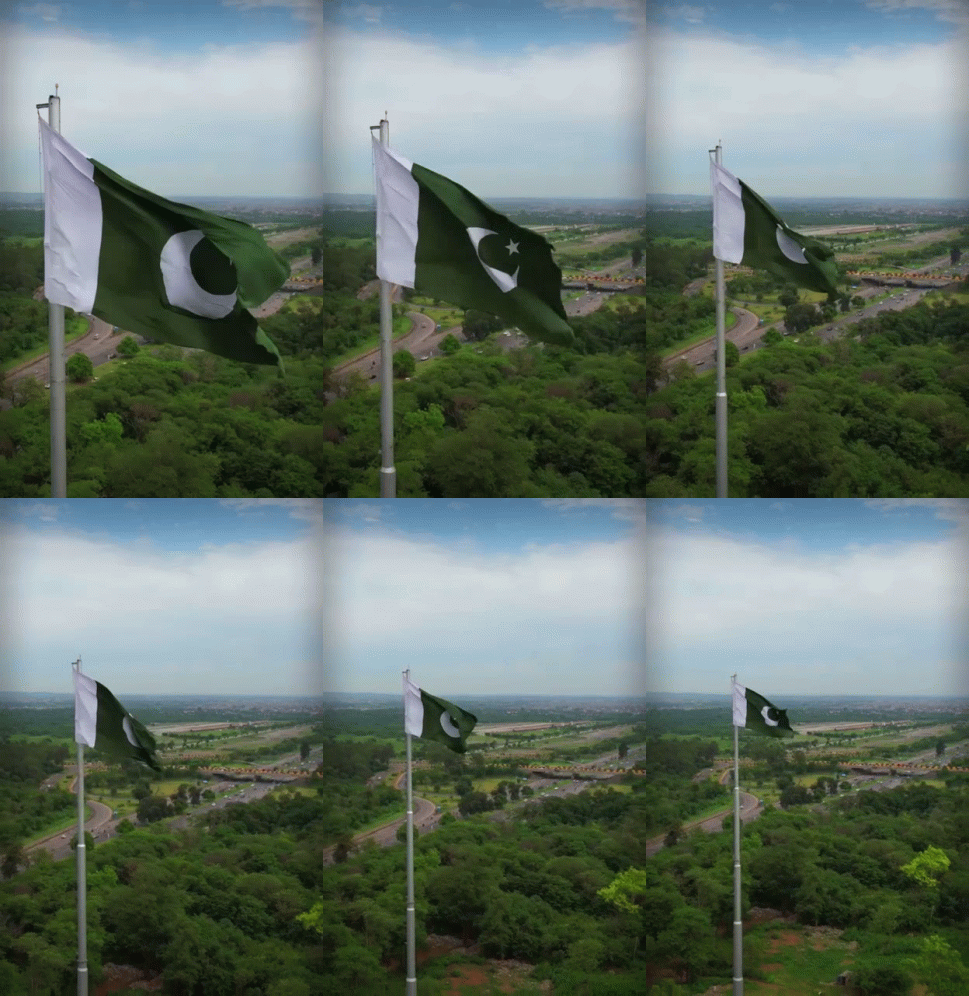
a green and white flag with a crescent moon in the middle ALT: a green and white flag with a crescent moon in the middle

#Art #Artist #StreetArt #Paintings #Painters #Landscape #Photography #Skech #Travel #Pakistan #PakistaniArtists #PakistaniArt #Sadqain #ahmedPervez #salimaHashmi #BashirMirza #SairaWasim #AnnaMolkaAhmed #ismailgulgee #ColinDavid #AnwarMaqsood #SughraRababi #JamalShah #farhatabbasshah #ParveenShakir

5 0 0 0
Preview
a man holds up a flag with a crescent moon and star ALT: a man holds up a flag with a crescent moon and star

#Art #Artist #StreetArt #Paintings #Painters #Landscape #Photography #Skech #Travel #Pakistan #PakistaniArtists #PakistaniArt #Sadqain #ahmedPervez #salimaHashmi #BashirMirza #SairaWasim #AnnaMolkaAhmed #ismailgulgee #ColinDavid #AnwarMaqsood #SughraRababi #JamalShah #farhatabbasshah #ParveenShakir

4 0 0 0
Preview
a poster for pakistan independence day with a green globe ALT: a poster for pakistan independence day with a green globe

#Art #Artist #StreetArt #Paintings #Painters #Landscape #Photography #Skech #Travel #Pakistan #PakistaniArtists #PakistaniArt #Sadqain #ahmedPervez #salimaHashmi #BashirMirza #SairaWasim #AnnaMolkaAhmed #ismailgulgee #ColinDavid #AnwarMaqsood #SughraRababi #JamalShah #farhatabbasshah #ParveenShakir

4 0 0 0

#Art #Artist #StreetArt #Paintings #Painters #Landscape #Photography #Skech #Pakistan #PakistaniArtists #PakistaniArt #Sadqain #ahmedPervez #salimaHashmi #BashirMirza #SairaWasim #AnnaMolkaAhmed #ismailgulgee #ColinDavid #AnwarMaqsood #SughraRababi #JamalShah #farhatabbasshah #ParveenShakir

14 0 0 0
Post image

#Art #Artist #StreetArt #Paintings #Painters #Landscape #Photography #Skech #Pakistan #PakistaniArtists #PakistaniArt #Sadqain #ahmedPervez #salimaHashmi #BashirMirza #SairaWasim #AnnaMolkaAhmed #ismailgulgee #ColinDavid #AnwarMaqsood #SughraRababi #JamalShah #farhatabbasshah #ParveenShakir

4 0 0 0

#Art #Artist #StreetArt #Paintings #Painters #Landscape #Photography #Skech #Pakistan #PakistaniArtists #PakistaniArt #Sadqain #ahmedPervez #salimaHashmi #BashirMirza #SairaWasim #AnnaMolkaAhmed #ismailgulgee #ColinDavid #AnwarMaqsood #SughraRababi #JamalShah #farhatabbasshah #ParveenShakir

14 1 0 0
Post image

#Art #Artist #StreetArt #Paintings #Painters #Landscape #Photography #Skech #Pakistan #PakistaniArtists #PakistaniArt #Sadqain #ahmedPervez #salimaHashmi #BashirMirza #SairaWasim #AnnaMolkaAhmed #ismailgulgee #ColinDavid #AnwarMaqsood #SughraRababi #JamalShah #farhatabbasshah #ParveenShakir

10 1 0 0

#Art #Artist #StreetArt #Paintings #Landscape #Photography #Skech #Pakistan #Pakistani #PakistaniArtists #PakistaniArt #Sadqain #ahmedPervez #salimaHashmi #BashirMirza #SairaWasim #AnnaMolkaAhmed #ismailgulgee #ColinDavid #AnwarMaqsood #SughraRababi #JamalShah #farhatabbasshah #ParveenShakir

14 0 0 0
Post image

#Art #Artist #StreetArt #Paintings #Landscape #Photography #Skech #Pakistan #Pakistani #PakistaniArtists #PakistaniArt #Sadqain #ahmedPervez #salimaHashmi #BashirMirza #SairaWasim #AnnaMolkaAhmed #ismailgulgee #ColinDavid #AnwarMaqsood #SughraRababi #JamalShah #farhatabbasshah #ParveenShakir

8 0 0 0
Post image

#Pakistan #Art #Pakistani #Artists #PakistaniArtists #PakistaniArt #Sadqain #ahmedPervez #salimaHashmi #BashirMirza #SairaWasim #AnnaMolkaAhmed #ismailgulgee #ColinDavid #AnwarMaqsood #SughraRababi #JamalShah #farhatabbasshah #ParveenShakir

10 0 0 0
Post image

#Pakistan #Art #Pakistani #Artists #PakistaniArtists #PakistaniArt #Sadqain #ahmedPervez #salimaHashmi #BashirMirza #SairaWasim #AnnaMolkaAhmed #ismailgulgee #ColinDavid #AnwarMaqsood #SughraRababi #JamalShah #farhatabbasshah #ParveenShakir

6 0 0 0
This watercolor on paper painting by esteemed Pakistani artist Abdur Rahman Chughtai shows a scene from a poem by celebrated 19th century Urdu poet Mirza Ghalib about a woman who continues to wait for her lover even after the light from the candle has extinguished. Golden moths are falling over the woman who is reclined in front of a doorway on a thin flat beneath mattress beneath a dark tall gold candle stand.

The motif of burnt moths which went too close to fire often appears in Persian literature and paintings to symbolize the fragility of passionate love.

Abdur Rehman Chughtai is a Pakistani painter who worked in Lahore around the time the city was still in the territory of British India. He established his original style by fusing different ways of expression including the tradition of Bengali School led by Abanindranath Tagore, Indian miniature painting, modern Japanese painting, and Art Nouveau.

Using fluid colors and elegant lines which are the characteristics of the "wash technique" of Bengali School, he made a range of delicate poetic paintings of Hindu and Buddhist myths, historical figures in Islam, and Urdu and Persian poetry.

He is considered to be "the first significant modern Muslim artist from Pakistan," and the "national artist of Pakistan." On Pakistan's independence day in 1951, he produced a set of 9 stamps, better known as 'Chughtai Art set'. At that time, this set was considered as the most beautiful stamps of the world.

Poet Mirza Asadullah Beg Khan, commonly known as Mirza Ghalib, is widely regarded as one of the greatest poets in the Urdu language. He also produced a significant body of work in Persian. 

Ghalib's poetry often addresses existential struggle, sorrows, and socio-political disturbances, particularly the decline of the Mughal Empire. Even thought he spent most of his life in poverty, his work remains popular not only in the Indian subcontinent but also among the Hindustani diaspora around the world.

This watercolor on paper painting by esteemed Pakistani artist Abdur Rahman Chughtai shows a scene from a poem by celebrated 19th century Urdu poet Mirza Ghalib about a woman who continues to wait for her lover even after the light from the candle has extinguished. Golden moths are falling over the woman who is reclined in front of a doorway on a thin flat beneath mattress beneath a dark tall gold candle stand. The motif of burnt moths which went too close to fire often appears in Persian literature and paintings to symbolize the fragility of passionate love. Abdur Rehman Chughtai is a Pakistani painter who worked in Lahore around the time the city was still in the territory of British India. He established his original style by fusing different ways of expression including the tradition of Bengali School led by Abanindranath Tagore, Indian miniature painting, modern Japanese painting, and Art Nouveau. Using fluid colors and elegant lines which are the characteristics of the "wash technique" of Bengali School, he made a range of delicate poetic paintings of Hindu and Buddhist myths, historical figures in Islam, and Urdu and Persian poetry. He is considered to be "the first significant modern Muslim artist from Pakistan," and the "national artist of Pakistan." On Pakistan's independence day in 1951, he produced a set of 9 stamps, better known as 'Chughtai Art set'. At that time, this set was considered as the most beautiful stamps of the world. Poet Mirza Asadullah Beg Khan, commonly known as Mirza Ghalib, is widely regarded as one of the greatest poets in the Urdu language. He also produced a significant body of work in Persian. Ghalib's poetry often addresses existential struggle, sorrows, and socio-political disturbances, particularly the decline of the Mughal Empire. Even thought he spent most of his life in poverty, his work remains popular not only in the Indian subcontinent but also among the Hindustani diaspora around the world.

The Extinguished Flame by Abdur Rahman Chughtai (Pakistani) - Watercolor on paper / 1920s - Fukuoka Asian Art Museum (Japan) #womeninart #art #watercolorart #artwork #PakistaniArtist #PakistaniArt #FukuokaAsianArtMuseum #福岡アジア美術館 #womensart #AbdurRahmanChughtai #Chughtai #Ghalib #MirzaGhalib #poetry

63 7 0 0
Post image

Tree House
.
.
.
#art #pakistan #pakistaniart #hope #photography #mobilephotography #urbanphotography #pakistaniphotography #snapseed

11 0 0 0
Post image

Oil Painting | Size: 18x24 inches
Spot Village: جامکے چیمہ
A serene depiction of rural charm
Available exclusively at Sketchups Art Gallery.

#oilPainting #VillageLife #PakistaniArt #painting

7 0 0 0