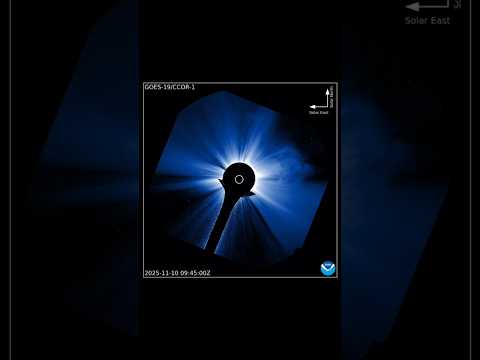
Solar Storms Are Steering Our Weather: solar forces "CAN NUDGE" Earth's weather. Geomagnetic storms, coronal mass ejections, and their interactions with the magnetosphere #geomagneticstorms #solarstorms
youtu.be/Lb0i41IbG3s
statusl.ink/solarstormsa...
Dead of Winter's brass monkey balls night. Much snow on the second floor deck, so it's forego tripod and mind over matter handheld, shivers be damned. Nikon sees more than eye can. Snap snap away and get the hell back to bed. #photography #auroraborealis #geomagneticstorms #vividsky #skyphotos #sky
My Resonant Agl Swarm Theory (RAST) paper was uploaded to ResearchGate.net!
Geomagnetic storms + silver iodide (Agl) = atmospheric plasmoid UAPs.
What are your thoughts?
#UAP #Plasma #GeomagneticStorms #SilverIodide
www.researchgate.net/publication/...
A coronal mass ejection from the Sun is expected to arrive by midday, potentially causing “strong” geomagnetic storms and impacting the aurora. Here's the view line for tonight and tomorrow night. If you're lucky enough to see it, ROCK ON!!!
#CoronalMassEjection #GeomagneticStorms #TheAurora #NOAA
All of these geomagnetic storms would be considered an omen by primative peoples of something horrible coming our way.
I think they were right.
#AuroraBorealis
#SolarFlares
#GeomagneticStorms
World News
RAST November sightings video drop! My theory predicts RAST plasma orb sightings mistaken for UAPs before and after geomagnetic storms. Kp 6 forecasted for tomorrow and Thursday. What are your thoughts?
#RAST #GeomagneticStorms #CloudSeeding #UAP #UFO
Unexpected ‘Zigzag’ Structures Discovered in Earth’s Magnetic Field
#MagneticSwitchbacks #GeomagneticStorms #SpacePhysics
www.youtube.com/watch?v=LDc8...
Solar Flare Disruptions in Earth’s Ionosphere: What Happened and Why It Matters Solar flare disruptions in Earth’s ionosphere recently made waves, not just in the sky, but across our critical c...
#Research #AtmosphericScience #GeomagneticStorms […]
[Original post on nasaspacenews.com]
Superstorm Gannon, the strongest in over 20 years, dramatically compressed Earth's plasmasphere to one-fifth its size, highlighting the potential impacts of extreme space weather 🌍⚡ Link: https://tinyurl.com/25so2qb3 #SpaceWeather #EnvironmentalImpact #GeomagneticStorms
www.npr.org/2025/11/12/n...
Gorgeous. <3 Thanks, NPR! @npr.org
#AuroraBorealis #geomagneticstorms
Aurora Alert! Aurora Alert!
Dobviews Solar Activity Report Nov 11, 2025
#cannibalCME
#astronomy
#CME
#solarflares
#geomagneticstorms
#photography
#astrophotography
#smartphoneastronomy
youtube.com/shorts/enlHq...
The study of 'space tornadoes' reveals their potential to trigger geomagnetic storms, complicating space weather forecasts due to complex simulation requirements. 🌌 Link: https://tinyurl.com/2xje2dqd #SpaceWeather #GeomagneticStorms #SpaceScience
This eruption launched plasma out into space and specialists are working to establish if the plasma could impact our planet's magnetic field. Other 2 bursts of sun-stuff are expected to reach #Earth over the next day, potentially triggering #geomagneticstorms and #auroras:
buff.ly/uukCWuq
📸 NOAA.
Janelle Shanks discusses Geomagnetic storms, Pennsylvania, and Pies. www.geohipster.com/2025/09/23/i... #geohipster #gps #geomagneticstorms
Holyoke, Colorado Weather 7.6.2025 #solarstorm #geomagneticstorms #hailstorms #lightening #colarado
Geomagnetic Storms Bring Satellites Down Faster #Science #Space #SpaceWeather #GeomagneticStorms #Satellites
Solar Storms Are Pushing Elon Musk’s Satellites Back to Earth gizmodo.com/solar-storms-are-pushing... #GeomagneticStorms #science #SolarMaximum #SpaceAmpSpaceflight #technology
Severe geomagnetic storm Sunday night/ Monday morning . Auroras maybe be visible down to the Carolinas
https://agupubs.onlinelibrary.wiley.com/doi/10.1029/2020SW002664
Figure 5: Variations of the interplanetary and geophysical parameters during 19–23 November 2003 Technical Terms: F10.7 Index – A measure of solar radio flux at 10.7 cm wavelength, indicating solar activity. IMF (Interplanetary Magnetic Field) By and Bz – Components of the solar magnetic field interacting with Earth's magnetosphere. AE Index (Auroral Electrojet Index) – A measure of geomagnetic activity in the auroral zones. Kp Index – A global geomagnetic activity index on a scale from 0 to 9. Dst Index (Disturbance Storm Time Index) – Measures geomagnetic storm intensity by tracking variations in Earth's magnetic field. X and Y Axes: X-axis: Time (19–23 November 2003), showing how parameters change over several days. Y-axes: Different panels have different Y-axes. Top panel: F10.7 index (solar activity level) Middle panels: IMF components (By, Bz in nT) and geomagnetic indices (AE, Kp) Bottom panel: Dst index (storm intensity, in nT) Importance: This figure visualizes how solar and geomagnetic activity evolved during the November 2003 geomagnetic storm. It helps correlate solar wind conditions with geomagnetic disturbances affecting satellite orbits. The sharp drop in Dst and high peaks in AE and Kp indices indicate the storm’s main phase.
Figure 7: Variations of the interplanetary and geophysical parameters during 6–10 September 2017 Technical Terms: Same technical terms as Figure 5, but referring to the September 2017 geomagnetic storm. X and Y Axes: X-axis: Time (6–10 September 2017). Y-axes: Top panel: F10.7 index (solar radiation level). Middle panels: IMF By and Bz components (nT). Lower panels: AE, Kp, and Dst indices. Importance: Shows how the September 2017 geomagnetic storm developed and compares its impact to other storm events. Highlights how the storm affected Earth's magnetosphere and thermosphere, influencing satellite drag and orbital decay. Helps explain why different satellites at different altitudes experienced varied orbital decay rates.
Figure 8: Satellite orbital decays and decay rates of Swarm-B, Swarm-A, and GRACE during 7–9 September 2017 Technical Terms: Swarm-B, Swarm-A, and GRACE – Satellites used to monitor Earth's gravity and atmospheric density. Orbital Decay Rate – The rate at which a satellite's altitude decreases due to atmospheric drag. Storm-Induced Orbital Decay – The additional orbital decay caused by geomagnetic storms, beyond normal background decay. X and Y Axes: Left panels (decay rates): X-axis: Time (7–9 September 2017). Y-axis: Orbital decay rate (meters per day, m/d). Right panels (orbital decay): X-axis: Time (7–9 September 2017). Y-axis: Total orbital decay (meters, m). Importance: This figure illustrates the impact of the storm on three different satellites at different altitudes. Shows how satellites at lower altitudes (GRACE at 338 km) experienced greater decay than higher-altitude ones (Swarm-B at 515 km). Helps validate the Precise Orbit Determination (POD) integration method, showing how well it estimates satellite decay compared to traditional accelerometer data. Final Thoughts: Figures 5 and 7 establish the cause (geomagnetic storm conditions). Figure 8 shows the effect (how these storms altered satellite orbits at different altitudes). Understanding these relationships is crucial for predicting satellite lifetimes, avoiding collisions, and improving orbit models in space weather forecasting.
Understanding how geomagnetic storms impact satellite orbits! 🛰️⚡A research improves orbital decay predictions using precise data from GRACE & Swarm, revealing storm-induced altitude changes with higher accuracy. 🌍🔭
#SpaceWeather #SatelliteTracking #GeomagneticStorms #LEO #Science
https://agupubs.onlinelibrary.wiley.com/doi/10.1029/2022SW003152
Figure 1 – Coronal Mass Ejections (CMEs) Observation: This figure shows images of two Earth-directed CMEs captured by SOHO and STEREO-A coronagraphs, overlaid with the Graduated Cylindrical Shell (GCS) model to determine their direction, speed, and structure. Why it’s important: Understanding CME trajectories and characteristics is crucial for predicting their impact on Earth’s space weather and satellite operations.
X-axis (Horizontal Axis): Timeframe: February 2–6, 2022 (Universal Time - UT). Shaded Areas: Indicate the passage of two magnetic clouds (associated with CMEs) that hit Earth, leading to geomagnetic storms. Y-axes (Vertical Axes) & Panels: The figure consists of four panels, each showing different space weather parameters: Magnetic Field Strength & Components (Top Panel): Y-axis (left, in nT – nanoteslas): Magnetic field strength. Lines: |B| (black): Total magnetic field strength. Bx (red), By (green), Bz (blue): Magnetic field components in GSM coordinates (Geocentric Solar Magnetospheric system). Bz (blue) is crucial—when strongly negative (southward), it connects with Earth's magnetic field, intensifying geomagnetic storms. During the shaded areas (CME impacts), Bz dips negative, triggering geomagnetic disturbances. Solar Wind Velocity & Proton Density (Second Panel): Y-axis (left, black, km/s): Solar wind speed (Vsw). Y-axis (right, red, #/cm³): Proton number density (np), showing the concentration of protons in the solar wind. Both CMEs caused a spike in solar wind speed (~600 km/s) and proton density, intensifying the geomagnetic storms. Proton Temperature & Plasma Beta (Third Panel): Y-axis (left, black, MK – megaKelvin): Proton temperature (Tp) in the solar wind. Y-axis (right, red, unitless): Plasma beta (βp)—the ratio of plasma pressure to magnetic pressure. Low βp (<1): Magnetic pressure dominates, typical inside CMEs. Drops in βp during the shaded regions confirm the presence of magnetic clouds. Geomagnetic Storm Strength – Dst Index (Bottom Panel): Y-axis (nT): Dst index (Disturbance Storm Time Index), a measure of geomagnetic storm intensity. 0 nT: Quiet conditions. Below −50 nT: Moderate storm. Below −100 nT: Strong storm. Two dips (~−60 nT) during the CME events confirm moderate geomagnetic storms, which increased atmospheric drag.
Panel a – Global Joule Heating (JH) Over Time X-axis (Horizontal): Timeframe: February 2–5, 2022 (Universal Time - UT). This range covers the geomagnetic storms caused by the CMEs. Y-axis (Vertical, in GW – Gigawatts): Global JH: Represents the total power of Joule heating—energy transferred from the solar wind into Earth’s upper atmosphere due to electrical currents driven by geomagnetic storms. Key Insight: There are two significant JH peaks, aligning with the two CME impacts. The highest peak (~1,000 GW) corresponds to the stronger geomagnetic storm, increasing atmospheric density and drag on satellites. Panel b – IMF Bz Component Over Time X-axis (Horizontal): Same timeframe: February 2–5, 2022. Y-axis (Vertical, in nT – nanoteslas): IMF Bz Component: Tracks the north-south orientation of the Interplanetary Magnetic Field (IMF). Negative Bz (southward) enhances magnetic reconnection with Earth's field, increasing energy transfer and geomagnetic storm intensity. Key Insight: Strong negative Bz (~−15 nT) during the CME arrivals correlates with JH spikes, confirming that southward IMF drives stronger Joule heating. Panel c – Spatial Distribution of Joule Heating (16:00 UT, Feb 4) Map: Displays the polar view of Earth (centered on the North Pole) showing the spatial distribution of Joule heating at the storm’s peak. Color Scale (erg/cm²/s): Blue to red gradient represents increasing Joule heating intensity. Red Zones: Areas of highest energy input, mainly around the auroral oval—regions near the poles where geomagnetic activity is concentrated. Key Insight: The strongest Joule heating occurs in high-latitude regions (~60°–75°), where geomagnetic currents are most intense. These regions contribute significantly to atmospheric expansion, affecting satellites in low Earth orbit. Technical Terms Explained: Joule Heating (JH): conversion of kinetic energy IMF Bz Component: driver of geomagnetic storms Pedersen Conductivity (Σp): currents flow in the ionosphere
Unraveling the impact of space weather on satellites! 🛰️⚡ A study reveals how geomagnetic storms on Feb 3-4, 2022, increased atmospheric drag, leading to the destruction of 38 Starlink satellites. 🚀🌍 Better space weather prediction is crucial!
#SpaceWeather #Starlink #GeomagneticStorms
https://agupubs.onlinelibrary.wiley.com/doi/full/10.1029/2022SW003193
Figure 1: NOAA’s classification of geomagnetic storms (G1–G5) based on severity and impact on satellites. Importance: Helps predict space weather risks, guiding satellite operators in planning and mitigation strategies
Figure 2: Shows increased atmospheric density and geomagnetic activity during the February 2022 Starlink loss event. Importance: Demonstrates how even minor storms can significantly impact satellites in Very Low Earth Orbit (VLEO).
Figure 6: Compares altitude decay and positional errors of satellites during G1 vs. G5 geomagnetic storms. Importance: Highlights the drastic effects of extreme storms on satellite stability, emphasizing the need for accurate density forecasting.
Understanding space weather’s impact on satellites 🌍🛰️! A study highlights how geomagnetic storms increase drag on Very Low Earth Orbit (VLEO) satellites, affecting their stability and fuel needs. Better forecasting is key! ⚡🚀
#SpaceWeather #Satellites #VLEO #GeomagneticStorms #OrbitalDynamics
PhD - Numerical modelling of electron flux decreases during geomagnetic storms - Potsdam, Germany - www.earthworks-jobs.com/jobs/gfz25014 - #jobs #research #PhD #modelling #electronflux #geomagneticstorms #spacephysics #physics #computersciences #geophysics #mathematics #naturalsciences
A significant coronal hole, spanning over a quarter of the Sun's surface, has been detected. This occurrence allows high-speed solar winds to escape and head toward Earth. #SpaceWeather #SolarWinds #Auroras #NorthernLights #CoronalHole #Astronomy #Skywatching #GeomagneticStorms #SolarActivity
PhD position (f_m_x) - Numerical modelling of electron flux decreases during geomagnetic storms - Potsdam, Germany - www.earthworks-jobs.com/jobs/gfz24122 - #jobs #research #PhD #modelling #geomagneticstorms #spacephysics #physics #computerscience #geophysics #mathematics #geoscience
The #Sun is active and USU researchers are active in #SolarFlare #research #coronalmassejection #CME #NSF #geomagneticstorm #geomagneticstorms #solarflares #coronalmassejections #CMEs #machinelearning #researchmodels #superflares
www.usu.edu/today/story/...
Discover the secrets of the aurora borealis and why recent geomagnetic storms are bringing this natural wonder to places like Italy and Illinois.
#AuroraBorealis #NorthernLights #GeomagneticStorms #NaturalWonder #Italy #Illinois #SpaceWeather
Read here.. www.freeastroscience.com/2024/12/a-ce...
Recently Completed #Geophysics #Survey Will Help Protect #Critical #Infrastructure From #GeomagneticStorms And #SpaceWeather
-
alturl.com/t2rcr
-
#GIS #spatial #mapping #power #telecom #risk #hazard #geomagnetic #minerals #impacts #USA #powersystems #blackouts
@USGS @NSF @NASA @EarthScope @NOAA
from soho.nascom.nasa.gov
from noaa
from nasa
from spaceweather
A bit disappointed, but as expected😅😅😅
#solarflares #geomagneticstorms #cme #sun #spaceweather #nasa